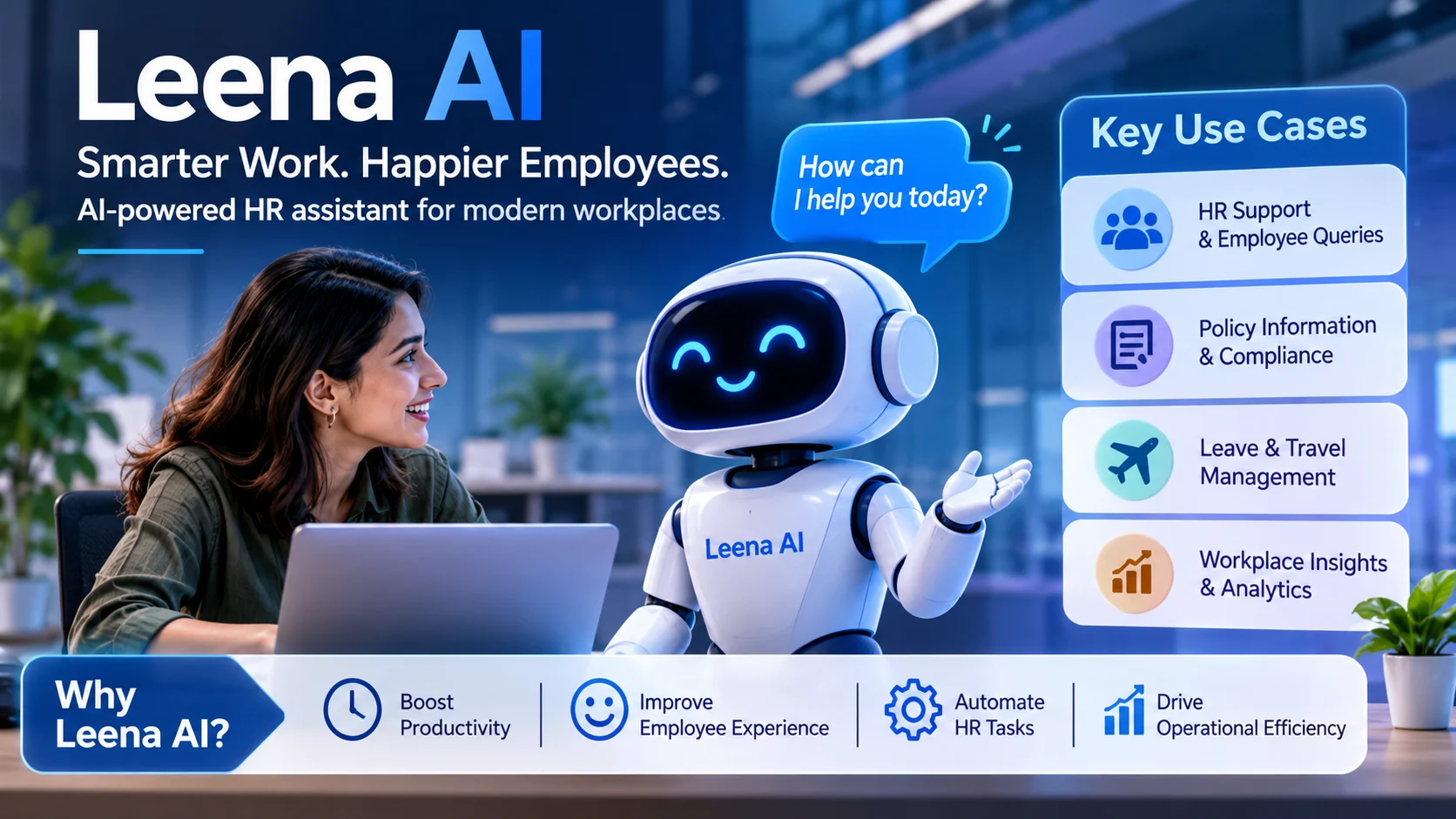
Quick Answer: Leena AI is an enterprise agentic AI platform that automates employee support and business workflows across HR, IT, finance, and procurement. It uses AI agents, enterprise integrations, and controlled workflows to answer employee questions and complete tasks across connected business systems.
Leena AI at a Glance
Platform overview
Enterprise AI
- Primary purpose: Enterprise workflow and employee support automation.
- Main departments: Human resources, IT, finance, and procurement.
- Core technology: Agentic AI, language models, integrations, and workflow orchestration.
- AI assistants: Harrison for HR, Iris for IT, and Fiona for finance.
- Communication: Web, collaboration platforms, email, and voice channels.
- Pricing: Contact the vendor for a customized quotation.Based on the vendor’s current product documentation and published product information.
What Is Leena AI?
Leena AI is an enterprise software platform that helps organizations automate internal business operations.
Instead of requiring employees to navigate multiple company applications, it provides a conversational interface for accessing information and completing work.
For example, an employee might ask about their remaining annual leave. The AI assistant can retrieve relevant information from the connected HR system and help initiate a leave request.
The platform goes beyond answering questions. Its AI agents can interact with connected business applications and execute approved actions.
Leena AI describes these digital workers as AI Colleagues. They are designed to perform recurring operational tasks while following organizational rules and permissions. Leena AI Documentation+1
Is Leena AI a Chatbot or an AI Agent Platform?
This distinction matters when evaluating the product.
A traditional chatbot mainly responds to questions using predefined answers or retrieved information. An AI agent can also use connected tools to perform tasks.
For instance:
- A chatbot explains how to request a password reset.
- An AI agent can initiate the approved password-reset workflow.
- A chatbot explains an employee leave policy.
- An AI agent can retrieve leave information and submit an authorized request.
Leena AI combines conversational assistance with workflow execution.
However, an AI agent does not automatically have permission to perform every action. Its capabilities depend on integrations, configured tools, access permissions, and organizational policies.
How Does Leena AI Work?
Leena AI connects an organization’s existing applications with AI agents and automated workflows.
The general process involves four stages.
How the platform operates
- Employee requestAn employee asks a question or requests an action through an available communication channel.
- AI understandingThe agent interprets the request and identifies the relevant information, workflow, or connected tool.
- System interactionThe agent accesses authorized business systems, checks relevant information, and performs permitted actions.
- Response and trackingThe employee receives a response, while administrators can monitor workflows and operational activity.
1. Understanding Employee Requests
Employees communicate using natural language instead of navigating complicated software menus.
For example, someone might write:
“Please tell me how many vacation days I have remaining.”
The AI interprets the request and identifies the information required to answer it.
2. Connecting Enterprise Applications
Leena AI integrates with systems that organizations already use.
Its integration documentation covers HRIS, ITSM, identity providers, and collaboration tools.
These connections allow workflows and AI agents to retrieve information or perform actions across applications. Leena AI Documentation
3. Executing Automated Workflows
The platform supports workflows involving forms, approval paths, logic, and integrations.
This is particularly useful when a business process requires several steps.
For example, employee onboarding might involve:
- Creating an employee record.
- Collecting required documents.
- Requesting system access.
- Assigning onboarding tasks.
- Notifying the relevant departments.
The exact automation depends on the organization’s configuration.
4. Monitoring and Improving Operations
Administrators can use analytics and helpdesk insights to examine platform usage, workflow performance, and employee support activity.
These insights can help identify recurring requests and processes that may benefit from further automation. Leena AI Documentation
Key Features of Leena AI
Leena AI combines several enterprise automation capabilities within one platform.
AI Colleagues for Different Departments
One of its central product concepts is the AI Colleague.
The company currently highlights three prebuilt assistants.
Automate HR workflows and employee request management | Leena AI<!– –>
Harrison: Universal HR Assistant
Designed for employee-related requests, including onboarding, leave, benefits, payroll questions, and HR policies.
Universal IT Assistant: Agentic AI for IT Service | Leena AI
Iris: Universal IT Assistant
Designed to support IT requests, technical assistance, access-related workflows, and employee IT support.
Universal Finance Assistant: Agentic AI for Finance Ops | Leena AI
Fiona: Universal Finance Assistant
Designed to assist with finance-related employee requests and connected financial workflows.Leena AI
The important point is that these assistants serve different operational functions. Their actual capabilities depend on the available integrations and configured permissions.
HR Service Automation
Human resources teams regularly receive repetitive questions about policies, compensation, leave, benefits, and employee documentation.
Leena AI can centralize these requests through an AI-powered employee assistant.
Potential applications include:
- Answering HR policy questions.
- Helping employees submit leave requests.
- Supporting onboarding and offboarding.
- Retrieving employee-related information.
- Automating recurring HR workflows.
This can reduce repetitive administrative work and give HR professionals more time for complex employee matters.
IT Service Management
IT departments often handle repetitive requests that interrupt more important technical work.
Examples include password assistance, software access, device-related requests, and troubleshooting.
Leena AI’s IT automation capabilities aim to streamline these processes.
Organizations can connect relevant systems and configure agents to execute permitted actions rather than simply provide instructions.
Finance and Procurement Automation
Finance and procurement operations involve approvals, documentation, employee inquiries, and recurring administrative processes.
Leena AI provides workflow automation capabilities for these departments.
However, organizations should verify the exact supported actions, financial controls, and approval requirements before deploying agents into sensitive financial processes.
Workflow Studio
Workflow Studio allows organizations to design multi-step business processes.
Its documented capabilities include:
- Forms.
- Approval paths.
- Logic nodes.
- Application integrations.
- Automated workflow execution.
This makes it possible to connect different operational steps without treating every employee request as an independent support ticket. Leena AI Documentation+1
Knowledge Management
AI assistants need reliable information to provide useful answers.
Leena AI includes knowledge management capabilities for organizing, maintaining, and governing enterprise knowledge.
This is important because outdated HR policies or conflicting internal documents can produce incorrect responses.
Organizations should establish clear ownership of their knowledge sources and review processes.
Multichannel Employee Experience
Employees should not need to learn a completely new interface just to access internal support.
Leena AI documents a web-based assistant and external communication channels. Its supported-channel documentation also explains that some external channels offer fewer interface capabilities than its full web experience. Leena AI Documentation
Analytics and Helpdesk Insights
Administrators need to understand whether automation is actually improving operations.
Leena AI provides analytics and helpdesk insights to examine usage, request patterns, and workflow performance.
These measurements can support decisions about which processes deserve further automation.
What Can Businesses Use Leena AI For?
Leena AI is designed for organizations with repetitive internal processes and multiple enterprise applications.
| Department | Example use case | Potential benefit |
|---|---|---|
| HR | Leave and payroll inquiries | Less repetitive HR work |
| IT | Access and password requests | Streamlined support |
| Finance | Expense-related workflows | More structured processing |
| Procurement | Purchase request workflows | Improved coordination |
| Management | Operational analytics | Better process visibility |
| Employee operations | Onboarding and offboarding | Consistent employee journeys |
Real-World Example: Automating Employee Onboarding
Consider a company hiring 100 new employees.
Without automation, HR, IT, and administration teams may need to coordinate documents, accounts, equipment, and training manually.
With a properly configured Leena AI workflow, the process could be organized into connected tasks.
- HR initiates the onboarding process.
- The employee receives document submission instructions.
- Required information enters the appropriate system.
- IT receives an account and access request.
- Relevant managers receive their assigned tasks.
- The employee receives onboarding updates.
This example illustrates the platform’s potential. It does not guarantee that every step is available without configuration.
Leena AI Pricing | How Much Does It Cost?
Leena AI does not provide a universal public price list. Instead, it uses enterprise pricing based on employee numbers, selected products, use cases, and expected usage.
Its official pricing page currently describes two main pricing structures. Custom Quote in One Business Day
Universal Assistant Pricing
The Universal Assistant follows a flat annual licensing model.
- Pricing is calculated per employee per year.
- Larger workforces may receive different rates.
- The company describes usage as unlimited.
- Usage is not charged through additional token consumption under this model.
This structure may suit organizations that want employees to access a shared AI assistant.
AI Colleagues Platform Pricing
The AI Colleagues Platform uses a different pricing model.
Its structure includes:
- An annual platform fee.
- Additional usage charges based on tokens.
- Usage tracking for individual AI Colleague executions.
- Cost estimates based on actual workflows during evaluation.
Tokens are small units of text processed by AI models. Their consumption can affect operating costs, particularly when agents perform complex tasks.
Pricing Comparison
| Pricing component | Universal Assistant | AI Colleagues Platform |
|---|---|---|
| Billing structure | Annual employee license | Annual platform fee plus usage |
| Usage limits | Unlimited, according to vendor | Token-based |
| Additional token billing | No | Yes |
| Public fixed price | Not published | Not published |
| Best suited for | Employee-initiated requests | Configured autonomous workflows |
Is there a free plan?
The official pricing information does not advertise a standard free consumer plan. Businesses should contact Leena AI for a customized proposal and clarify any proof-of-value or demonstration arrangements.
Before signing a contract, ask for:
- Annual licensing costs.
- Implementation and onboarding fees.
- Token pricing and usage estimates.
- Integration charges, if any.
- Support and maintenance costs.
- Contract renewal and cancellation terms.
One important detail is that the Universal Assistant and autonomous AI Colleagues have different billing structures. Comparing only their headline subscription costs could produce an inaccurate budget.
Leena AI Integrations and Compatibility
Enterprise integrations are central to Leena AI’s functionality.
The platform connects AI agents and workflows with existing business applications. Its documentation explains how connected systems expose actions to Workflows Studio and Skill Studio.
It also supports Model Context Protocol (MCP) tools within its integration architecture. Leena AI Documentation+1
Some relevant integration categories include:
| Integration category | Examples |
|---|---|
| HR management | Workday and SAP |
| IT service management | ServiceNow |
| Identity management | Microsoft Entra ID and Okta |
| Collaboration | Microsoft Teams and Slack |
| Enterprise applications | Other connected HR, IT, and business systems |
The company advertises more than 200 prebuilt connectors. However, the existence of a connector does not guarantee that every feature or action is supported.
Why Integration Quality Matters
A successful enterprise deployment requires more than connecting applications.
Businesses should evaluate:
- Which data can the AI retrieve?
- Which actions can it execute?
- Does it support read and write operations?
- Can administrators restrict sensitive actions?
- How does authentication work?
- What happens when an integration fails?
- Are custom workflows necessary?
These questions help determine whether Leena AI can support actual business operations rather than simply provide conversational assistance.
Is Leena AI Safe? Privacy and Security Explained
Security is particularly important for enterprise AI because employee platforms may process confidential information.
This can include payroll details, personal records, internal policies, financial information, and IT access requests.
Leena AI publishes information about its security architecture and enterprise controls.
Its official security documentation describes:
- AES-256-GCM encryption at rest.
- TLS 1.2 or higher for data in transit.
- Single sign-on and multi-factor authentication support.
- Role-based access controls.
- Audit trails.
- Multi-tenant, single-tenant, and private VPC deployment options.
- Data residency options across multiple regions.
The company also lists SOC 2, ISO 27001, HIPAA, and other compliance-related standards on its security materials. Enterprise Agentic AI+1
Documented security controls
Does SOC 2 Mean Leena AI Offers Zero Data Retention?
No. SOC 2 and Zero Data Retention are different concepts.
SOC 2 is an independent audit framework for evaluating controls related to areas such as security and availability.
Zero Data Retention means a service does not retain specified customer data under defined conditions.
One does not automatically establish the other.
Leena AI’s published security page describes data deletion and retention arrangements, but buyers should request the contractual retention schedule and confirm whether model providers retain prompts or outputs.
What Businesses Should Verify Before Deployment
A proper security review should examine:
- Data retention and deletion periods.
- AI model providers and their data-processing terms.
- Whether customer information is used for model training.
- Regional data storage requirements.
- Administrator permissions and audit access.
- Incident response procedures.
- Third-party integration permissions.
Security statements on a vendor’s website are useful starting points. They should not replace reviewing contractual commitments and technical documentation.
Benefits of Using Leena AI
Leena AI may provide several operational benefits when configured correctly.
Reduced Repetitive Work
HR and IT teams often spend significant time answering similar questions.
Automating routine requests can reduce the number of tasks requiring manual attention.
Faster Employee Support
Employees can access internal assistance through conversational interfaces instead of searching through multiple applications.
More Consistent Processes
Centralized knowledge and predefined workflows can help organizations standardize recurring procedures.
Improved Cross-Department Coordination
Connected systems can help HR, IT, finance, and procurement coordinate tasks that would otherwise require separate manual interactions.
Better Operational Visibility
Analytics can help managers identify frequently requested services, workflow bottlenecks, and opportunities for automation.
Support for Large Workforces
The platform is designed for enterprise environments with multiple departments, applications, and employee communication channels.
However, these benefits are potential outcomes, not guaranteed results. Actual improvements depend on implementation quality, data accuracy, employee adoption, and the complexity of existing processes.
Limitations and Potential Challenges
Despite its capabilities, Leena AI is not automatically suitable for every organization.
Enterprise-Oriented Pricing
The lack of publicly displayed fixed prices makes initial budget comparisons difficult.
Small businesses may find it challenging to justify an enterprise deployment if they only need basic HR assistance.
Implementation Complexity
Connecting HR, IT, finance, and identity systems requires careful planning.
Legacy software, inconsistent employee records, and complicated approval structures can increase deployment effort.
Dependence on Data Quality
AI assistants depend on accurate information.
Outdated policies, duplicated documents, and conflicting knowledge sources can reduce answer quality.
Integration Limitations
A listed connector may not support every action a business needs.
Organizations should test the precise workflows they intend to automate.
AI Execution Risks
An incorrect answer is one problem. An incorrect automated action can create a much larger operational issue.
For example, an improperly configured agent might submit an incorrect request or trigger an unauthorized workflow.
Approval requirements, permission checks, testing, and monitoring remain essential.
Vendor Dependence
A company integrating an AI platform into its internal operations may become dependent on its connectors, workflow configurations, and service availability.
Before committing, evaluate data export, integration portability, documentation, and exit arrangements.
Leena AI Alternatives and Competitors
Businesses evaluating Leena AI should compare it with platforms that address similar employee support, HR service delivery, and IT automation needs.
The following products serve overlapping but not identical markets.
Moveworks Logo Vector File Download | Logowik
Moveworks
Pricing: Contact vendor.
Moveworks focuses on enterprise employee support and AI-powered service automation. It is relevant for businesses evaluating conversational assistance across internal systems.
Official website
Free High-Quality Servicenow Logo for Creative Design
ServiceNow
ServiceNow provides enterprise service management and workflow automation. Its ecosystem covers IT service management and broader business operations.
Consider it for: Organizations with established service-management requirements.
Pricing: Depends on products and contract.
Official website
Working at Aisera | Great Place To Work®
Aisera
Aisera operates in enterprise conversational AI and service automation, including employee-facing support use cases.
Consider it for: AI-powered service operations.
Pricing: Contact vendor.
Official website
Workday – WDAY — Global Brands Matter
Workday
Workday provides human capital and financial management software. Its capabilities overlap with Leena AI in employee operations, but it also serves as a core system of record.
Consider it for: Organizations evaluating broader HR and financial management systems.
Pricing: Enterprise quotation.
Official website
Darwinbox Launches Cortex, Its New AI-Native HCM Platform
Darwinbox
focuses on human capital management, including employee lifecycle and HR processes.
Consider it for: Businesses evaluating integrated HR management software.
Pricing: Contact vendor.
Official website
Leena AI vs. Its Competitors
| Platform | Primary focus | Typical target user | Main distinction |
|---|---|---|---|
| Leena AI | Agentic employee and back-office automation | Enterprise operations teams | AI Colleagues and cross-functional workflows |
| Moveworks | Employee support automation | Large enterprises | Enterprise employee assistant |
| ServiceNow | Service management and workflows | IT and operations teams | Broad service-management ecosystem |
| Aisera | Enterprise service automation | IT and employee service teams | Conversational AI and service automation |
| Workday | HR and financial management | HR and finance departments | Core enterprise management systems |
| Darwinbox | Human capital management | HR departments | Integrated HR lifecycle management |
The comparison is based on product positioning, not a controlled feature or performance benchmark. Pricing transparency is limited across several enterprise vendors.
For additional market research, buyers can examine Gartner Peer Insights and G2.
Gartner’s 2026 listing identifies ServiceNow, SAP, Oracle, and other enterprise platforms among the alternatives considered by Leena AI buyers. Integrated HR Service Management Solutions+2
Who Should Use Leena AI?
Leena AI may be worth evaluating for:
- Large enterprises: Organizations managing thousands of employees and complex internal processes.
- HR departments: Teams handling frequent employee questions and lifecycle workflows.
- IT departments: Teams seeking to automate repetitive service requests.
- Finance teams: Organizations with recurring employee-facing financial processes.
- Enterprise technology leaders: CIOs and CTOs looking to coordinate AI agents across existing applications.
- Operations managers: Teams interested in improving internal service delivery.
Who Might Not Need Leena AI?
It may not be appropriate for:
- Individuals looking for a personal AI chatbot.
- Students seeking AI writing assistance.
- Freelancers who need basic productivity tools.
- Small businesses with very limited internal support requirements.
- Organizations without the resources to maintain enterprise integrations.
The platform’s value is most relevant when there are enough recurring workflows to justify the cost and implementation effort.
How to Evaluate Leena AI Before Buying
A product demonstration alone is not enough to determine whether an enterprise AI platform is suitable.
Businesses should conduct a proof of value using real operational scenarios.
Here is a practical evaluation checklist:
| Evaluation area | What to test |
|---|---|
| Accuracy | Does the assistant retrieve correct company information? |
| Automation | Can it complete actual employee workflows? |
| Integrations | Does it connect with existing software? |
| Security | Are permissions and access controls enforced? |
| Cost | Are licensing and token expenses predictable? |
| Performance | How does it handle concurrent requests? |
| Governance | Can administrators review and control actions? |
| Portability | Can workflows and data be migrated if needed? |
Three Practical Tests
Test 1: HR support
Ask the assistant to retrieve an employee’s leave balance and initiate a leave request.
Check whether it uses the correct employee record and approval process.
Test 2: IT support
Ask the assistant to handle a software access request.
Check whether it follows identity verification and authorization requirements.
Test 3: Finance operations
Submit a sample expense-related request.
Check whether the workflow follows approval rules and records the appropriate activity.
These tests provide more meaningful evidence than a generic product demonstration.
Latest Leena AI Developments in 2026
Leena AI’s current product positioning emphasizes agentic AI rather than traditional employee-facing chatbots.
Several developments are particularly relevant:
- AI Colleagues: The company promotes dedicated HR, IT, and finance assistants.
- Agent development: Its documentation includes AI Colleagues Studio and Workflow Studio.
- Enterprise integrations: Its pricing page advertises more than 200 prebuilt connectors.
- MCP support: Integrations can expose connected applications as tools for AI agents.
- Enterprise security: The company documents multiple deployment options and security controls.
- Usage-based pricing: Its AI Colleagues Platform uses token-based billing alongside an annual platform fee.
These are vendor-documented capabilities, not independent guarantees of implementation quality or business performance. Leena AI Documentation+3
For the latest product information, consult the official Leena AI website and its documentation.
Frequently Asked Questions About Leena AI
1. What is Leena AI used for?
Leena AI automates employee support and business operations across HR, IT, finance, and procurement using AI agents and workflows.
2. Is Leena AI free to use?
Leena AI does not advertise a standard free plan. Its enterprise pricing depends on licensing, platform fees, and AI usage. Contact the provider for a quote.
3. Does Leena AI support HR automation?
Yes. It automates HR tasks such as employee onboarding, leave requests, benefits inquiries, payroll questions, and HR policy assistance.
4. Is Leena AI safe for enterprise use?
Leena AI documents security features such as encryption, access controls, and audit trails. However, businesses should review its compliance evidence and data protection policies before deployment.
5. What are the main alternatives to Leena AI?
Alternatives include Moveworks, ServiceNow, Aisera, Workday, and Darwinbox. Compare their automation features, integrations, pricing, and HR capabilities.
Conclusion
Leena AI helps enterprises automate employee support, HR processes, and internal operations through AI agents and workflow automation. Additionally, its integrations and knowledge management features support complex business environments. However, implementation costs, security, and compatibility require careful evaluation. Ultimately, businesses should test real workflows and compare the total cost with expected productivity improvements before investing.