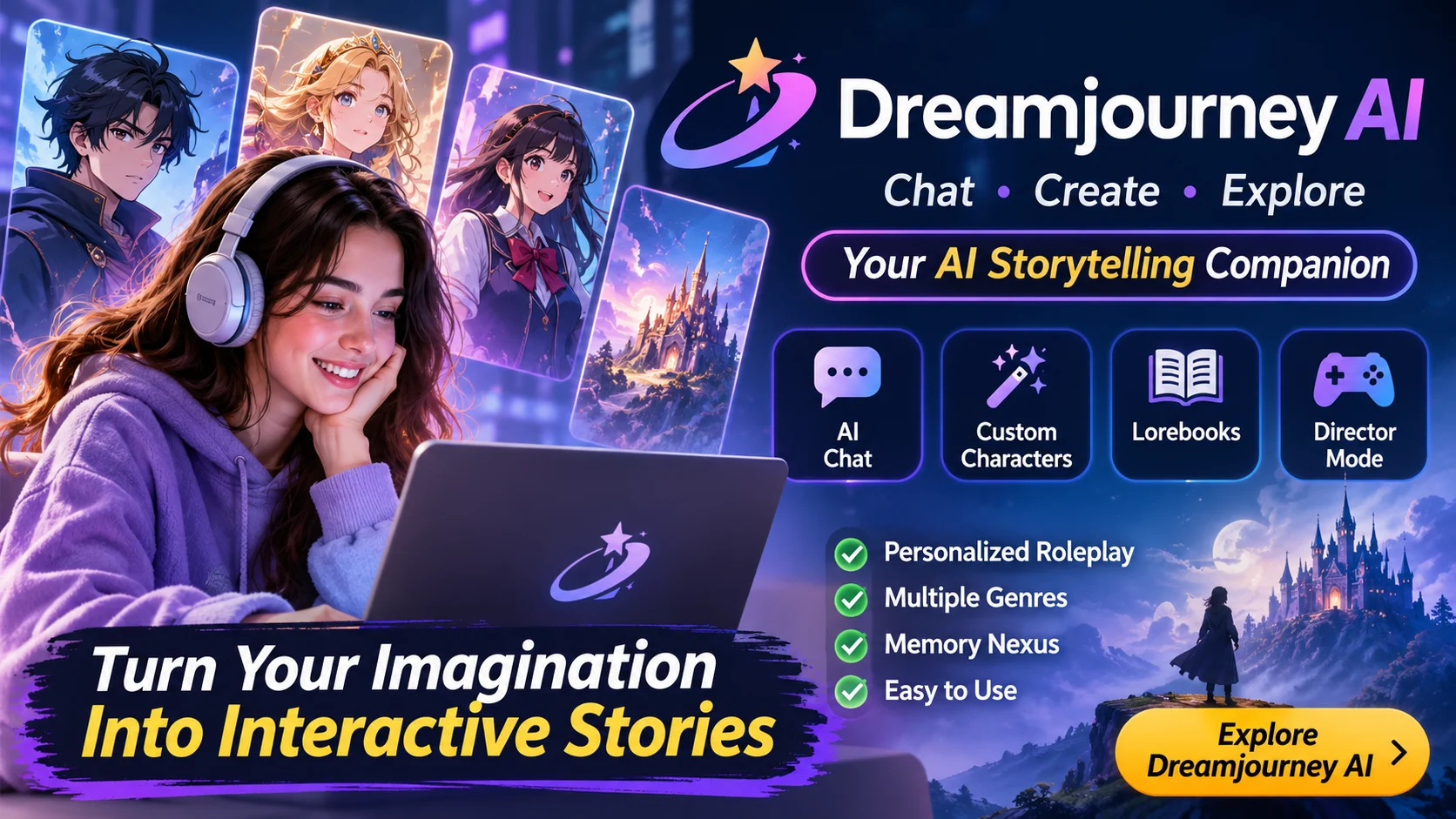
Quick Answer: Dreamjourney AI is an interactive AI roleplay and storytelling platform where users can chat with virtual characters, create custom personalities, and develop fictional worlds. Its Memory Nexus, Lorebooks, Director Mode, and multiple AI models help users build more continuous and customizable storytelling experiences.
Dreamjourney AI is an interactive AI platform that transforms ordinary conversations into personalized storytelling experiences. It allows users to chat with virtual characters, create custom personalities, and explore fictional worlds through AI-powered roleplay.
Whether you enjoy anime, fantasy adventures, romance, or creative writing, Dreamjourney AI offers tools to shape conversations around your imagination.
Its features, including Memory Nexus, Lorebooks, and Director Mode, help users maintain story continuity and control how narratives develop. In this guide, we explore Dreamjourney AI’s features, pricing, benefits, limitations, privacy considerations, and alternatives to help you decide whether it suits your needs.
What Is Dreamjourney AI? A Complete Guide and Review
Dreamjourney AI is designed for people who want more than ordinary chatbot conversations. It turns text-based AI interactions into ongoing fictional experiences.
Users can explore existing characters, develop original personalities, create scenarios, and guide stories through interactive conversations.
The platform is particularly interesting for people who enjoy anime-inspired adventures, fantasy roleplay, romance, science fiction, and collaborative storytelling.
Dreamjourney AI at a Glance:
- Platform type: AI character chat and interactive storytelling.
- Character library: More than 10,000 public characters, according to its website.
- Community: The website advertises more than 90,000 storytellers.
- Free access: 300 starting credits, according to the homepage.
- Main features: Memory Nexus, Lorebooks, Director Mode, and model selection.
- Age requirement: 18 or older under its published Terms of Service.Platform figures and promotional claims are based on the official website, checked November 7, 2026. Dreamjourney AI+1
How Does Dreamjourney AI Work?
Dreamjourney AI combines AI-generated responses with character descriptions, fictional settings, and conversation history.
Instead of asking a general chatbot to answer questions, users enter a fictional scenario and interact with a character inside that environment.
For example, you might create a fantasy adventure involving a mysterious kingdom, a powerful sorcerer, and a character searching for an ancient artifact.
The AI responds according to the character’s personality and the available story context. Your next message then influences what happens.
Choose an Existing Character
The platform provides a community-created character library.
You can explore categories such as:
- Fantasy
- Romance
- Anime
- Science fiction
- Horror
- Mystery
- Comedy
- Roleplaying games
- Modern-day scenarios
Each character comes with its own background, personality, and introductory scenario.
This makes it easier to begin a conversation without designing everything yourself.
Start an Interactive Conversation
After selecting a character, you can begin chatting.
The AI generates responses based on the conversation and the character’s available instructions. You can influence the direction by introducing new events, asking questions, or changing the scenario.
Unlike a traditional story, the narrative develops through your decisions.
Create Your Own Characters
Users can also develop original AI personalities.
The character creation system allows you to define important details, including:
- Character name
- Personality
- Appearance
- Background and scenario
- First message
- Public or private visibility
This gives writers more control over how their fictional characters behave.
Build a Larger Fictional World
Dreamjourney AI includes Lorebooks and Memory Nexus to help maintain continuity.
These features are especially relevant when a story involves several characters, locations, relationships, and events.
The objective is to make longer conversations feel connected rather than treating every message as an isolated interaction. Dreamjourney AI+1
Key Features of Dreamjourney AI
Dreamjourney AI offers several tools focused on interactive fiction rather than general-purpose productivity.
Memory Nexus
Memory Nexus is one of the platform’s central features.
In ordinary AI conversations, characters can lose track of earlier details as the conversation grows. This can damage a story’s continuity.
Memory Nexus is designed to address that problem.
According to the platform, it maintains information about:
- Important characters and relationships.
- Locations and fictional objects.
- Significant story events.
- Previous interactions and promises.
- Details that influence future scenes.
Its newer Nexus experience also allows users to inspect, edit, lock, or undo memory changes.
Why it matters: Imagine developing a story over several days. One character promises to protect another, while a third character disappears during an important event.
Memory Nexus aims to preserve these details so future conversations can refer to earlier developments.
However, persistent memory does not guarantee perfect recall. Users should still check important story details. Dreamjourney AI+1
Lorebooks
Lorebooks help users organize information about their fictional universes.
Think of a Lorebook as a reference document that supplies additional context when relevant subjects appear.
For example, a fantasy writer might create entries for:
- Kingdoms and cities.
- Magical abilities.
- Historical events.
- Important characters.
- Weapons and artifacts.
- Political organizations.
Users can assign trigger words to entries. When those words appear, the relevant information can become available to the AI.
This approach is useful for complex stories because the AI does not have to rely entirely on the latest conversation messages.
Multiple AI Models
Different storytelling situations require different writing styles.
A fantasy adventure may need descriptive narration, while a romantic conversation might benefit from natural dialogue.
Dreamjourney AI advertises multiple models designed for roleplay and fiction.
The website also mentions Athena and Nyx, which it describes as models that plan replies before generating them.
Users can switch between available models while continuing their stories.
However, the platform does not provide enough public technical information to establish the exact underlying model architectures, model providers, context-window sizes, or independent performance benchmarks.
Therefore, model availability should not be confused with independently verified model quality.
Director Mode
Director Mode gives users additional control over how a story develops.
Instead of rewriting an entire message, you can provide instructions that influence the next response.
Examples include:
- Move the plot forward.
- Increase the tension.
- Add more dialogue.
- Slow down the scene.
- Avoid controlling the user’s character.
You can also keep a direction active for subsequent replies.
This feature is useful when the AI takes a story in an unexpected direction. It provides a way to guide the narrative without abandoning the existing conversation.
Regenerate and Branch Conversations
Creative writing often involves experimentation.
Sometimes an AI-generated response does not match the scene you imagined.
Dreamjourney AI offers options to regenerate responses and branch conversations.
Regeneration gives you another version of a response. Branching allows you to explore a different direction without necessarily abandoning the original storyline.
This is particularly useful for writers who want to compare alternative character decisions or plot developments.
Customizable Storytelling Settings
The platform also provides controls that influence the writing style.
Available settings include:
| Setting | Purpose |
|---|---|
| Response length | Adjusts how detailed replies should be |
| Point of view | Selects first person, third person, or automatic |
| Dialogue and narration | Controls the balance between spoken dialogue and descriptive writing |
| Tense | Selects present or past tense |
These settings help users create a more consistent storytelling experience.
The ability to adjust narrative presentation is useful for people who want something closer to interactive fiction than ordinary chatbot conversations. Dreamjourney AI+1
Main Use Cases of Dreamjourney AI
Dreamjourney AI supports several creative activities. Its usefulness depends on whether you prefer casual character conversations or more structured storytelling.
AI Character Roleplay
Character roleplay is one of its primary use cases.
Users can interact with fictional personalities and influence their decisions through conversations. The experience can involve romance, friendship, fantasy adventures, mysteries, or dramatic situations.
It is particularly appealing to people who enjoy anime characters and fictional universes.
Interactive Storytelling
Writers can use Dreamjourney AI to develop stories through conversations.
Instead of writing every chapter manually, they can introduce characters, establish conflicts, and let the AI suggest narrative developments.
This approach can help overcome writer’s block and explore alternative plot directions.
Fantasy and RPG Adventures
The platform also supports game-like storytelling.
Users can participate in fictional adventures involving quests, battles, magical abilities, and character progression.
For example, you could create an adventure in which your character becomes the leader of a kingdom. The AI can then help develop encounters, rivalries, and unexpected events.
Character Development
Writers can experiment with different personalities, backgrounds, and motivations.
They can create characters with conflicting interests and explore how those personalities respond to different situations.
This can help develop dialogue and test character relationships before incorporating them into a larger story.
Creative Writing Assistance
Dreamjourney AI can also serve as an informal writing partner.
You can use conversations to:
- Explore alternative endings.
- Develop fictional dialogue.
- Create character backstories.
- Experiment with different narrative styles.
- Expand fictional settings.
- Test unusual story ideas.
However, its primary design is interactive roleplay rather than professional document editing or research.
Benefits of Using Dreamjourney AI
Several aspects make the platform worth exploring for creative users.
1. Large character collection: The advertised library of more than 10,000 public characters provides different personalities and scenarios to explore.
2. Custom character creation: Users can develop original characters rather than relying entirely on existing community creations.
3. Story continuity: Memory Nexus aims to preserve important details across longer conversations.
4. World-building support: Lorebooks help organize fictional information and introduce relevant context into conversations.
5. Creative control: Director Mode, regeneration, branching, and narrative settings provide additional storytelling flexibility.
6. Free starting access: The website advertises 300 starting credits without requiring a payment card.
These benefits are most relevant to users who enjoy collaborative storytelling and want more control than a basic chatbot provides. Dreamjourney AI+1
Limitations and Potential Drawbacks
Despite its creative features, Dreamjourney AI has several considerations worth understanding before investing time or money.
AI Characters Can Still Make Mistakes
Memory systems can improve narrative continuity, but they cannot eliminate AI errors.
Characters may misunderstand instructions, contradict previous events, or introduce details that do not belong in the story.
Users should review important developments and correct inconsistencies when necessary.
Pricing Transparency Needs Improvement
Dreamjourney AI advertises free access with 300 credits.
However, the publicly accessible homepage does not provide a complete breakdown of subscription prices, credit consumption, or paid-plan allowances.
This makes it difficult to calculate the long-term cost of frequent conversations.
Before upgrading, users should check the actual purchase screen and confirm:
- Monthly and annual subscription costs.
- Credit consumption per message.
- Whether unused credits expire.
- Model-specific usage costs.
- Subscription cancellation terms.
Do not assume that free starting credits mean unlimited free conversations.
Limited Public Technical Documentation
The platform advertises multiple models and advanced memory functionality.
However, detailed public documentation about underlying model providers, context windows, training methods, and independent benchmarks is limited.
This matters to experienced users who want to understand how the platform generates responses.
Community Content May Vary in Quality
A large character library does not guarantee consistent quality.
Some characters may have detailed personalities and carefully developed scenarios. Others may contain limited descriptions or poorly structured instructions.
The experience can therefore differ considerably between creators.
Not a Professional Writing Suite
Dreamjourney AI focuses on interactive fictional conversations.
It is not primarily designed for professional editing, academic research, business writing, or structured content production.
Writers who need those capabilities may prefer dedicated writing tools.
Dreamjourney AI Pricing: Is It Free?
Pricing is an important consideration for anyone planning to use an AI roleplay platform regularly.
Free starting access
Available
300 credits
Advertised by the official homepage. No payment card is required to start.
Paid subscriptions
The website provides an upgrade option inside the application, but a complete, independently verifiable public price list was not available during this review.Dreamjourney AI+1
What Should You Check Before Purchasing?
Do not evaluate an AI subscription based only on its monthly price.
Consider the amount of conversation you receive, the models included, and the credit restrictions.
For example, a subscription with a lower monthly fee may become expensive if advanced models consume credits quickly.
Also check whether subscriptions renew automatically and whether unused credits carry forward.
My recommendation: Start with the available free credits. Test several characters and models before purchasing a subscription.
You can visit the official Dreamjourney AI website to check current access and upgrade options.
Is Dreamjourney AI Safe? Privacy and Security Considerations
Privacy deserves attention on AI character-chat platforms because conversations can contain personal information, fictional identities, and sensitive creative material.
Dreamjourney AI publishes a Privacy Policy explaining its information collection and handling practices.
According to that policy, the platform may collect:
- Names and email addresses.
- Payment information.
- Information voluntarily provided by users.
- Information associated with third-party authentication.
- Technical information, including IP addresses and browsing activity.
The policy also describes sharing information with service providers for activities such as analytics, moderation, payment processing, and account registration. Dreamjourney AI
Are Conversations Private?
The official homepage states that conversations, character creations, and Lorebook entries are private by default.
However, this should not be interpreted as a guarantee that no third party can process associated information.
The Privacy Policy describes third-party service providers and data processing for service functionality.
It also states that information is retained as long as necessary for the purposes for which it was collected. Dreamjourney AI+1
Important Terms of Service Considerations
There are two additional details worth reviewing.
First, the Terms of Service grant Dreamjourney AI a worldwide, royalty-free license to use submitted user content in connection with operating and improving the service.
Second, the terms state that the platform is not obligated to back up user content and that content may be deleted without prior notice. Dreamjourney AI
These provisions do not automatically mean that the platform misuses user content. However, they are important when deciding what material to upload.
Is Dreamjourney AI Suitable for Children?
No. Its published Terms of Service require users to be at least 18 years old.
Parents and younger users should not treat the platform as a general-purpose chatbot for children.
Privacy Checklist Before Using the Platform
- Avoid sharing passwords, financial details, or personal identification documents.
- Do not upload confidential business or personal material.
- Read the current Privacy Policy before creating an account.
- Understand how third-party providers may process information.
- Review the content license before publishing original characters.
- Keep independent copies of important creative work.
There is no publicly verified basis here to claim SOC 2 certification or Zero Data Retention. These should not be assumed.
Dreamjourney AI vs. Other AI Roleplay Platforms
Dreamjourney AI operates in a competitive market that includes character-chat services, interactive fiction applications, and customizable AI interfaces.
The following platforms are worth comparing because they address overlapping creative needs.
Character.AI focuses on conversations with user-created AI characters. It is worth considering for people who prioritize character discovery and casual interactions.
Pricing: Check current plans. Limitation: Its content rules and memory behavior may differ from Dreamjourney AI.
Official website
Janitor AI
Janitor AI is another character-chat platform with a community-driven approach. It is relevant for users exploring alternative roleplay characters and conversation experiences.
Pricing: Check current plans and model access. Limitation: Model availability and usage arrangements can affect the experience.
Official website
NovelAI
NovelAI is more focused on AI-assisted fiction writing and narrative development. It is worth considering for users who prioritize longer-form creative writing.
Pricing: Subscription-based; verify current plans. Limitation: Its primary workflow differs from community character chat.
Official website
SillyTavern
SillyTavern is a customizable interface for AI conversations and roleplay. It gives technically comfortable users more control over character cards, prompts, and connected model providers.
Pricing: Free, open-source software. Limitation: Users must configure an appropriate model backend, which may involve additional costs.
Official website
DreamGen
DreamGen is another option for interactive storytelling and AI-assisted roleplay. It is relevant to users who prefer narrative-focused creative experiences.
Pricing: Check its current subscription options. Limitation: Its workflow and feature set differ from Dreamjourney AI.
Official website
Platform Comparison
| Platform | Main strength | Target user | Pricing transparency |
|---|---|---|---|
| Dreamjourney AI | Memory and world-building | Story roleplayers | Limited public details |
| Character.AI | Character discovery | Casual character chat | Check current plans |
| Janitor AI | Community character chat | Roleplay enthusiasts | Check current plans |
| NovelAI | Fiction writing | Creative writers | Published plans |
| SillyTavern | Configuration flexibility | Technical users | Free software; backend costs vary |
| DreamGen | Narrative roleplay | Interactive fiction fans | Check current plans |
No platform is automatically superior in every category. The right choice depends on your preferred storytelling style, budget, privacy requirements, and desired level of customization.
Who Should Use Dreamjourney AI?
Dreamjourney AI is most relevant to people who enjoy interactive fictional experiences.
It may suit:
- Anime and fantasy enthusiasts who enjoy character-based adventures.
- Writers who want to experiment with fictional personalities.
- Roleplay fans who prefer customizable conversations.
- Storytellers managing complex fictional universes.
- Users interested in persistent character relationships and narrative continuity.
It may not suit:
- Businesses looking for productivity automation.
- Developers seeking a documented public API.
- Users who need verified enterprise security certifications.
- Writers who require professional editing and publishing software.
- People looking for image generation rather than text-based storytelling.
- Anyone under its stated 18-year age requirement.
How to Get Started With Dreamjourney AI
Getting started does not require advanced technical knowledge.
Follow these steps:
- Visit the official Dreamjourney AI website.
- Select the option to start using the platform.
- Create an account and review the applicable terms.
- Browse the available public characters.
- Select a character or create your own.
- Begin a conversation and introduce your preferred scenario.
- Explore Memory Nexus and Lorebooks as your story develops.
- Adjust response length, narration, and other settings to suit your preferences.
Start with a simple scenario before creating a complicated fictional universe.
This makes it easier to understand how character instructions, memory, and storytelling controls work together.
Common Mistakes to Avoid When Using Dreamjourney AI
A few simple practices can improve the quality of AI-generated stories.
Writing Vague Character Instructions
A character needs clear personality traits and motivations.
Instead of writing “a mysterious knight,” describe their personality, history, goals, and behavior.
Ignoring Lorebooks
When creating a complicated fictional universe, store important information in Lorebooks.
Otherwise, the AI may introduce inconsistent locations, relationships, or historical details.
Expecting Perfect Memory
Memory Nexus helps maintain continuity, but it does not guarantee flawless recall.
Review important memories and correct inaccurate details.
Changing Too Many Story Elements
Frequent changes to character personalities and narrative settings can make stories inconsistent.
Establish the main rules before starting a long-running roleplay.
Purchasing Without Testing
Use the free starting credits to understand the platform first.
Check credit consumption, available models, and subscription conditions before spending money.
Frequently Asked Questions About Dreamjourney AI
1. What is Dreamjourney AI used for?
Dreamjourney AI is used for AI character conversations, interactive storytelling, fictional roleplay, and world-building. Users can explore existing characters or create their own personalities and scenarios.
2. Is Dreamjourney AI free to use?
Yes. Dreamjourney AI offers free starting access with 300 credits and does not require a payment card to begin. Additional usage and paid subscription conditions should be checked on the platform.
3. Does Dreamjourney AI remember previous conversations?
Dreamjourney AI includes Memory Nexus, which tracks important characters, locations, relationships, and story events. It aims to maintain continuity across longer roleplay sessions, although perfect recall is not guaranteed.
4. Is Dreamjourney AI safe and private?
Dreamjourney AI publishes a Privacy Policy describing its data collection, third-party providers, and retention practices. Users should review these policies and avoid sharing sensitive personal information.
5. What are the best alternatives to Dreamjourney AI?
Character.AI, Janitor AI, NovelAI, SillyTavern, and DreamGen are potential alternatives. Each offers different approaches to character conversations, interactive fiction, and AI-assisted storytelling.
Conclusion
Dreamjourney AI is an interactive storytelling platform designed for character conversations, fictional adventures, and creative roleplay. Its Memory Nexus, Lorebooks, Director Mode, and customizable writing settings make it an interesting option for users who enjoy developing longer fictional narratives.
However, its credit-based access, limited public pricing information, and privacy considerations deserve attention.
The best approach is to explore the free starting credits, test different characters, and evaluate memory quality before purchasing a subscription. Users should also review the platform’s terms and privacy policy before sharing personal or original creative material.
Ultimately, Dreamjourney AI is worth considering for people who want a customizable AI storytelling experience rather than a conventional chatbot.