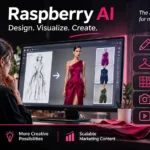
Quick Answer: Raspberry AI is a generative AI platform designed for fashion brands and creative professionals who want to accelerate clothing design, product visualization, and marketing production. It transforms sketches, reference images, and existing designs into realistic fashion visuals while helping teams explore materials, colors, patterns, and product variations.
Raspberry AI is an AI-powered fashion design platform that transforms sketches, reference images, and creative ideas into realistic fashion visuals.
It helps designers and clothing brands create garment concepts, experiment with fabrics and colors, generate product images, and develop marketing content without relying on traditional photoshoots for every design.
At a Glance: Raspberry AI
- Primary purpose: AI-powered fashion design, product visualization, and creative production.
- Main users: Fashion designers, apparel brands, manufacturers, and retail businesses.
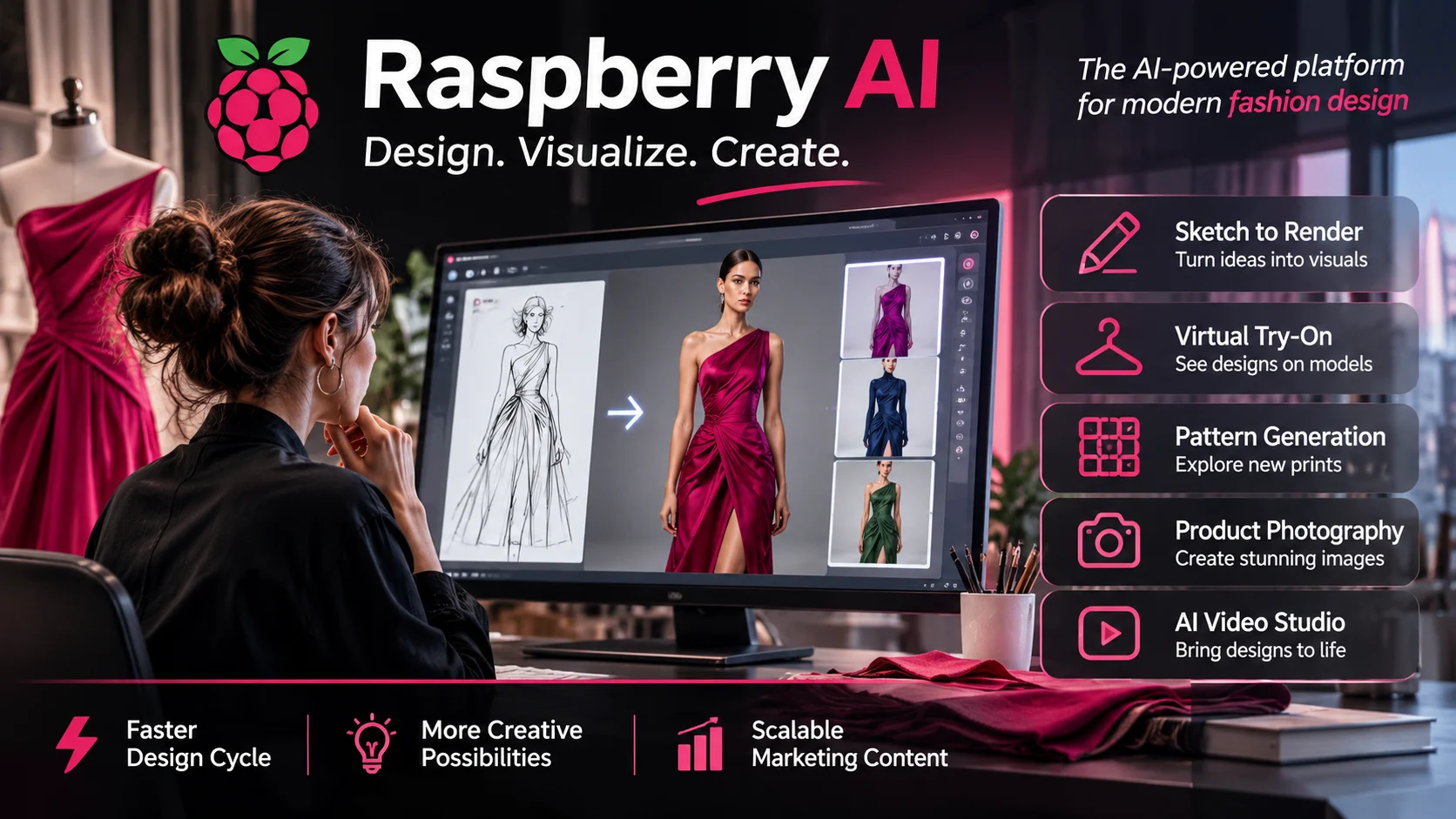
- Core capabilities: Sketch-to-render, virtual try-on, pattern generation, product photography, and AI video.
- Workflow advantage: Helps teams visualize designs before investing in physical samples.
- Pricing: Paid subscriptions start at $49 per user per month, with a limited free option.
- Main consideration: AI-generated visuals still require professional review before manufacturing decisions.
What Is Raspberry AI?
Raspberry AI is a specialized generative AI platform built for the fashion and retail industries. It helps creative teams move from initial design concepts to realistic product images and marketing materials.
Unlike general-purpose AI image generators, Raspberry AI focuses on fashion-specific workflows. Users can upload sketches, reference photographs, and existing product designs to generate new visual concepts.
The platform supports several stages of fashion product development, including:
- Initial concept development.
- Garment visualization.
- Fabric and material experimentation.
- Color and pattern variations.
- Virtual model presentations.
- Product photography.
- Marketing and campaign content.
Its purpose is to reduce the time between imagining a product and presenting a convincing visual version of it.
For example, a clothing designer can upload a simple jacket sketch and explore different fabrics, colors, and styling options without creating multiple physical samples.
Raspberry AI also supports accessories, footwear, handbags, luggage, jewelry, and other fashion-related product categories.
The company positions its platform as a creative workspace that connects design, product development, and marketing teams.
How Does Raspberry AI Work?
Raspberry AI uses generative AI to interpret creative inputs and produce fashion-focused visual outputs.
The process generally starts with an existing design, reference image, or written concept. Users then select the appropriate creative tool and refine the generated results.
1. Upload a Sketch or Reference Image
Designers can begin with a hand-drawn sketch, an existing garment image, or a visual reference.
This gives the AI a starting point rather than requiring users to describe every detail through text prompts.
For instance, a designer might upload a basic drawing of a summer dress and request a different neckline, fabric appearance, or color combination.
2. Generate Realistic Product Visuals
The platform converts creative inputs into photorealistic fashion visualizations.
Designers can examine how different materials, patterns, and color combinations might look on a finished product.
This makes early design discussions easier because teams can evaluate visual directions before ordering physical prototypes.
3. Refine Designs and Explore Variations
After generating an initial concept, users can make targeted adjustments.
These may include:
- Changing garment colors.
- Applying different fabric textures.
- Adjusting design elements.
- Creating alternative prints.
- Exploring different styling options.
- Producing multiple product views.
The editing process helps teams compare several creative directions without rebuilding every concept from scratch.
4. Create Marketing and Product Images
Once a design reaches the presentation stage, Raspberry AI can generate product photography, on-model imagery, lifestyle visuals, and campaign content.
Brands can use these assets for product listings, digital catalogs, social media, and promotional campaigns.
However, generated images should still be checked against actual product specifications before publication.
Key Features of Raspberry AI
Raspberry AI offers a collection of tools designed around different stages of fashion creation.
1. AI Sketch to Render
Sketch-to-render is one of the platform’s central capabilities.
It transforms basic fashion sketches into realistic product visualizations. Designers can communicate their ideas more clearly without manually creating every presentation image.
This feature is particularly useful during early product development.
A simple clothing illustration can become a more detailed visual concept showing fabric appearance, garment structure, and styling.
2. AI Virtual Try-On
The virtual try-on functionality allows designers to visualize garments on digital models.
Instead of arranging a physical photoshoot for every design variation, teams can generate model-based presentations.
This can help brands evaluate:
- Garment appearance on models.
- Different styling combinations.
- Product presentation concepts.
- Campaign visual directions.
It is important to distinguish visual try-on from technical fit validation. A convincing image does not prove that a garment will fit correctly in real life.
3. AI Design Mixer
Design Mixer helps users combine different visual inspirations to explore new creative directions.
Designers can experiment with reference images, materials, and design concepts to develop fresh product ideas.
It can be useful when building seasonal collections or exploring alternative versions of existing products.
4. Fabric and Material Visualization
Material visualization allows designers to experiment with different fabric appearances.
For example, a basic garment concept can be explored with denim, leather, cotton, satin, or other material references.
This helps creative teams communicate their intended appearance before physical sampling.
However, visual texture generation should not be confused with accurate physical fabric simulation.
5. Seamless Print and Pattern Generation
Fashion products frequently require repeating patterns and distinctive graphic elements.
Raspberry AI provides tools for generating seamless prints, graphics, and placement designs.
These capabilities can help designers explore:
- Repeating textile patterns.
- Decorative graphics.
- Garment prints.
- Brand-inspired visual elements.
- Alternative surface designs.
Production teams should still verify pattern dimensions, repeat alignment, color specifications, and printing requirements.
6. Product Photography and Lifestyle Images
Raspberry AI can generate product-focused and lifestyle photography.
Fashion brands can create visual presentations without arranging a traditional photoshoot for every concept.
The platform supports different presentation styles, backgrounds, and product views.
This may help e-commerce teams prepare visual content for product detail pages and promotional campaigns.
7. Product Multi-View Generation
A single product image may not communicate every important design detail.
Multi-view generation helps create different perspectives, including front, back, side, and quarter views.
These images can support product discussions, presentations, and marketing workflows.
However, teams should confirm that generated angles accurately represent the actual product.
8. AI Video Studio
Raspberry AI also includes video-generation capabilities.
Brands can create motion-based promotional visuals and campaign content using their fashion designs.
This can help creative teams develop additional content for digital marketing without organizing a separate production process for every concept.
Main Use Cases of Raspberry AI
Raspberry AI is designed for several professional applications across the fashion industry.
Fashion Design and Collection Development
Designers can explore new silhouettes, patterns, materials, and colors during the early stages of collection development.
Instead of manually preparing every visual variation, they can generate alternative concepts and compare them.
This supports faster creative discussions and more organized design exploration.
Clothing Brands and Apparel Manufacturers
Apparel businesses can use AI-generated visualizations to communicate product ideas with internal teams and manufacturing partners.
A clear visual concept can make early discussions about materials, colors, and garment appearance easier.
However, manufacturers still need accurate technical specifications and production-ready documentation.
E-commerce Product Presentation
Online retailers depend heavily on product images.
Raspberry AI can help generate different product presentations, model imagery, and lifestyle visuals for digital storefronts.
These assets may support product launches and marketing campaigns.
Retailers should ensure that generated images do not misrepresent the actual item customers will receive.
Fashion Marketing and Advertising
Marketing teams can use the platform to explore campaign concepts, backgrounds, product presentations, and promotional visuals.
It can also help brands develop creative variations for social media and other digital channels.
The main benefit is the ability to explore more visual directions before committing to a full production shoot.
Footwear and Accessories Design
Fashion design extends beyond clothing.
Raspberry AI also targets categories such as shoes, handbags, jewelry, luggage, and other accessories.
Design teams can explore materials, colors, product details, and alternative visual presentations.
This makes the platform relevant to businesses working across multiple fashion categories.
Benefits of Using Raspberry AI
Raspberry AI offers several potential advantages for fashion businesses.
Faster concept visualization: Designers can turn initial sketches into realistic visual concepts without manually producing every presentation.
More creative experimentation: Teams can explore different colors, materials, and patterns with fewer manual steps.
Reduced sampling pressure: Visualizing alternatives before manufacturing may help teams eliminate unsuitable concepts earlier.
Improved communication: Realistic product images can make discussions between designers, merchandisers, and marketing teams clearer.
Scalable marketing content: Brands can produce additional product and campaign visuals without organizing a separate photoshoot for every variation.
Connected creative workflows: Bringing design and marketing tools into one environment can reduce unnecessary handoffs between departments.
The actual benefits depend on the company’s existing workflow, product complexity, and ability to review AI-generated results.
Raspberry AI Pricing: How Much Does It Cost?
Raspberry AI offers several subscription options for independent creatives and professional teams.
According to its official pricing page, the published monthly plans are:
| Plan | Monthly price | Monthly credits |
|---|---|---|
| Free | $0 | Free allocation |
| Individual | $49/user | 120 |
| Basic | $198/user | 500 |
| Professional | $298/user | 750 |
| Enterprise | Custom | Custom |
Prices are listed in USD. Confirm the current checkout price, billing terms, and plan availability before purchasing.
What Do Raspberry AI Credits Mean?
Credits represent the amount of AI processing available within an account.
The number of credits required depends on the operation.
For example:
- One standard image generation generally costs one credit.
- A 3D render costs five credits.
- Video animation costs vary according to video length.
- Certain high-resolution operations consume additional credits.
- SVG export costs one credit.
The platform also states that unsuccessful generations are not charged.
Important Pricing Details
Several pricing conditions deserve attention before subscribing.
Free access: The pricing page currently displays a free option. However, its plan table lists 20 monthly credits, while its FAQ describes a one-time allocation of up to 50 free credits. Confirm the actual allowance shown during registration.
Credit expiration: Monthly credits reset and unused credits do not roll over.
Additional usage: Basic and Professional accounts can use overage credits at $0.50 per credit, subject to account limits.
Individual restrictions: Individual accounts pause work when their allowance is exhausted until the next reset or an upgrade.
Team allowances: Credits are assigned separately to each member. They cannot be pooled or transferred between users.
Resolution costs: Some operations cost more at 4K resolution. Automatic resolution settings can therefore affect usage.
These details matter because the advertised subscription price does not necessarily represent the full cost of high-volume creative production.
Raspberry AI Privacy and Security
Privacy is particularly important for fashion brands working with unreleased collections, confidential designs, and proprietary product concepts.
Raspberry AI states that its platform has SOC 2 Type II certification.
The company also publishes several data-handling commitments:
- Users retain ownership of their generated assets.
- Uploaded and generated content is not used to train or improve its AI models.
- Authorized personnel may access accounts for customer support.
- Paid users grant limited account access for support purposes.
- Brand Ambassador agreements may permit Raspberry to use submitted content for promotional purposes.
These statements are based on the company’s published security information and help documentation.
However, SOC 2 Type II certification should not be interpreted as proof of Zero Data Retention (ZDR). They address different security considerations.
Businesses handling confidential designs should review the complete privacy policy, contractual terms, access controls, and applicable enterprise security arrangements.
They should also ask about data retention periods, deletion procedures, hosting arrangements, and integration permissions before uploading sensitive product information.
Raspberry AI vs. Other Fashion Design Tools
Raspberry AI operates in a specialized market where different platforms solve different parts of the creative process.
Some tools prioritize generative visuals, while others focus on garment construction, pattern development, or professional 3D simulation.
| Platform | Target user | Main strength | Pricing transparency | Main limitation |
|---|---|---|---|---|
| Raspberry AI | Fashion brands and creative teams | AI-driven design and campaign workflows | Public subscription pricing | Credit limits and AI output verification |
| CLO | Fashion designers and 3D developers | Garment construction and 3D simulation | Check official pricing | Requires a more technical workflow |
| Browzwear | Apparel manufacturers and enterprise teams | 3D garment development | Primarily sales-led | Specialized learning requirements |
| Adobe Firefly | Designers and creative professionals | Generative image creation and editing | Published plan options | Not a complete fashion production system |
| Midjourney | Creative professionals | Visual exploration and concept imagery | Subscription-based | Not a technical garment development platform |
Raspberry AI vs. CLO
CLO focuses on digital garment construction and 3D apparel simulation.
Designers can work with garment patterns, digital fabrics, and virtual models to examine how clothing behaves.
Raspberry AI focuses more heavily on generative visualization and creative production.
Choose CLO when technical garment development and 3D simulation are priorities. Consider Raspberry AI when rapid design visualization and campaign content matter more.
Raspberry AI vs. Browzwear
Browzwear provides professional 3D apparel development tools for fashion businesses.
Its workflow is particularly relevant to digital garment development, product visualization, and fit-related processes.
Raspberry AI offers a different approach, emphasizing generative design exploration and visual content production.
The two platforms may complement each other rather than serve as direct replacements.
Raspberry AI vs. Adobe Firefly
Adobe Firefly supports generative image creation and editing within Adobe’s creative ecosystem.
It can be useful for designers who need broader visual editing capabilities.
Raspberry AI is more specialized in fashion workflows, including garment visualization, materials, product views, and on-model presentations.
The better option depends on whether a business needs general creative assistance or fashion-specific production tools.
Raspberry AI vs. Midjourney
Midjourney is widely used for generating creative images and exploring artistic directions.
It can help fashion designers build mood boards and experiment with visual concepts.
Raspberry AI offers more focused fashion-related workflows and product presentation features.
For inspiration and broad creative exploration, Midjourney may be sufficient. For a connected fashion design workflow, Raspberry AI deserves consideration.
Limitations of Raspberry AI
Despite its specialized capabilities, Raspberry AI is not a complete replacement for professional fashion design and manufacturing processes.
AI Images Do Not Guarantee Production Accuracy
A photorealistic garment image does not guarantee that the product can be manufactured exactly as shown.
Real production requires accurate measurements, pattern construction, material specifications, stitching details, and quality checks.
Designers must validate these elements separately.
Generated Details May Need Corrections
Generative image systems can sometimes produce inconsistent garment details.
Examples include unusual seams, inaccurate logos, distorted accessories, or unrealistic fabric behavior.
Human review remains important before using outputs in production or advertising.
Credit Consumption Can Increase Costs
Different tools require different amounts of credits.
Higher resolutions, 3D rendering, and video generation can consume allowances faster than standard image generation.
Businesses should estimate their expected monthly usage before choosing a subscription.
Specialized Rather Than General-Purpose
Raspberry AI is built around fashion and retail.
Businesses outside these industries may find general-purpose creative platforms more suitable.
Its specialized features are most valuable when they match an existing fashion workflow.
Professional Judgment Is Still Necessary
AI can support creative exploration, but it cannot independently replace an experienced designer’s understanding of construction, fit, materials, and customer preferences.
The strongest results come from combining automated visualization with human expertise.
Who Should Use Raspberry AI?
Raspberry AI may be suitable for several professional groups.
Fashion designers: Useful for exploring garment concepts, fabrics, colors, and alternative designs.
Clothing brands: Helpful for developing product visuals and preparing collection presentations.
Fashion startups: Can support early concept development without arranging a physical photoshoot for every idea.
E-commerce businesses: Useful for creating additional product imagery and marketing presentations.
Creative directors: Can use visual concepts to communicate ideas and coordinate design decisions.
Fashion marketing teams: May benefit from generating campaign visuals and promotional content.
However, independent users who only need occasional AI-generated fashion inspiration may find its professional subscription plans unnecessary.
Is Raspberry AI Worth It?
Whether Raspberry AI is worth the investment depends on the volume and complexity of your creative work.
For a fashion brand producing multiple collections, product variations, and marketing campaigns, a specialized AI workflow may offer meaningful operational value.
The platform’s ability to connect concept development, product visualization, and campaign production is its main attraction.
However, smaller users should consider the subscription cost and credit restrictions carefully.
Before purchasing, test the platform with actual design files rather than relying entirely on promotional demonstrations.
Evaluate the quality of generated garments, editing controls, consistency across product views, credit consumption, and compatibility with existing software.
A practical pilot using one real product category can reveal whether the platform delivers enough value to justify its cost.
Frequently Asked Questions About Raspberry AI
1. What is Raspberry AI used for?
Raspberry AI is used for fashion design visualization, garment concept development, product photography, virtual model presentations, and marketing content. It helps creative teams explore designs and create product visuals using generative AI.
2. Is Raspberry AI free to use?
Raspberry AI offers a free entry-level option with limited credits. Its pricing page contains different free-credit descriptions, so users should verify the current allowance during registration.
3. Can Raspberry AI create clothing designs from sketches?
Yes. Its sketch-to-render functionality transforms fashion sketches into realistic visual concepts. Designers can then explore different colors, fabrics, and styling variations.
4. Does Raspberry AI replace professional fashion designers?
No. Raspberry AI supports creative workflows but does not replace professional expertise in garment construction, pattern development, measurements, fit testing, or manufacturing.
5. How much does Raspberry AI cost?
The published monthly plans include Individual at $49, Basic at $198, and Professional at $298 per user. Enterprise pricing is customized, while a limited free option is also available.
Conclusion
Raspberry AI brings generative AI into the fashion design and retail production process. Its combination of sketch-to-render, material visualization, virtual try-on, product photography, and campaign creation makes it relevant to professional creative teams.
Its biggest advantage is helping designers explore and communicate product ideas before committing to expensive production steps. However, subscription costs, credit consumption, and the accuracy of generated visuals deserve careful consideration.
For fashion brands and apparel businesses, Raspberry AI is worth evaluating through a practical trial. The right decision depends on whether its specialized tools improve your existing creative workflow and deliver measurable value.