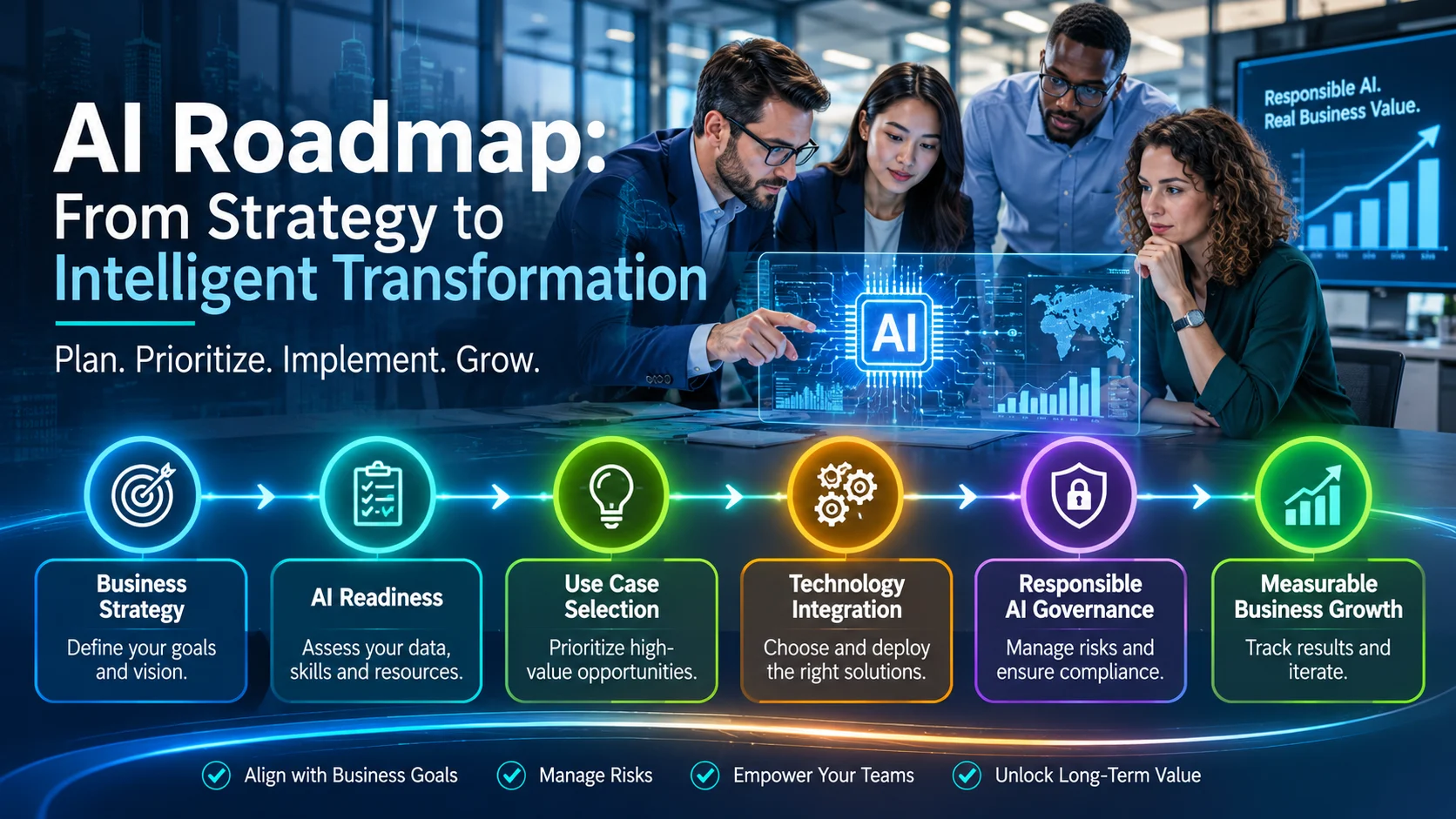
Quick answer: An AI roadmap is a strategic plan that outlines how an organization will adopt, implement, and scale artificial intelligence to achieve measurable business goals. It defines priority use cases, technology requirements, implementation timelines, responsible teams, budgets, and governance measures.
AI Roadmap at a Glance
- Strategic direction: Connect AI investments with measurable business objectives.
- Use case prioritization: Identify which business problems can benefit most from AI.
- Technical preparation: Evaluate data quality, infrastructure, software, and integration requirements.
- Implementation planning: Organize AI initiatives into realistic phases with clear responsibilities.
- Responsible adoption: Address security, privacy, accuracy, transparency, and human oversight.
- Performance measurement: Track productivity, operational improvements, costs, and business value.
What Is an AI Roadmap?
An AI roadmap is a structured plan that guides an organization from initial artificial intelligence experiments to practical, scalable implementation.
It identifies where AI can create value and explains how to achieve that value over time. The roadmap connects business priorities with technical capabilities, employee skills, infrastructure, investment, and responsible AI practices.
For example, a retail company might want to use AI to improve customer support, predict product demand, and automate inventory reporting.
Instead of implementing all three projects simultaneously, the company can assess their value, technical requirements, and potential risks. It can then prioritize projects and assign resources accordingly.
A practical AI roadmap answers six important questions:
- What business problems should AI solve?
- Which AI applications deserve priority?
- What data and infrastructure are required?
- Who will manage and implement each initiative?
- How much time and investment will implementation require?
- How will the organization measure success?
The roadmap should remain flexible because AI technologies, business requirements, and regulatory expectations continue to evolve.
AI Strategy vs. AI Roadmap vs. AI Implementation Plan
These three concepts are closely related, but they serve different purposes.
| Concept | Primary Purpose | Main Focus |
|---|---|---|
| AI strategy | Establishes the overall direction | Business goals and long-term vision |
| AI roadmap | Organizes priorities and implementation stages | Timelines, resources, dependencies, and milestones |
| AI implementation plan | Explains how a particular project will be delivered | Technical tasks, development, testing, and deployment |
An AI strategy explains where the organization wants to go. The roadmap determines the order of activities required to get there.
An implementation plan then translates an individual initiative into specific technical and operational tasks.
For example, a company’s strategy might focus on improving customer experience through AI. Its roadmap could prioritize an AI support assistant before introducing predictive customer analytics.
The implementation plan would explain how the support assistant will connect to company data, handle customer questions, and escalate complex requests.
Why Does an AI Roadmap Matter?
Artificial intelligence offers opportunities across customer service, marketing, finance, healthcare, manufacturing, and software development.
However, purchasing AI software does not automatically produce business value.
Organizations often struggle because they adopt disconnected tools without defining clear objectives. They may also underestimate data preparation, integration costs, employee training, and ongoing maintenance.
An AI roadmap addresses these problems by creating a shared implementation strategy.
1. Connects AI Investments With Business Goals
Every AI project should solve a recognizable business problem.
A roadmap helps decision-makers distinguish valuable opportunities from experiments that generate activity without meaningful results.
For instance, a logistics company might prioritize delivery-time prediction because it directly supports operational efficiency.
2. Improves Resource Allocation
AI initiatives require different combinations of people, technology, infrastructure, and funding.
A roadmap helps organizations distribute these resources according to project importance and readiness.
It also prevents several departments from purchasing overlapping tools or developing similar solutions independently.
3. Reduces Implementation Risks
AI systems can produce inaccurate information, expose sensitive data, or behave unpredictably under certain conditions.
Planning governance and evaluation requirements early helps organizations identify these risks before deployment.
4. Supports Employee Adoption
AI transformation involves people as well as technology.
Employees need appropriate training to understand AI capabilities, recognize limitations, and use new systems responsibly.
A roadmap includes these activities rather than treating employee adoption as an afterthought.
5. Makes Performance Easier to Measure
Without defined targets, organizations cannot reliably determine whether an AI project delivers value.
A roadmap establishes measurable indicators before implementation begins.
These might include reduced processing time, lower operating costs, improved response accuracy, or increased customer satisfaction.
How to Build an AI Roadmap: 8 Practical Steps
Building an effective AI roadmap requires more than selecting popular AI platforms. Organizations should begin with business requirements and gradually develop the technical and operational capabilities needed for implementation.
Step 1: Define Your AI Vision and Business Objectives
Start by identifying what the organization wants to achieve through artificial intelligence.
Avoid vague objectives such as becoming an AI-powered company. Instead, connect AI adoption with specific business outcomes.
Possible objectives include:
- Reducing repetitive administrative work.
- Improving customer support response times.
- Increasing sales forecasting accuracy.
- Automating document processing.
- Improving product recommendations.
- Identifying operational inefficiencies.
Each objective should have a measurable target.
For example, a business might aim to reduce the average time required to process customer inquiries by 25%.
This target provides a clearer direction for evaluating potential AI solutions.
Step 2: Assess Your Current AI Readiness
Before selecting technologies, evaluate whether your organization has the necessary capabilities.
An AI readiness assessment identifies existing strengths and gaps across several areas.
Data readiness: Determine whether relevant information is accurate, accessible, organized, and appropriately governed.
Technical infrastructure: Review existing software, cloud services, databases, networks, and integration capabilities.
Workforce skills: Identify whether employees understand AI tools and whether specialist expertise is available.
Financial readiness: Estimate available budgets, implementation costs, and ongoing operational expenses.
Governance readiness: Examine privacy requirements, security controls, accountability, and regulatory obligations.
An organization does not need perfect infrastructure before beginning its AI journey. However, it should understand its limitations before committing to expensive projects.
Step 3: Identify and Prioritize AI Use Cases
The next step is identifying processes where AI could produce meaningful improvements.
Different departments may have different opportunities.
| Department | Potential AI Use Case | Expected Business Value |
|---|---|---|
| Marketing | Customer segmentation and content assistance | Improved campaign efficiency |
| Sales | Lead scoring and forecasting | Better sales prioritization |
| Customer service | AI support assistants | Faster inquiry handling |
| Finance | Invoice extraction and anomaly detection | Reduced manual processing |
| Human resources | Recruitment administration and employee support | More efficient workflows |
| Operations | Predictive maintenance and demand forecasting | Improved operational planning |
| IT | Code assistance and incident analysis | Reduced repetitive technical work |
Not every process needs AI. Traditional automation, workflow improvements, or better software may provide a simpler solution.
Prioritize opportunities based on business value, technical feasibility, data availability, implementation effort, and risk.
A useful evaluation model is:
Use case priority = Business value + Feasibility + Strategic relevance – Implementation risk
This is a decision-making guide rather than a standardized industry formula. Organizations should define their own scoring weights.
Step 4: Select the Right AI Technology
Once priorities are established, evaluate which technologies can address the selected problems.
Different applications require different approaches.
Machine learning: Useful for identifying patterns, making predictions, and analyzing structured information.
Generative AI: Creates or transforms content, including text, images, audio, and code.
Large language models (LLMs): Process and generate human language for applications such as document analysis and conversational assistants.
Retrieval-Augmented Generation (RAG): Connects language models with external information sources so responses can use relevant organizational documents or databases.
AI agents: Can perform sequences of tasks using connected tools, subject to their permissions and configured controls.
Organizations should also evaluate whether to build solutions internally, purchase existing software, or combine both approaches.
For example, an established customer support platform may be sufficient for a small business. A company with specialized workflows might require a custom application connected to internal databases.
The selection should consider integration, reliability, operating costs, vendor dependency, data handling, and long-term maintenance.
Step 5: Establish AI Governance and Security
Responsible AI practices should be part of the roadmap from the beginning.
Governance defines who is accountable for AI systems and how the organization manages their potential risks.
Important considerations include:
- Data privacy and access permissions.
- Protection of confidential business information.
- Human review of important AI-generated decisions.
- Testing for inaccurate or misleading outputs.
- Monitoring for security vulnerabilities.
- Documentation of AI system limitations.
- Incident reporting and response procedures.
- Compliance with applicable laws and industry requirements.
The NIST AI Risk Management Framework provides guidance for identifying, assessing, and managing AI-related risks. Its Generative AI Profile addresses additional considerations associated with generative systems.
Organizations can use these resources to develop governance practices suited to their operations.
Importantly, a security certification or independent audit does not automatically guarantee that an AI provider offers Zero Data Retention. Review the actual contractual terms, data-processing policies, and retention settings before sharing sensitive information.
Step 6: Create a Phased Implementation Timeline
A roadmap becomes actionable when it organizes initiatives into manageable stages.
A practical starting point is a 12-month planning horizon, with detailed planning for the first 90 days. This is an example, not a universal implementation requirement.
| Phase | Timeline | Main Activities |
|---|---|---|
| Discovery | Months 1–2 | Define objectives, assess readiness, identify use cases |
| Preparation | Months 2–3 | Select technologies, prepare data, establish governance |
| Pilot projects | Months 4–5 | Test selected AI applications and measure results |
| Initial deployment | Months 6–8 | Integrate successful pilots into business workflows |
| Expansion | Months 9–10 | Extend proven applications to additional departments |
| Optimization | Months 11–12 | Improve performance, control costs, review outcomes |
The timeline should reflect actual dependencies.
For example, a customer-facing AI assistant may depend on accurate product documentation and appropriate access controls. Those requirements should be completed before the system enters production.
Step 7: Allocate Budgets and Assign Responsibilities
Every roadmap initiative needs an accountable owner and realistic financial planning.
AI costs extend beyond software subscriptions.
Depending on the solution, expenses may include:
- AI platform subscriptions.
- API usage and model inference.
- Cloud computing and storage.
- Data cleaning and preparation.
- Software integration.
- Development and consulting.
- Employee training.
- Security testing and compliance.
- Ongoing monitoring and maintenance.
Assign responsibilities across business, technical, and governance teams.
For example, a customer service AI project might involve a customer experience manager, an IT lead, a data specialist, and a privacy or security representative.
The business owner should remain accountable for the intended outcome, even when external vendors provide the technology.
Step 8: Measure Results and Update the Roadmap
AI adoption should be treated as an ongoing process rather than a one-time technology project.
Measure performance against the baseline established before implementation.
Useful KPIs include:
| KPI | What It Measures |
|---|---|
| Task completion time | Changes in workflow efficiency |
| Cost per task | Operational cost improvements |
| Error rate | Frequency of incorrect outputs |
| User adoption | Employee or customer usage |
| Customer satisfaction | Changes in service experience |
| AI operating cost | Ongoing infrastructure and usage expenses |
| Business ROI | Financial value compared with total investment |
Do not rely entirely on usage statistics.
An AI assistant receiving thousands of queries may still fail to deliver value if its answers are inaccurate or employees must repeatedly correct its output.
Review the roadmap regularly, update priorities, and discontinue projects that fail to meet agreed requirements.
What Should an AI Roadmap Include?
An effective AI roadmap should be detailed enough to guide decisions without becoming an unnecessarily complicated document.
The following elements provide a useful foundation.
Business Objectives and Strategic Priorities
Explain why the organization wants to adopt AI and which business outcomes matter most.
Prioritized AI Projects
List proposed initiatives, their expected value, feasibility, and relative importance.
Data and Infrastructure Requirements
Identify required databases, software integrations, cloud resources, computing capacity, and data permissions.
Technology and Vendor Selection
Document selected platforms, model providers, development approaches, and reasons for choosing them.
Implementation Timeline
Include project phases, dependencies, deadlines, and major milestones.
Ownership and Resource Allocation
Identify project owners, technical contributors, governance representatives, and budget responsibilities.
Risk Management and Governance
Define security requirements, privacy controls, human oversight, testing procedures, and escalation processes.
Performance Metrics
Specify how the organization will evaluate adoption, quality, efficiency, cost, and business impact.
AI Roadmap Example | A Retail Business
Consider a medium-sized online retailer that wants to improve its customer experience and operational efficiency.
The company receives hundreds of customer inquiries every day. Employees also spend considerable time preparing sales reports and checking inventory.
Rather than introducing AI across every department, management identifies three priority opportunities.
Project 1: AI Customer Support Assistant
The first project involves introducing an AI assistant that answers common questions using approved product and delivery information.
The initial pilot handles frequently asked questions. Complex inquiries are transferred to human representatives.
Success indicators include response time, answer accuracy, escalation rate, and customer satisfaction.
Project 2: AI Sales Forecasting
The second project uses historical sales information to support demand forecasting.
The company evaluates whether predictive models can improve purchasing decisions and reduce inventory shortages.
Its main indicators include forecast error, stock availability, and inventory costs.
Project 3: Automated Business Reporting
The third project focuses on generating routine reports from existing business data.
AI can assist with summarizing trends, identifying unusual changes, and preparing management reports.
The company measures preparation time, reporting accuracy, and employee productivity.
These initiatives can be organized into different implementation phases.
The customer support assistant might become the first pilot because the business already has a substantial collection of customer questions and product documentation.
Forecasting may follow after the company evaluates historical data quality. Reporting automation can be introduced when the necessary data connections and approval processes are ready.
This example illustrates an important principle: the order of implementation should depend on readiness and business value, not technological popularity.
Common AI Roadmap Mistakes to Avoid
Even organizations with substantial technology budgets can struggle with AI implementation.
Several common mistakes can undermine an otherwise promising roadmap.
1. Starting With Technology Instead of Business Problems
Choosing a popular AI model before identifying the actual problem can create unnecessary complexity.
Start with business requirements, then select suitable technology.
2. Trying to Implement Too Many Projects
Launching multiple AI initiatives simultaneously can overwhelm technical teams and available budgets.
Start with a manageable portfolio and expand when initial projects demonstrate value.
3. Ignoring Data Quality
AI systems depend on the information available to them.
Incomplete, outdated, inconsistent, or poorly governed data can undermine results.
4. Treating Pilot Success as Production Readiness
A demonstration may perform well under controlled conditions but fail with real users and unpredictable inputs.
Production deployment requires additional evaluation, monitoring, access controls, and support arrangements.
5. Overlooking Total Cost of Ownership
A low subscription price does not necessarily mean an inexpensive AI solution.
Consider usage charges, integration, maintenance, infrastructure, training, and potential switching costs.
6. Ignoring Employees
Employees may resist AI adoption when they do not understand its purpose or how it affects their responsibilities.
Provide training and involve relevant teams throughout implementation.
7. Creating a Fixed Long-Term Plan
AI capabilities and business requirements change quickly.
A roadmap should establish direction while allowing priorities, technologies, and timelines to evolve.
AI Roadmap Tools and Resources
Organizations can use several established platforms to research AI technologies, evaluate implementation approaches, and organize projects.
These resources serve different purposes. They are not interchangeable AI roadmap builders.
| Platform | Target User | Key Strength | Pricing Transparency | Core Limitation |
|---|---|---|---|---|
| Google Cloud | Businesses and technical teams | AI infrastructure and adoption guidance | Service-specific pricing | Cloud implementation may require technical expertise |
| Microsoft AI | Enterprises and IT teams | AI adoption resources and enterprise ecosystem | Product-specific pricing | Some capabilities depend on Microsoft products and licensing |
| Hugging Face Hub | Developers and researchers | Model discovery, datasets, and open-source ecosystem | Varies by service and deployment | Requires technical evaluation of models and licenses |
| Futurepedia | Professionals and businesses | AI tool discovery | Varies by listed product | Directory listings do not establish independent product quality |
| There’s An AI For That | General users and professionals | Discovering AI tools by task | Varies by listed product | Listings may change and require individual verification |
| Product Hunt | Founders and technology professionals | Discovering newly launched AI products | Varies by product | Launch visibility is not proof of reliability |
Google Cloud’s AI Adoption Framework offers guidance on developing organizational AI capabilities. Microsoft also provides AI strategy resources covering business alignment, technology, organizational culture, and governance.
Hugging Face is particularly relevant when technical teams need to explore available models and datasets.
For organizations evaluating AI tools, discovery directories can help create an initial shortlist. However, every shortlisted product should undergo separate evaluation for functionality, integration, licensing, pricing, and data handling.
How to Choose the Right AI Roadmap Approach
Not every organization requires a large enterprise transformation program.
The appropriate roadmap depends on company size, technical maturity, available resources, and business objectives.
Small businesses: Start with one or two practical opportunities, such as customer support assistance, document processing, or marketing workflow automation. Prefer solutions with transparent costs and straightforward integration.
Medium-sized businesses: Develop a cross-department roadmap that includes data preparation, workflow integration, employee training, and measurable pilot projects.
Large enterprises: Establish portfolio-level governance, executive accountability, architecture standards, vendor management, risk assessment, and continuous monitoring.
Startups: Focus on AI capabilities that support product differentiation, reduce development time, or improve customer experience. Avoid unnecessary infrastructure investments before demand is established.
Developers and technical teams: Evaluate model quality, APIs, inference costs, latency, context limits, deployment requirements, and maintainability.
The most suitable approach is the one that matches the organization’s actual capabilities and long-term requirements.
Latest AI Roadmap Considerations in 2026
AI planning increasingly involves more than choosing a generative AI model.
Organizations must consider how AI systems interact with existing software, business data, employees, and operational processes.
Several developments deserve attention when preparing a modern AI roadmap.
Generative AI and AI Agents
Generative AI is expanding beyond content creation into business workflows.
AI agents can interact with approved tools, retrieve information, and execute sequences of tasks. However, their permissions, accuracy, and ability to recover from errors require careful evaluation.
Organizations should begin with limited permissions and human approval for consequential actions.
Model Flexibility and Vendor Dependency
Businesses can choose between proprietary models, open-weight models, and managed AI services.
Each approach has different requirements.
Proprietary services may simplify access to advanced capabilities, while open-weight models can offer greater control over deployment. However, self-hosting introduces infrastructure, maintenance, and security responsibilities.
A roadmap should consider switching costs and avoid unnecessary dependence on a single provider.
AI Evaluation and Continuous Monitoring
Traditional software testing is not sufficient for every AI application.
Organizations need representative test datasets and evaluation criteria for accuracy, consistency, safety, and task completion.
Performance should also be monitored after deployment because model updates, changing data, and new user behavior can affect results.
Responsible AI and Regulatory Requirements
AI governance is becoming an essential part of enterprise planning.
The NIST AI Risk Management Framework and its Generative AI Profile provide resources for identifying and managing AI risks.
Organizations should also examine applicable privacy, consumer protection, employment, and sector-specific requirements in the jurisdictions where they operate.
The objective is to make governance part of implementation rather than introducing it after problems appear.
Frequently Asked Questions About AI Roadmaps
1. What is an AI roadmap?
An AI roadmap is a strategic plan that explains how an organization will adopt and implement artificial intelligence. It outlines business goals, projects, technology, budgets, timelines, and performance measures.
2. How do you create an AI roadmap?
Start by defining business goals and assessing organizational readiness. Next, identify useful AI projects, select suitable technologies, assign resources, establish governance, and create an implementation timeline.
3. How long does it take to implement an AI roadmap?
Implementation depends on project complexity, data readiness, and available resources. Small AI pilots may take weeks, whereas enterprise-wide adoption can require several months or longer.
4. What are the main components of an AI roadmap?
Key components include business objectives, AI use cases, data requirements, technology selection, budgets, timelines, team responsibilities, governance, and performance metrics.
5. Why do businesses need an AI roadmap?
An AI roadmap helps businesses prioritize investments, manage implementation risks, prepare employees, and measure results. It also prevents disconnected technology purchases and supports long-term planning.
Conclusion
An AI roadmap helps organizations turn artificial intelligence opportunities into practical business improvements. By connecting business objectives with technology, budgets, and resources, it creates a clear implementation strategy. Furthermore, measurable milestones help teams track progress and adjust priorities. Whether adopting small automation projects or implementing enterprise-wide AI, businesses should consider data readiness, privacy, integration, and long-term costs. Ultimately, a flexible roadmap supports more responsible and effective AI adoption.