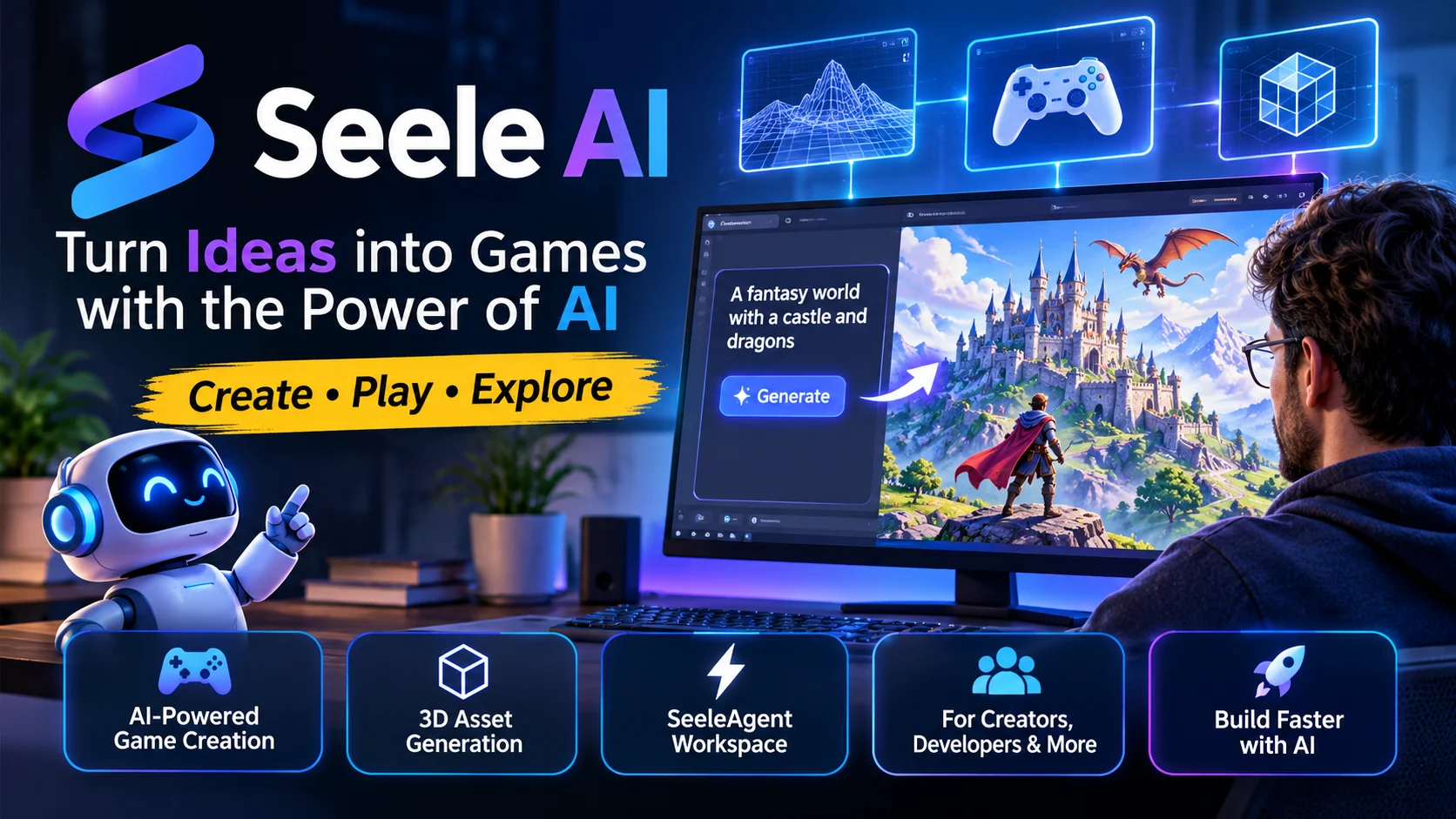
Seele AI is an AI-powered game creation platform that turns natural-language prompts and images into interactive games, 3D assets, and playable experiences. Its SeeleAgent workspace combines AI models, asset generation, coding, editing, and publishing tools to simplify game development for creators and developers.
Seele AI is an AI-powered game development platform that transforms text prompts and visual references into interactive games, 3D environments, and digital assets. With its SeeleAgent workspace and multimodal AI models, it helps beginners, indie developers, and creative teams build game prototypes, generate assets, and refine gameplay without handling every development task manually.
Whether you want to experiment with a new game idea or explore AI-assisted development, understanding Seele AI’s features, pricing, capabilities, and limitations can help you decide if it fits your creative needs.
What Is Seele AI?
Seele AI is an AI-powered game development platform designed to make interactive game creation more accessible.
Instead of manually writing every script, building every environment, and creating each asset, users can describe their ideas in natural language. The platform uses its AI agent to turn those instructions into game projects.
Its central product is SeeleAgent, an AI creation workspace that combines several development tasks:
- Game concept generation.
- Gameplay code creation.
- 2D and 3D asset generation.
- Character and environment design.
- Animation and audio generation.
- Game previews and testing.
- Project editing and publishing workflows.
The platform also offers a model and developer ecosystem through Seele API, alongside related products such as Seele TV.
The important distinction is that Seele AI aims to support an entire game production workflow, rather than generating isolated images or short text responses. Seele AI+2
How Does Seele AI Work?
Seele AI follows a prompt-based development process. Users describe a game, review the generated result, and request changes through the AI agent.
The workflow generally involves four stages.
1. Describe Your Game Idea
Start by explaining the game you want to create.
For example:
Create a 3D survival game where players collect resources, build shelters, and defend themselves against monsters.
You can also provide a reference image or sketch when the project requires visual guidance.
The more specific your instructions, the easier it becomes to communicate your intended gameplay, environment, and visual style.
2. Let SeeleAgent Generate the Project
SeeleAgent interprets the request and coordinates different creation tasks.
Depending on the project, these may include:
- Creating environments and game assets.
- Writing gameplay scripts.
- Building characters and interactive objects.
- Generating sound effects.
- Organizing project files.
This approach reduces the need to switch between separate tools during early development.
3. Preview and Improve the Game
After generation, users can inspect a playable preview inside the workspace.
The next step is refinement. You can ask the agent to adjust character movement, change an environment, introduce new mechanics, or correct specific problems.
Seele’s guide also recommends making focused changes rather than sending several unrelated requests together.
4. Export, Share, or Publish
Once the project reaches a suitable stage, users can review its files and available export options.
Seele’s documentation describes project downloads, sharing, and publishing workflows. Its website also advertises publishing support for major platforms, including Steam, Google Play, and Apple’s App Store.
However, actual store publication still involves platform requirements, account permissions, testing, and approval. AI generation does not automatically guarantee acceptance by an app store. seeles.ai+2
Key Features of Seele AI
Seele AI brings several game development capabilities into one environment. These features are more relevant to creators than its general AI positioning.
AI Game Generator
The AI game generator turns written ideas into playable prototypes.
Users can describe gameplay mechanics, characters, environments, and objectives. SeeleAgent then attempts to construct the corresponding experience.
This can help beginners test ideas before investing in traditional development.
Image-to-Game Generation
Seele AI also supports image-based game creation.
Users can upload concept art, sketches, or visual references and use them as starting points for an interactive scene.
This is particularly useful for artists who already have visual ideas but lack the programming skills to turn them into playable environments.
3D Game Development
The platform includes tools for creating and editing 3D environments and assets.
Its advertised capabilities include:
- 3D environments and game worlds.
- Character and object assets.
- Game-ready models.
- Scene editing.
- 3D asset optimization.
This makes it relevant to creators working on more than simple two-dimensional browser games.
AI Code Editor
Game development requires more than attractive graphics. Games also need functional mechanics and reliable code.
SeeleAgent can generate and modify gameplay scripts through natural-language instructions. Users can request changes without manually locating every relevant section of code.
Developers should still inspect the generated scripts, particularly when working with complex game logic.
AI Video and Audio Creation
Seele’s broader creation workspace includes image, video, and audio-related workflows.
These capabilities can support:
- Game trailers.
- Promotional videos.
- Sound effects.
- Background audio.
- Visual storytelling.
- Marketing materials.
Seele TV is a related product focused on AI video creation and controllable multi-shot production. It should not be confused with the main game development workspace. Seele AI+1
Multi-Turn Editing
One useful aspect of an AI development agent is the ability to refine an existing project through follow-up instructions.
Rather than restarting after every change, users can work through successive revisions.
For example:
- Create a small racing game.
- Add three different racing tracks.
- Introduce obstacles and collectible coins.
- Improve the vehicle controls.
- Change the environment to a nighttime setting.
This approach makes experimentation more practical. However, complex changes may still require debugging and manual adjustments.
Seele AI Models: Seele02, eva01, and PEGA
One area that distinguishes SEELE from many AI game-building interfaces is its focus on developing game-oriented foundation models.
These models are part of the company’s broader technical strategy.
Seele02
Seele02 is the company’s multimodal foundation model for game creation.
According to SEELE, it uses a Mixture-of-Transformers architecture to work across text, 3D, and spatial information.
In simpler language, the model is designed to understand more than written instructions. It aims to connect descriptions, visual assets, and spatial structures within a game development workflow.
The company describes it as supporting generation, understanding, multi-turn editing, and tool use.
eva01
Its stated direction is to treat 3D geometry and mesh structures as native information rather than treating them only as images.
This could be useful for generating and modifying objects while preserving their visual identity across multiple editing steps.
However, the company’s technical descriptions should not be confused with independently verified performance across professional production workloads.
PEGA World Model
PEGA is SEELE’s world-model initiative.
A world model attempts to understand and predict how an environment changes over time.
For gaming, this matters because a playable world must respond consistently to movement, interactions, and changing conditions.
SEELE describes PEGA as a system designed for long-horizon 3D contextual memory and spatial consistency. Its announced development roadmap has identified Q3 2026 as its first-version target.
That announcement is not, by itself, confirmation that every planned capability is generally available. Seele AI+1
Who Should Use Seele AI?
Seele AI is aimed at people who want to experiment with game creation without managing every technical task manually.
| User type | Potential benefit |
|---|---|
| Beginners | Create prototypes using natural-language prompts |
| Indie developers | Accelerate early development and asset creation |
| Game designers | Test mechanics and visual concepts |
| 3D artists | Explore image-to-game and 3D workflows |
| Educators | Demonstrate interactive game development |
| Small studios | Explore AI-assisted production workflows |
| Experienced developers | Generate starting points for further development |
It may be especially interesting to creators who have game ideas but lack a complete development team.
Experienced developers may find it useful for prototyping, although they should evaluate code quality, export flexibility, and integration requirements before adopting it for production.
Seele AI Pricing: Is It Free?
Seele AI offers a free starting option, alongside paid subscriptions and enterprise services.
Its pricing structure uses Koins, an internal credit system that users spend on AI generation and editing tasks.
The amount consumed depends on the selected model and the complexity of the requested operation.
Available Pricing Plans
The official website currently displays the following subscription tiers:
| Plan | Displayed monthly price | Main positioning |
|---|---|---|
| Free | Free to start | Initial exploration |
| Standard | $20/month | Entry-level paid access |
| Pro2X | $100/month | Higher-volume creation |
| Ultra | $200/month | Advanced capacity and features |
| Enterprise | Custom | Studios and publishers |
Prices are displayed in USD. Confirm the final checkout price, billing period, and included Koins before subscribing.
The paid plans advertise different combinations of:
- Monthly Koins.
- Access to Seele02 models.
- Cloud workspace storage.
- Parallel generation tasks.
- Priority processing.
- Asset downloads.
- Commercial-use permissions.
- Publishing and monetization features.
The Pro2X and Ultra tiers advertise larger resource allocations and additional production capabilities. Enterprise customers can inquire about private deployment, API access, and custom capacity. Seele AI+1
How Does the Koin System Work?
Koins function as platform credits. Different activities consume different amounts.
SEELE’s published guide provides these approximate usage figures:
| Operation | Estimated Koin usage |
|---|---|
| Playable game generation with Flash | 120–140 |
| Playable game generation with Pro | 1,400–1,500 |
| Image generation | Around 20 |
| Video generation | Around 186 |
| 3D asset or scene | Around 18 |
| Editing with Flash | 77–81 |
| Editing with Pro | 520–710 |
These are estimates, not guaranteed fixed prices. Actual consumption can vary depending on the request and selected model.
An important pricing consideration: A subscription’s monthly price does not tell you how many complete games you can generate.
Before upgrading, calculate how many generations and revisions your typical project requires.
Also check the distinction between subscription credits and separately purchased Koins. SEELE’s terms state that unused subscription allocations do not carry over, while its help information describes Koins as remaining in an account after cancellation. These provisions should be checked against the specific credit type and current plan conditions.
Check official Seele AI pricing and plans.
Benefits of Using Seele AI
Seele AI offers several potential advantages for people interested in AI-assisted game development.
1. Lower Technical Entry Barrier
Traditional game development often requires programming, 3D modeling, animation, and engine knowledge.
SeeleAgent attempts to reduce these requirements through natural-language instructions.
Beginners can start experimenting without mastering every development discipline first.
2. Multiple Creative Tools in One Workspace
Game developers often switch between separate applications for artwork, modeling, animation, coding, and testing.
Seele AI brings many of these activities into a shared workspace.
This can reduce workflow interruptions during early development.
3. Faster Prototyping
Creating a basic prototype manually can take considerable time.
AI-assisted generation provides another way to explore gameplay concepts and test ideas.
This is especially useful when comparing different mechanics or visual directions.
4. Opportunities for Independent Creators
Small development teams may not have dedicated specialists for every production task.
AI-assisted asset and code generation can help independent creators explore projects that would otherwise require additional resources.
However, generated work still requires review and refinement.
5. Integrated Publishing and Monetization Direction
SEELE promotes a broader ecosystem that extends beyond initial game generation.
Its website describes publishing, creator rewards, and monetization capabilities.
These features may interest creators who want to distribute their projects. However, revenue opportunities should be treated as platform offerings, not guaranteed income.
Limitations and Things to Consider
Despite its potential, Seele AI has limitations that users should understand before relying on it.
AI-Generated Games Still Need Testing
Generating a playable prototype is different from delivering a polished commercial game.
AI-generated projects may contain:
- Gameplay bugs.
- Incorrect scripts.
- Unbalanced difficulty.
- Inconsistent visual elements.
- Performance problems.
- Missing functionality.
SEELE’s own terms acknowledge that generated content can contain errors and that users remain responsible for reviewing and testing their projects. Seele AI
Complex Projects May Require Programming Knowledge
Natural-language generation can simplify development, but it does not eliminate the need for technical understanding.
Large projects often require debugging, performance optimization, architecture decisions, and careful testing.
Professional developers may still need to modify the generated code manually.
Koin Consumption Can Increase Project Costs
Repeated revisions can consume additional credits.
A project that requires extensive visual changes, multiple gameplay systems, or repeated generations may use more Koins than expected.
This makes usage tracking important.
Platform Dependency
SeeleAgent is a cloud-based workspace.
Users should understand which project files can be downloaded, which features require an active subscription, and whether exported projects can be maintained independently.
Before building a long-term commercial product, test the export and recovery process.
Seele AI Privacy and Security
Privacy deserves attention because AI game development can involve uploading artwork, original concepts, scripts, and project files.
SEELE’s published trust documentation states that its infrastructure runs on Amazon Web Services in US regions. It also describes encryption in transit, access controls, and separation between production and development environments. Seele AI
However, these statements should be interpreted carefully.
What Happens to Uploaded Content?
SEELE’s terms state that users retain ownership of their submitted content and AI-generated outputs.
The terms also grant the company certain licenses to host, store, display, reproduce, and distribute content as needed to operate the service.
They additionally acknowledge that some features may use third-party AI models or APIs. User content may therefore be processed by third-party providers under their respective terms. Seele AI+2
Important Privacy Considerations
Before uploading commercially sensitive material, examine:
- How long project files are retained.
- Which third-party AI providers process content.
- Whether uploaded material can be used for model improvement.
- How account and project deletion work.
- Whether enterprise customers receive separate data controls.
- Where project data is stored.
The published trust page describes security safeguards, but it does not establish Zero Data Retention.
Likewise, the reviewed documentation does not establish a SOC 2 certification or independent security audit.
For confidential studio projects, request written clarification about data processing and retention before uploading proprietary assets.
Seele AI Alternatives and Competitors
Seele AI operates in a growing category of AI-assisted game development platforms.
However, not every competitor follows the same approach. Some generate complete game prototypes, while others assist developers inside established game engines.
Here are three relevant alternatives.
Rosebud AI
Best for browser-based AI game creation
Rosebud focuses on creating interactive games and experiences using natural-language instructions. It is worth comparing for creators who prioritize quick experimentation.
Roblox Studio
Best for Roblox ecosystem development
Roblox Assistant can generate and modify scripts, create objects, and help developers work inside Studio. Roblox also has a separate AI-powered Build experience.
Unity
Best for established game development workflows
Unity’s AI tools provide an in-editor assistant, planning capabilities, and project-aware development support. They are designed to help developers working inside Unity.
Official website
Competitor Comparison
| Platform | Target user | Key strength | Main limitation |
|---|---|---|---|
| Seele AI | Indie creators and developers | Integrated AI game generation | Credit consumption and AI output review |
| Rosebud AI | Beginners and creators | Prompt-based game creation | Evaluate workflow and export requirements |
| Roblox Studio | Roblox developers | Integrated engine and publishing ecosystem | Focused on Roblox |
| Unity | Professional and independent developers | Established engine and development control | Requires more technical involvement |
Roblox’s official documentation confirms that its Assistant can modify objects, generate scripts, and create 3D meshes. Unity’s AI suite is designed around its existing editor and development workflow. Documentation – Roblox Creator Hub+2
Which alternative should you choose?
- Choose Seele AI if you want an integrated AI game creation workspace.
- Consider Rosebud AI if browser-based experimentation is your priority.
- Choose Roblox Studio if you specifically want to build for Roblox.
- Consider Unity if you need an established development environment with deeper manual control.
Is Seele AI Suitable for Professional Game Development?
Seele AI may be useful during early production, especially when developers need to test concepts quickly.
However, professional development requires more than generating a playable demonstration.
Studios should evaluate several factors before making it part of their production pipeline:
| Evaluation area | What to check |
|---|---|
| Code quality | Can developers inspect and modify generated scripts? |
| Game performance | Does the game run smoothly under realistic conditions? |
| Export options | Can projects move into an external development environment? |
| Asset quality | Are generated models suitable for the intended game? |
| Scalability | Can the project support additional levels and systems? |
| Ownership | Are commercial rights clearly covered by the subscription? |
| Data protection | Are project files and confidential assets handled appropriately? |
A particularly important distinction is the difference between a prototype and a production-ready game.
SeeleAgent can help create the initial structure, but developers must still validate the result.
What About Seele AI’s Model Benchmarks?
SEELE publishes comparisons involving its SEELE02 models and other AI models on game-development benchmarks.
Its website reports results from GameCraft-Bench and GameDevBench. These figures are company-published benchmark claims, not independent confirmation that SEELE performs better across every type of game development.
When evaluating these comparisons, examine:
- The benchmark’s testing methodology.
- The number and difficulty of tasks.
- Whether results measure successful execution or partial completion.
- The model versions and configurations.
- Whether independent researchers have reproduced the findings.
A high benchmark score does not automatically establish better commercial game quality. Seele AI+1
Latest Developments in Seele AI
Seele AI is expanding beyond basic prompt-based game generation.
Three developments are particularly relevant.
1. Seele02 foundation models: The company is developing its own multimodal model family for game-related generation, editing, and spatial understanding.
2. SeeleAgent expansion: Its workspace now advertises a broader collection of capabilities, including 3D asset editing, game trailers, image-to-game generation, AI-assisted coding, and game publishing.
3. PEGA world model: SEELE’s roadmap identifies PEGA as a system for maintaining spatial consistency and modeling how game environments evolve. Its first-version target was Q3 2026, so users should check the current product documentation to confirm its actual release and availability.
These developments indicate a broader ambition: building AI infrastructure specifically for interactive digital experiences rather than offering only isolated creative tools. Seele AI+2
Common Mistakes to Avoid When Using Seele AI
Even a capable AI game generator can produce disappointing results when users approach it without a clear development plan.
Here are some mistakes worth avoiding.
Writing Vague Prompts
A request such as “Make an adventure game” leaves many important details undefined.
Instead, describe the genre, objectives, environment, characters, controls, and gameplay mechanics.
Generating Everything at Once
Large requests can make it harder to identify errors.
Start with the core gameplay loop. Add environments, characters, and additional mechanics through focused revisions.
Ignoring Testing
A game that opens successfully may still contain broken interactions or gameplay problems.
Test movement, collisions, menus, controls, and other important systems before sharing the project.
Overlooking Credit Consumption
Repeated generations can use significant amounts of Koins.
Monitor your usage and prioritize the changes that improve the game most.
Assuming AI Ownership Means Automatic Copyright Protection
SEELE’s terms state that users own their generated content, but they also acknowledge that similar outputs may be generated for different users.
Ownership under a platform agreement does not automatically guarantee copyright protection in every jurisdiction.
Check applicable intellectual property laws before commercial distribution. Seele AI+1
Frequently Asked Questions About Seele AI
1. What is Seele AI used for?
Seele AI is used to create AI-assisted games, interactive environments, 3D assets, and gameplay code. Its SeeleAgent workspace allows users to describe projects through natural language and refine generated results.
2. Is Seele AI free to use?
Seele AI offers a free starting option. However, advanced models, additional Koins, higher usage limits, and certain commercial features require paid plans.
3. Can beginners create games with Seele AI?
Yes. Beginners can describe their game ideas using natural language without writing every script manually. However, testing, refining, and understanding basic game mechanics remain important.
4. Does Seele AI allow commercial use?
According to its Terms of Service, active paid subscriptions at the Pro tier or above authorize commercial use of eligible user-created content. Users should review the current licensing terms before publishing or selling games.
5. Is Seele AI suitable for professional game developers?
Seele AI can help professional developers prototype ideas, generate assets, and accelerate certain development tasks. However, complex projects still require code review, debugging, performance testing, and human oversight.
Conclusion
Seele AI represents an interesting approach to AI-assisted game development. Its SeeleAgent workspace combines game generation, coding, 3D assets, and creative tools within a shared environment.
The platform may appeal to beginners, independent creators, and developers who want to experiment with interactive projects without building everything manually.
However, its credit-based pricing, generation limitations, export requirements, and data policies deserve careful consideration.
The most practical approach is to test the free option, create a small playable project, and evaluate the output before committing to a subscription.
Seele AI can assist the development process, but successful games still depend on thoughtful design, testing, and human creativity.