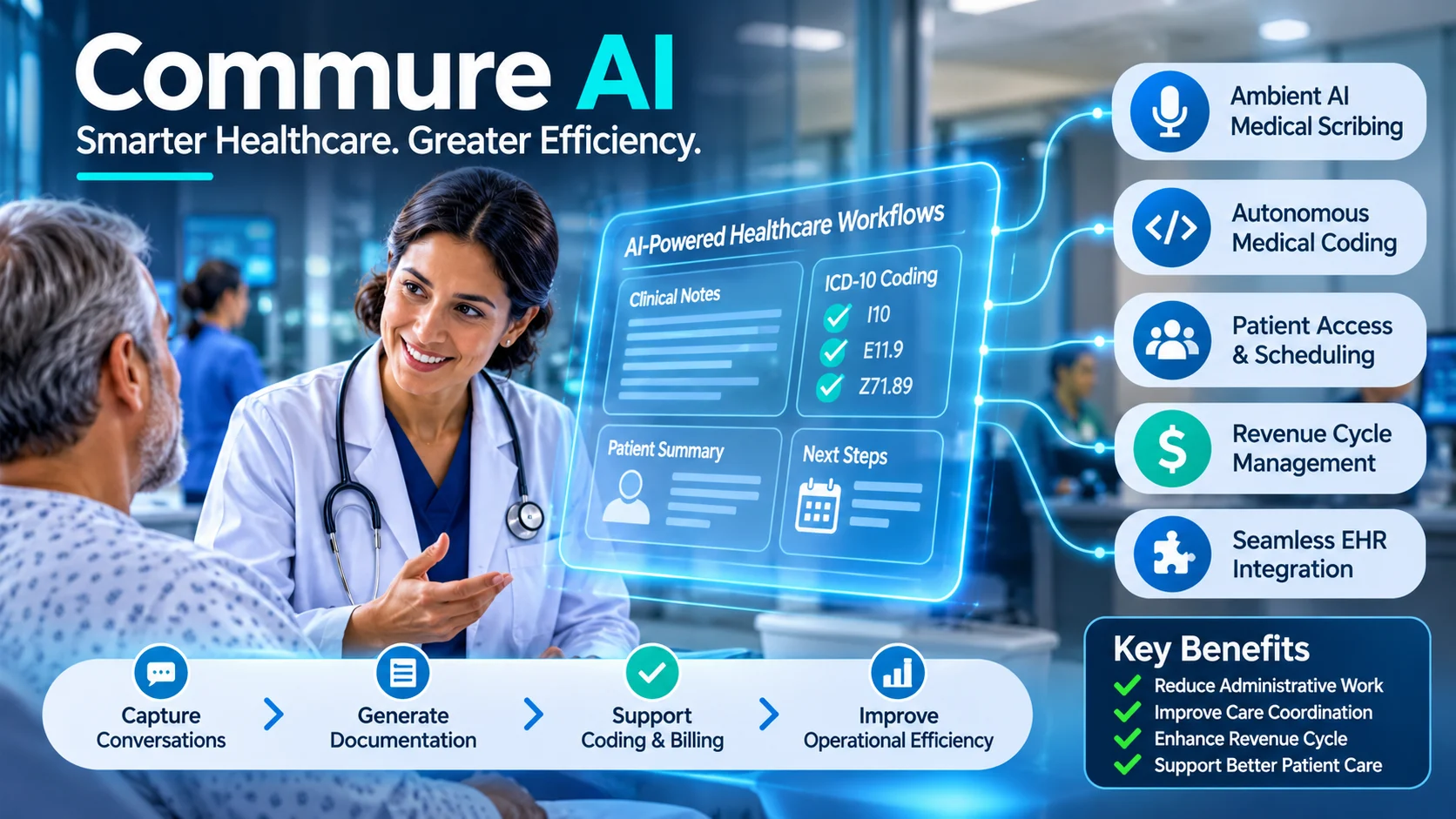
Quick Answer: Commure AI is a healthcare technology platform that uses artificial intelligence to automate clinical documentation, medical coding, patient access, and revenue cycle workflows. It helps hospitals and healthcare organizations reduce administrative work, improve operational efficiency, and connect clinical activities with financial processes.
What Is Commure AI?
Commure AI is an artificial intelligence platform designed specifically for the healthcare industry. It helps medical organizations automate repetitive administrative and clinical tasks.
Unlike general-purpose AI assistants, Commure focuses on healthcare workflows. These include patient scheduling, clinical documentation, medical coding, billing, and claims management.
The platform aims to connect different stages of healthcare operations. For example, information collected during a patient appointment can support clinical documentation and downstream billing activities.
Commure’s approach is particularly relevant to hospitals dealing with large patient volumes, complex electronic health records, and administrative workloads.
Understanding Commure’s Background
Commure developed its healthcare technology business around improving hospital operations and connecting fragmented healthcare systems.
An important development occurred in October 2024, when Commure completed its acquisition of Augmedix. Augmedix had established expertise in AI-assisted medical documentation.
This acquisition strengthened Commure’s position in ambient clinical documentation and helped bring medical scribing capabilities into its broader healthcare platform. Augmedix+1
Today, Commure presents itself as an integrated platform covering patient access, clinical intelligence, and revenue cycle management.
How Does Commure AI Work?
Commure AI connects information from clinical conversations and healthcare systems. It then uses AI-powered tools to turn that information into structured documentation and operational tasks.
A typical workflow involves several stages.
1. Capturing Patient Conversations
The ambient documentation system captures conversations between healthcare professionals and patients.
It uses speech recognition and natural language processing to identify relevant information. This can include symptoms, medical history, examination findings, and treatment discussions.
The objective is to reduce manual note-taking during consultations.
2. Generating Clinical Documentation
After capturing the conversation, the system organizes relevant information into structured clinical notes.
These notes can follow specialty-specific formats and clinician preferences.
The physician can review and edit the generated documentation before approving it. AI-generated notes should not be treated as automatically verified medical records.
3. Supporting Medical Coding
Commure also offers AI-assisted and autonomous coding capabilities.
The system can generate or suggest:
- ICD-10 diagnosis codes.
- CPT procedure codes.
- Billing modifiers.
- Charge information.
- Clinical documentation and coding indicators.
These capabilities help connect clinical documentation with billing requirements.
4. Connecting With Electronic Health Records
Electronic Health Records (EHRs) store patient information, medical histories, diagnoses, and treatment records.
Commure integrates its software with healthcare systems to reduce repetitive data entry.
The company advertises integration with more than 60 EHRs. However, buyers should verify which integrations support their required workflows and whether they offer direct write-back. commure.com+1
5. Supporting Revenue Cycle Management
The final stage connects clinical information with financial operations.
Commure’s broader platform includes tools for claims processing, denial management, payment workflows, and revenue integrity.
This creates a connection between what happens during a patient appointment and the administrative processes that follow.
Key Features of Commure AI
Commure is not limited to medical transcription. Its product ecosystem covers several healthcare functions.
1. Ambient AI Medical Scribing
Ambient AI is one of Commure’s central capabilities.
It listens to clinical conversations and generates documentation without requiring physicians to manually type every detail.
The company offers different support levels:
| Product | Main purpose |
|---|---|
| Ambient AI | Self-service AI-generated clinical notes |
| Ambient Assist | AI documentation with human specialist support |
| Ambient Live | Dedicated documentation assistance for complex encounters |
| Ambient+ | Ambient documentation combined with autonomous coding and dictation |
These options address different documentation needs and levels of clinical complexity. commure.com
2. AI Clinical Assistant
Commure’s clinical assistant capabilities help physicians work with patient information.
Depending on the configured product and workflow, these tools can:
- Summarize previous patient encounters.
- Review longitudinal patient histories.
- Surface relevant clinical information.
- Help generate care plans.
- Prepare after-visit summaries.
The value depends on how accurately the system retrieves and organizes information from the patient’s records.
3. Autonomous Medical Coding
Medical coding translates clinical information into standardized codes used for billing and reporting.
Commure uses AI to support coding tasks, including ICD-10 and CPT code generation.
This can reduce manual work for coding teams. However, healthcare organizations should evaluate coding accuracy against specialty-specific records and established coding standards.
Commure also reports that its autonomous coding solution has achieved an Epic Toolbox designation. This is a product-specific integration and recognition milestone, not a guarantee of coding accuracy. Commure AI Platform and Healthcare Innovation+1
4. AI-Powered Patient Access
Patient access tools focus on activities that happen before a medical appointment.
These include:
- Appointment scheduling.
- Patient intake.
- Referral management.
- Check-in processes.
- Prior authorization workflows.
- Call routing and patient communication.
Automating these processes can reduce administrative bottlenecks and help patients navigate healthcare services.
5. Revenue Cycle Management
Revenue Cycle Management (RCM) covers the financial processes involved in delivering and receiving payment for healthcare services.
Commure’s RCM capabilities support:
- Claims processing.
- Denial management.
- Payment workflows.
- Reconciliation.
- Appeals automation.
- Patient responsibility management.
Connecting clinical documentation with billing information can help organizations identify missing information earlier.
6. Specialty-Specific Documentation
Different medical specialties require different documentation structures.
A cardiologist, emergency physician, and orthopedic surgeon do not necessarily need the same clinical note format.
Commure says its Ambient AI supports more than 25 specialties and adapts documentation to different care environments. Its advertised capabilities include inpatient, ambulatory, procedural, and high-acuity workflows. commure.com
Main Use Cases of Commure AI
Commure’s capabilities are most relevant to organizations managing complex healthcare operations.
| Healthcare environment | Potential application |
|---|---|
| Hospitals | Clinical documentation and administrative automation |
| Outpatient clinics | Ambient medical scribing |
| Emergency departments | Documentation support for complex encounters |
| Specialty practices | Specialty-specific notes and coding |
| Billing departments | Claims and denial management |
| Patient access teams | Scheduling, referrals, and intake |
| Healthcare administrators | Operational workflow automation |
Example: A Physician’s Daily Workflow
Consider a physician who sees 25 patients during a busy working day.
Without ambient documentation software, the physician may need to enter consultation details manually into the EHR.
With Commure Ambient AI, the workflow can look different:
- The physician begins a consultation.
- The system captures the conversation.
- AI prepares a structured clinical note.
- The physician reviews and corrects the draft.
- Approved information enters the appropriate EHR workflow.
- Coding and billing processes can use the resulting documentation.
This example illustrates the intended workflow, not a guarantee that every step happens automatically in every Commure deployment.
Benefits of Using Commure AI
Reduced Administrative Work
Medical professionals spend considerable time documenting consultations and updating patient records.
Ambient documentation can reduce repetitive typing and help clinicians focus more attention on patients.
Commure reports that its platform can save clinicians up to two hours per day, depending on specialty. This is a company-reported figure, not an independently guaranteed outcome. commure.com
Better Workflow Coordination
Commure connects clinical documentation with patient access and financial operations.
This can reduce information gaps between different healthcare departments.
For example, documentation generated during an appointment can support subsequent coding and billing workflows.
Support for Different Medical Specialties
Specialty-specific documentation can make AI-generated notes more relevant to individual clinical workflows.
This matters because medical terminology, examination structures, and reporting requirements vary between specialties.
Improved Revenue Cycle Visibility
Automated coding and claims workflows can help healthcare organizations identify incomplete information and administrative problems.
Commure reports an average 25% reduction in denials on its Ambient AI product page. Organizations should request the underlying methodology, customer population, and baseline before treating this as an expected result. commure.com
Enterprise-Level Integration
Commure’s focus on EHR connectivity makes it relevant to larger healthcare organizations.
However, integration quality matters more than the number of supported systems. Buyers should test actual workflows instead of relying only on integration counts.
Commure AI Pricing: Is It Free?
Commure does not clearly publish a universal self-service subscription price for its enterprise healthcare platform.
Its pricing appears to follow an enterprise sales model, where costs depend on organizational requirements and selected services.
Factors that may influence a commercial proposal include:
- Number of physicians and healthcare professionals.
- Number of patient encounters.
- Selected Ambient AI support level.
- Required EHR integrations.
- Coding and billing automation requirements.
- Implementation and training needs.
- Contract duration and support arrangements.
Pricing transparency
Custom pricing
Commure’s official Ambient AI page directs prospective customers to contact its sales team. No verified standard public monthly subscription rate is provided there. commure.com+1
Official website: Commure
What Should Buyers Ask Before Signing?
A healthcare organization should request a detailed quotation covering:
- Implementation and onboarding fees.
- Per-provider or per-encounter charges.
- Human documentation support costs.
- Integration and customization fees.
- Contract minimums and renewal terms.
- Data export and termination arrangements.
- Additional charges for coding and RCM modules.
These questions help reveal the total cost of ownership rather than focusing only on the initial subscription quote.
Privacy, Security, and HIPAA Considerations
Healthcare organizations handle highly sensitive information. This makes privacy and security essential when evaluating any AI documentation platform.
Commure publishes privacy documentation and a Business Associate Agreement (BAA) for applicable service agreements.
Its published privacy materials describe safeguards such as:
- Authentication and access controls.
- Encryption.
- Administrative and technical security measures.
- Physical security safeguards.
- Procedures for handling personal information.
The company also describes its Ambient AI platform as SOC 2 Type II compliant. commure.com+1
Does Commure AI Support HIPAA Compliance?
Commure provides a BAA framework addressing the handling of Protected Health Information (PHI) under HIPAA.
A BAA establishes responsibilities between a healthcare organization and a business associate. However, signing a BAA does not automatically make every organizational workflow HIPAA compliant.
Healthcare organizations must still configure their systems and internal processes appropriately.
Is Commure AI a Zero Data Retention Platform?
This is an important distinction.
SOC 2 Type II compliance and Zero Data Retention (ZDR) are different concepts.
- SOC 2 Type II: Evaluates controls over a defined audit period.
- Zero Data Retention: Refers to specific arrangements that prevent a provider from retaining certain customer data after processing.
Commure’s published privacy policy describes retention practices that can extend up to six years after account closure, depending on the data and applicable obligations. It also discusses anonymized data retention. This policy should not be interpreted as proof of ZDR or as the retention schedule for every enterprise deployment. Command Your Tech, Empower Your People
Before implementation, ask Commure for written answers about:
- Audio recording retention.
- Transcript and clinical note retention.
- Use of PHI for model training.
- Third-party AI subprocessors.
- Data deletion procedures.
- Backup retention.
- Regional data storage.
- Contract-specific ZDR options, if available.
These details should be verified in the applicable contract, BAA, and technical documentation.
Limitations of Commure AI
Although Commure offers a broad healthcare technology ecosystem, it is not automatically suitable for every medical organization.
1. Enterprise Implementation Complexity
Large healthcare deployments require planning, technical configuration, and staff training.
Organizations may need to coordinate IT departments, clinical teams, compliance officers, and EHR administrators.
This can make implementation more complicated than adopting a standalone transcription application.
2. Dependence on EHR Integration
The usefulness of Commure depends partly on how well it works with existing healthcare software.
A listed integration does not necessarily mean every feature works natively in every EHR.
Organizations should test documentation write-back, coding workflows, patient matching, and error handling.
3. AI Documentation Requires Human Review
AI can misunderstand medical terminology, omit relevant details, or incorrectly interpret conversations.
Background noise, multiple speakers, accents, and complex clinical discussions can create additional challenges.
Physicians must review generated notes before approving them.
4. Pricing Is Not Fully Transparent
Organizations cannot easily calculate their expected costs from a public subscription page.
They need a customized quotation and should compare the complete implementation cost against expected operational savings.
5. Product Complexity
Commure covers multiple healthcare workflows, including documentation, patient access, and financial operations.
That breadth may be useful for large health systems. However, a smaller practice seeking only an AI medical scribe may not need the entire platform.
Commure AI Alternatives and Competitors
Commure operates in the growing ambient clinical intelligence and healthcare automation market.
Its competitors differ in their product focus, integration capabilities, and intended customers.
| Platform | Target user | Main strength | Pricing transparency |
|---|---|---|---|
| Abridge | Hospitals and health systems | Clinical documentation and connected workflows | Custom pricing |
| Suki | Physicians and medical organizations | Voice-enabled clinical assistance | Contact sales |
| Nabla | Clinicians and healthcare organizations | Ambient clinical documentation | Varies by plan and market |
| Microsoft Dragon Copilot | Hospitals and clinical teams | Clinical voice technology and Microsoft ecosystem | Enterprise-oriented |
| Ambience Healthcare | Hospitals and specialty practices | Clinical documentation and revenue intelligence | Custom pricing |
Pricing descriptions are indicative purchasing models, not verified quotations. Availability and commercial terms can vary.
1. Abridge
Website: abridge.com
Abridge focuses on transforming clinical conversations into structured medical documentation.
Its platform also emphasizes clinical context and workflows before, during, and after patient encounters.
It is worth comparing with Commure when a health system prioritizes ambient documentation and deep clinical workflow integration. Ambient AI for Clinicians
2. Suki AI
Website: suki.ai
Suki focuses on AI-powered clinical documentation and voice assistance.
It is relevant to physicians looking for tools that reduce documentation and administrative effort.
3. Nabla
Website: nabla.com
Nabla develops AI tools for clinical documentation and healthcare workflows.
It is worth considering when the main requirement is an ambient documentation assistant rather than a broad revenue cycle management platform.
4. Microsoft Dragon Copilot
Website: Microsoft Dragon Copilot
Dragon Copilot combines ambient conversation capture, clinical documentation, and additional AI-supported workflows.
Microsoft also provides developer documentation for integrating extensions into Dragon Copilot environments. Microsoft Learn
5. Ambience Healthcare
Website: ambiencehealthcare.com
Ambience Healthcare focuses on clinical documentation and AI-powered healthcare workflows.
It is another relevant option for organizations evaluating enterprise-level clinical AI solutions.
Which Alternative Should You Consider?
The right choice depends on the organization’s actual requirements.
- Broad healthcare automation: Evaluate Commure.
- Ambient clinical documentation: Compare Commure, Abridge, and Nabla.
- Voice-enabled clinical assistance: Consider Suki.
- Microsoft ecosystem integration: Evaluate Dragon Copilot.
- Enterprise clinical workflows: Compare Commure and Ambience Healthcare.
No single platform is automatically superior across every specialty, EHR environment, and organizational requirement.
Latest Commure AI Developments in 2026
Commure’s recent announcements show a move beyond medical transcription toward broader healthcare automation.
Three developments deserve attention.
Epic Toolbox Designation for Autonomous Coding
Commure announced that its autonomous coding product achieved an Epic Toolbox designation. The company also reports designations across Ambient AI and autonomous coding.
This is relevant because documentation and coding can become more closely connected within Epic workflows. Commure AI Platform and Healthcare Innovation
Expansion Into the UK and European Markets
On September 3, 2026, Commure announced that its Ambient AI product had received CE marking as Class I medical device software under the EU Medical Device Regulation and registration with the UK’s MHRA.
The announcement describes commercial availability across the UK and Europe. This is a company announcement, and prospective customers should verify the applicable regulatory status and product availability for their intended deployment. Commure
AI-Powered Referral Automation
Commure also announced a collaboration with Compassus involving its Orchestrator product.
According to the company, the implementation reduced referral decision time by 64% across 79 home-based care programs. This is a reported customer outcome rather than a universal performance guarantee. Commure AI Platform and Healthcare Innovation
These developments suggest that Commure is expanding its focus from individual clinical tasks toward connected healthcare operations.
Who Should Use Commure AI?
Commure is particularly relevant to organizations that need more than a basic AI transcription tool.
Potentially suitable users include:
- Large hospitals managing substantial patient volumes.
- Healthcare systems with complex EHR environments.
- Medical groups seeking automated clinical documentation.
- Healthcare administrators managing operational inefficiencies.
- Revenue cycle teams looking to automate coding and claims workflows.
- Organizations interested in connecting patient access with clinical and financial processes.
It may be less suitable for:
- Individuals seeking a free AI chatbot.
- Students looking for a general-purpose AI assistant.
- Small practices needing only occasional voice transcription.
- Organizations unwilling to invest in enterprise integration.
- Buyers who require fully transparent public subscription pricing.
Frequently Asked Questions About Commure AI
1. What is Commure AI used for?
Commure AI is used to automate healthcare operations, including medical documentation, patient intake, clinical coding, and revenue cycle management. Its tools help hospitals and healthcare professionals reduce repetitive administrative work and connect clinical information with financial workflows.
2. Is Commure AI an AI medical scribe?
Yes. Commure offers Ambient AI, which captures patient conversations and generates structured clinical documentation. It also provides different levels of documentation assistance, including self-service AI and human-supported options.
3. How much does Commure AI cost?
Commure does not publish a universal subscription price for its enterprise platform. Pricing depends on the selected products, healthcare organization size, integration requirements, and implementation needs. Prospective customers should request a customized quotation.
4. Is Commure AI HIPAA compliant?
Commure publishes a Business Associate Agreement and privacy documentation addressing HIPAA-related responsibilities. However, healthcare organizations must verify the applicable contractual protections, security controls, data retention policies, and deployment configuration before using the platform with protected health information.
5. What are the best alternatives to Commure AI?
Relevant alternatives include Abridge, Suki, Nabla, Microsoft Dragon Copilot, and Ambience Healthcare. Each offers different clinical documentation and workflow capabilities, so organizations should compare EHR compatibility, pricing, specialty support, and privacy requirements.
Conclusion: Is Commure AI Worth Considering?
Commure AI represents a broader approach to healthcare automation. Rather than focusing exclusively on medical transcription, it connects patient access, clinical documentation, medical coding, and revenue cycle management.
Its strongest appeal is to hospitals and healthcare organizations seeking connected operational workflows.However, enterprise pricing, implementation complexity, EHR compatibility, and data governance deserve careful evaluation.