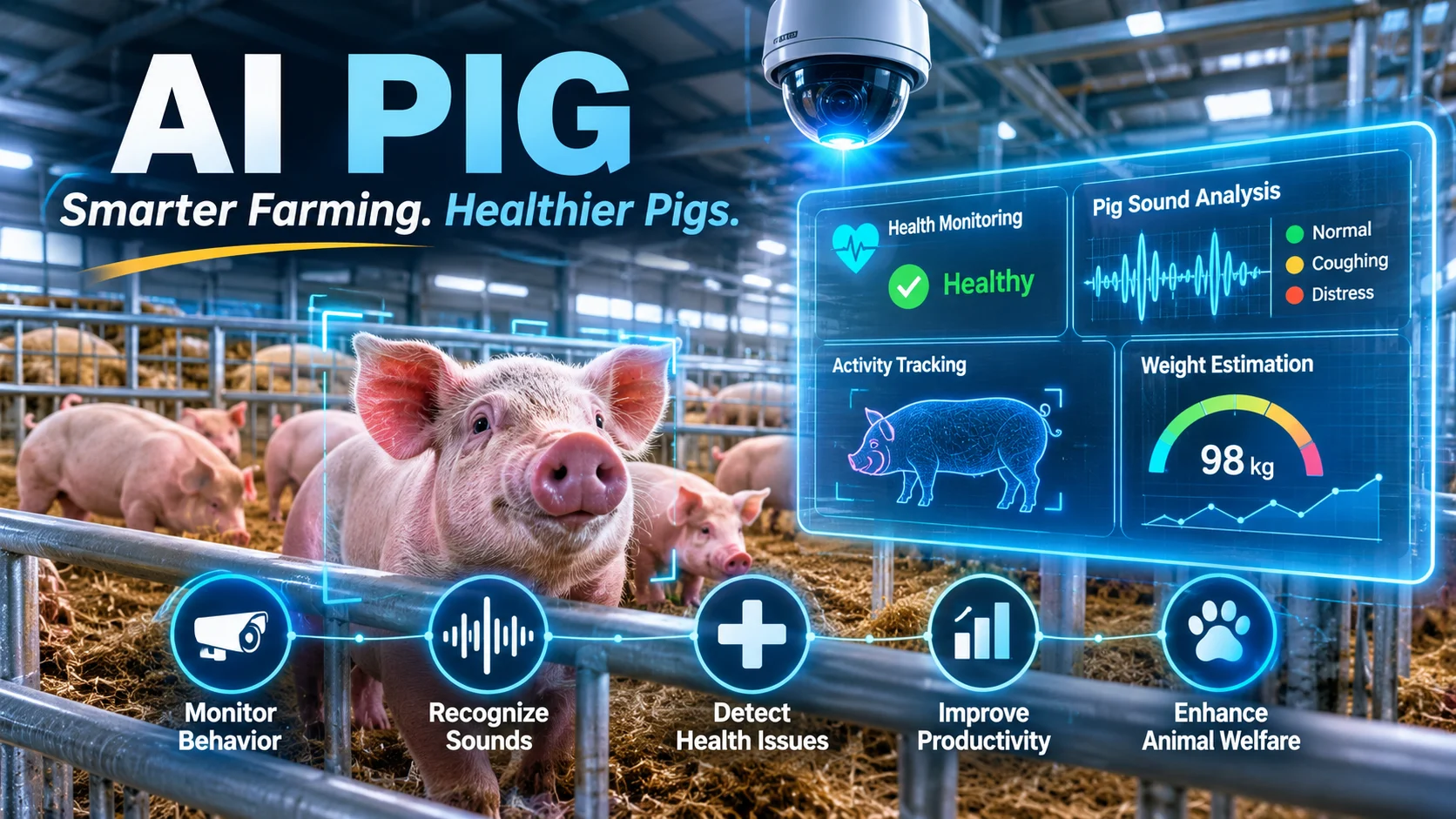
Quick Answer: AI Pig refers to the use of artificial intelligence to monitor pigs, recognize their behavior, analyze vocalizations, and support smarter livestock management. By combining cameras, microphones, machine learning, and automated analysis, AI-powered farming systems can help farmers identify potential health and welfare problems earlier.
AI Pig is a broad term describing the application of artificial intelligence to pig-related activities, particularly livestock monitoring, animal behavior analysis, and agricultural management.
Rather than referring to one universally recognized software platform, the term covers several technologies that help farmers understand and manage pigs more effectively.
Traditional pig farming relies heavily on physical inspections. Farmers observe animals, check feeding patterns, monitor movement, and look for visible signs of illness.
AI introduces another layer of observation. Computer vision, audio recognition, and machine learning systems can continuously analyze information collected from cameras and microphones.
For example, an AI-powered monitoring system might identify an unusual vocalization, detect changes in movement, or recognize abnormal behavior in a group of pigs.
These technologies do not replace veterinary professionals. Instead, they provide additional information that can help farmers make informed decisions.
How Does AI Pig Technology Work?
AI pig technology combines different artificial intelligence techniques to collect and interpret information about livestock.
Most systems follow a process involving data collection, analysis, pattern recognition, and alerts.
Data Collection Through Cameras and Microphones
The first step involves collecting information from the farm environment.
Common equipment includes:
- CCTV cameras for observing movement and behavior.
- Microphones for recording grunts, squeals, and coughing.
- Environmental sensors for measuring temperature and humidity.
- Smart weighing equipment for tracking animal growth.
- Connected devices for collecting farm-management information.
These devices provide the raw information that AI models analyze.
Machine Learning and Pattern Recognition
Machine learning allows computers to recognize patterns within collected information.
For example, a model can learn to distinguish between ordinary pig movement and unusual activity.
Similarly, audio recognition systems can analyze sound patterns associated with coughing, screaming, or other vocal behaviors.
The system compares incoming information with patterns learned during training.
When it detects something unusual, it can generate an alert for farm workers.
Computer Vision for Pig Monitoring
Visual analysis of livestock behavior using artificial intelligence.
Computer vision enables AI systems to interpret images and videos.
In pig farming, computer vision can support several activities:
- Detecting individual animals.
- Monitoring movement and posture.
- Estimating body weight.
- Observing feeding behavior.
- Identifying unusual physical activity.
- Monitoring sow and piglet interactions.
These applications can reduce the need for constant manual observation.
However, camera placement, lighting, animal density, and image quality can affect detection accuracy.
Automated Reports and Alerts
After analyzing the collected information, an AI system can generate reports or notifications.
For instance, a farmer might receive an alert when a pig shows unusual activity or when coughing patterns increase within a particular group.
Some advanced research systems also use large language models (LLMs) to turn technical monitoring results into readable reports.
The final decision should remain with trained farm workers or veterinary professionals.
Key Applications of AI Pig Technology
AI is becoming an important research and development area within precision livestock farming.
Its applications extend beyond basic monitoring.
AI Pig Sound Recognition
One particularly interesting application involves understanding pig vocalizations.
Pigs communicate through different sounds, including grunts, squeals, and screams. These sounds can contain information about their behavior and surrounding conditions.
AI models analyze audio recordings to identify patterns associated with different situations.
Research published in Scientific Reports in 2022 demonstrated the potential of automatically recognizing pig vocalizations for animal-welfare monitoring.
More recent research continues to improve this technology.
A May 2026 study published in Applied Animal Behaviour Science investigated a lightweight deep-learning model for recognizing normal vocalizations, coughing, oestrus-related sounds, and screams. ScienceDirect
Potential benefits include:
- Detecting unusual vocal activity.
- Identifying possible signs of distress.
- Monitoring coughing patterns.
- Supporting animal-welfare assessments.
- Helping farmers investigate problems earlier.
An important distinction is that recognizing a sound does not automatically reveal exactly how an animal feels. Vocalizations must be interpreted alongside other observations.
AI-Based Pig Health Monitoring
Animal health monitoring is another important application.
Farmers traditionally identify health problems through physical inspections and changes in animal behavior.
AI can provide additional monitoring by examining:
- Movement patterns.
- Feeding activity.
- Coughing frequency.
- Posture changes.
- Unusual vocalizations.
- Interactions with other animals.
For example, a sudden reduction in movement may indicate a problem that deserves further investigation.
However, AI cannot independently diagnose every disease. Veterinary examination and appropriate testing remain essential.
Pig Weight Estimation Using AI
Monitoring animal growth is important for farm productivity.
Traditional weighing requires workers to move pigs onto weighing equipment. This process takes time and may create additional handling stress.
AI-based computer vision can estimate body weight using images, depth cameras, and trained prediction models.
Potential applications include:
- Tracking growth over time.
- Identifying differences in development.
- Supporting feeding decisions.
- Improving livestock records.
- Planning farm management activities.
The reliability of these estimates depends on camera calibration, animal positioning, breed, and model training.
Piglet Monitoring and Protection
Piglet monitoring is particularly important during early development.
AI-powered camera systems can help observe sow posture, piglet movement, and interactions within farrowing areas.
Research published in Computers and Electronics in Agriculture in March 2026 introduced PigTalk 2.0, an AIoT-based monitoring system.
The researchers reported 97% accuracy in sow posture detection and 96% accuracy in piglet birth recognition within their experimental evaluation. ScienceDirect
These findings demonstrate the potential of combining artificial intelligence with connected monitoring devices.
They should not be interpreted as guaranteed results for every commercial farm.
Smart Feeding and Farm Management
AI can also support feeding and general farm management.
Data from feeding equipment, cameras, and environmental sensors can help identify patterns in animal activity.
Possible applications include:
- Monitoring feeding frequency.
- Identifying changes in consumption.
- Supporting feed-management decisions.
- Tracking environmental conditions.
- Improving farm recordkeeping.
These systems can help farmers understand what is happening across different areas of their facilities.
Real-World AI Pig Research and Technologies
AI pig technology is not just a theoretical concept. Researchers have already developed systems that analyze real livestock recordings and farm environments.
The following examples illustrate the direction of current research.
| Research or technology | Main purpose | Reported findings |
|---|---|---|
| SOUNDWEL research | Recognizing pig vocalizations | Demonstrated automated sound recognition |
| PigTalk 2.0 | Monitoring sow posture and piglet births | 97% and 96% accuracy in respective tasks |
| Acoustic behavior recognition (2026) | Classifying pig sounds | 97.7% accuracy in the study |
| Audio-video monitoring (2025) | Identifying screaming pigs | 0.747 mean average precision |
These results come from different experiments, datasets, and evaluation methods. They should not be compared as though they measure the same task.
Can AI Really Understand Pig Language?
The idea of translating animal sounds into human language attracts considerable attention.
Researchers have explored whether machine learning can identify emotional and behavioral information within pig vocalizations.
AI can recognize certain acoustic patterns and associate them with recorded situations. However, this is different from understanding language in the human sense.
For example, a model might identify a scream associated with a stressful event. It cannot necessarily determine the animal’s exact thoughts or intentions.
The most realistic application is therefore an animal-welfare monitoring assistant, not a fully developed pig translator.
Benefits of Using AI in Pig Farming
Artificial intelligence offers several potential advantages when implemented correctly.
Improved Animal Welfare
Continuous monitoring can help farmers identify unusual behavior that might otherwise go unnoticed.
Early alerts may encourage faster investigation of potential welfare problems.
Reduced Manual Monitoring
Farm workers cannot observe every animal continuously.
Automated cameras and microphones can monitor multiple areas and highlight events requiring attention.
Better Farm Productivity
Growth monitoring, feeding analysis, and automated recordkeeping can support more informed management decisions.
Early Warning Systems
AI models can identify patterns associated with possible health or environmental problems.
This can help farmers investigate issues before they become more serious.
Data-Driven Decisions
Instead of relying exclusively on occasional observations, farmers can examine historical monitoring information.
This provides a clearer picture of changes in animal activity and farm conditions.
Limitations and Challenges of AI Pig Technology
Despite its potential, AI pig technology has practical limitations.
Farmers should understand these challenges before investing in automated monitoring systems.
Data Quality and Accuracy
AI models require suitable training data.
Poor-quality recordings, insufficient examples, and differences between farms can reduce performance.
A model trained in one environment might not work equally well in another.
Background Noise
Pig farms are noisy environments.
Other animals, ventilation systems, machinery, and human activity can interfere with microphone recordings.
Audio models must distinguish relevant sounds from background noise.
Installation Costs
A complete monitoring system may require:
- Cameras and microphones.
- Sensors and connected equipment.
- Computing hardware.
- Network infrastructure.
- Software subscriptions or maintenance.
The total investment depends on farm size and system complexity.
Internet and Infrastructure Requirements
Some monitoring systems process information through cloud services.
Others use local computing equipment, known as edge devices.
Cloud-based systems may depend on reliable internet connections, while edge systems require suitable local hardware.
Human Verification
AI predictions are not always correct.
A monitoring system might generate a false alert or miss an unusual event.
Farm workers must verify important findings rather than treating automated predictions as confirmed diagnoses.
AI Pig vs. Traditional Pig Farming
The main difference is how information is collected and used.
| Factor | Traditional farming | AI-assisted farming |
|---|---|---|
| Animal observation | Manual inspections | Cameras and automated analysis |
| Sound monitoring | Human observation | AI audio recognition |
| Weight tracking | Physical weighing | Camera-based estimation or automated scales |
| Health assessment | Physical examination | Additional automated warning signals |
| Recordkeeping | Manual or digital records | Automated data collection |
| Decision-making | Experience and observation | Experience combined with data |
AI does not make traditional farming knowledge unnecessary.
Instead, it provides additional tools that can improve monitoring and decision-making.
Popular AI Tools and Platforms Relevant to AI Pig Technology
There is no single universally established software product called AI Pig that covers all these applications.
Farmers and developers generally need specialized livestock-monitoring solutions rather than a generic AI chatbot.
Here are relevant platforms and research resources.
An academic smart-farming system researched for sow posture and piglet birth recognition. Its reported results come from a specific research evaluation, not a general commercial performance guarantee. ScienceDirect
Model and dataset discovery platform
Developers can explore machine-learning models and datasets that may help with animal sound classification, image recognition, and related research.
Website: Hugging Face Hub.
A directory for discovering AI applications across different industries. It can help users explore general-purpose image, audio, and automation tools.
Website: Futurepedia.
Product Hunt
New software discovery
A platform for discovering newly launched technology products. Users can investigate emerging agricultural AI applications and related software.
Website: Product Hunt.
Important: These platforms serve different purposes. They are not interchangeable, and none should be described as a complete AI pig farming solution.
Privacy and Security Considerations
AI livestock monitoring systems collect information about farm operations.
Depending on the implementation, this information may include video recordings, audio recordings, production data, and environmental measurements.
Before adopting a platform, farmers should investigate:
- Where recordings and farm data are stored.
- Whether information is processed locally or in the cloud.
- Who can access recorded information.
- How long data is retained.
- Whether third-party providers process the information.
- Whether the vendor provides appropriate security documentation.
For commercial farms, these questions matter because operational information can be sensitive.
A security certification alone does not establish that a service offers zero data retention. These are separate considerations that require independent verification.
Who Should Use AI Pig Technology?
AI pig technology can benefit different groups working in livestock production and agricultural research.
Pig farmers: Can use monitoring systems to observe animal behavior, track growth, and investigate unusual activity.
Veterinarians: May use AI-generated observations as additional information during animal health assessments.
Agricultural researchers: Can study pig vocalizations, behavior, welfare, and machine-learning applications.
Livestock technology developers: Can build computer vision, sound recognition, and automated reporting systems.
Farm management businesses: Can explore data-driven monitoring to improve operational visibility.
Small farms may prefer simple monitoring equipment, while larger operations may benefit from integrated camera, sensor, and analytics systems.
Future of AI Pig Technology
The future of AI pig technology will likely involve more integrated monitoring systems.
Researchers are exploring ways to combine audio, video, environmental information, and machine learning.
Several developments deserve attention.
Multimodal AI Monitoring
Multimodal systems combine different information sources.
For example, a system could analyze pig vocalizations alongside camera footage to identify unusual events more accurately.
A December 2025 study in Computers and Electronics in Agriculture investigated this approach using audio-video information and machine-generated behavioral reports. ScienceDirect
More Efficient AI Models
Smaller machine-learning models could make automated monitoring more practical.
These models may run directly on farm equipment without sending every recording to cloud servers.
This could reduce network dependency and support faster local processing.
Better Animal Welfare Analysis
Future research may improve the identification of stress-related behavior and other welfare indicators.
However, researchers must continue testing these systems across different breeds, housing conditions, and commercial environments.
Integration With Smart Agriculture
AI pig monitoring may eventually become part of larger agricultural management systems.
These platforms could connect livestock monitoring with feeding equipment, environmental sensors, farm databases, and automated reporting.
The goal is to provide farmers with a more complete understanding of their operations.
Frequently Asked Questions About AI Pig
1. What is AI Pig?
AI Pig refers to artificial intelligence technologies used in pig farming and livestock monitoring. These technologies analyze animal sounds, movement, behavior, and physical conditions to support farm management and animal welfare.
2. Can AI translate pig sounds into human language?
AI can recognize patterns in pig vocalizations and associate them with certain behavioral situations. However, it cannot reliably translate every grunt or squeal into exact human sentences or thoughts.
3. How does AI help farmers monitor pig health?
AI systems analyze information from cameras, microphones, and sensors. They can identify unusual movement, coughing patterns, and behavioral changes that may require further investigation.
4. Is AI pig technology expensive?
Costs depend on the equipment, farm size, software, and installation requirements. Basic monitoring equipment may cost less than an integrated system involving multiple cameras, sensors, and automated analytics.
5. Can AI replace farmers and veterinarians?
No. AI supports livestock monitoring and decision-making, but it cannot replace experienced farmers or veterinary professionals. Human assessment remains essential for diagnosing diseases and managing animal welfare.
Conclusion
AI Pig represents an emerging application of artificial intelligence in livestock management. It combines computer vision, sound recognition, machine learning, and smart sensors to help farmers monitor animal behavior and health.
Its most promising applications include pig vocalization recognition, piglet monitoring, weight estimation, and automated farm management.
However, accuracy, installation costs, data quality, and human verification remain important considerations.
Farmers should evaluate real-world performance and practical requirements before adopting any AI monitoring solution. The technology is most useful when it supports experienced farm workers rather than replacing their judgment.