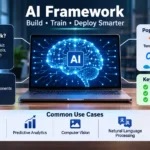
Quick Answer: An AI framework is a collection of software libraries, tools, and components that developers use to build, train, test, and deploy artificial intelligence applications. It simplifies complex development tasks by providing reusable components for machine learning, deep learning, generative AI, and intelligent AI agents.
Artificial intelligence is transforming how businesses, developers, and researchers solve complex problems. Behind many AI-powered applications are specialized software tools that make development, training, and deployment easier.
An AI framework provides reusable libraries, algorithms, and components that help developers build intelligent systems without starting from scratch.
From machine learning and deep learning to generative AI and autonomous agents, these frameworks support a wide range of applications. Understanding how AI frameworks work, their different types, and popular tools can help you choose the right solution for your project.
At a Glance | Key Takeaways
- AI frameworks provide reusable tools for developing artificial intelligence applications.
- Machine learning frameworks help developers train models and make predictions.
- Deep learning frameworks support neural networks and complex data processing.
- Generative AI frameworks connect large language models with external tools and data.
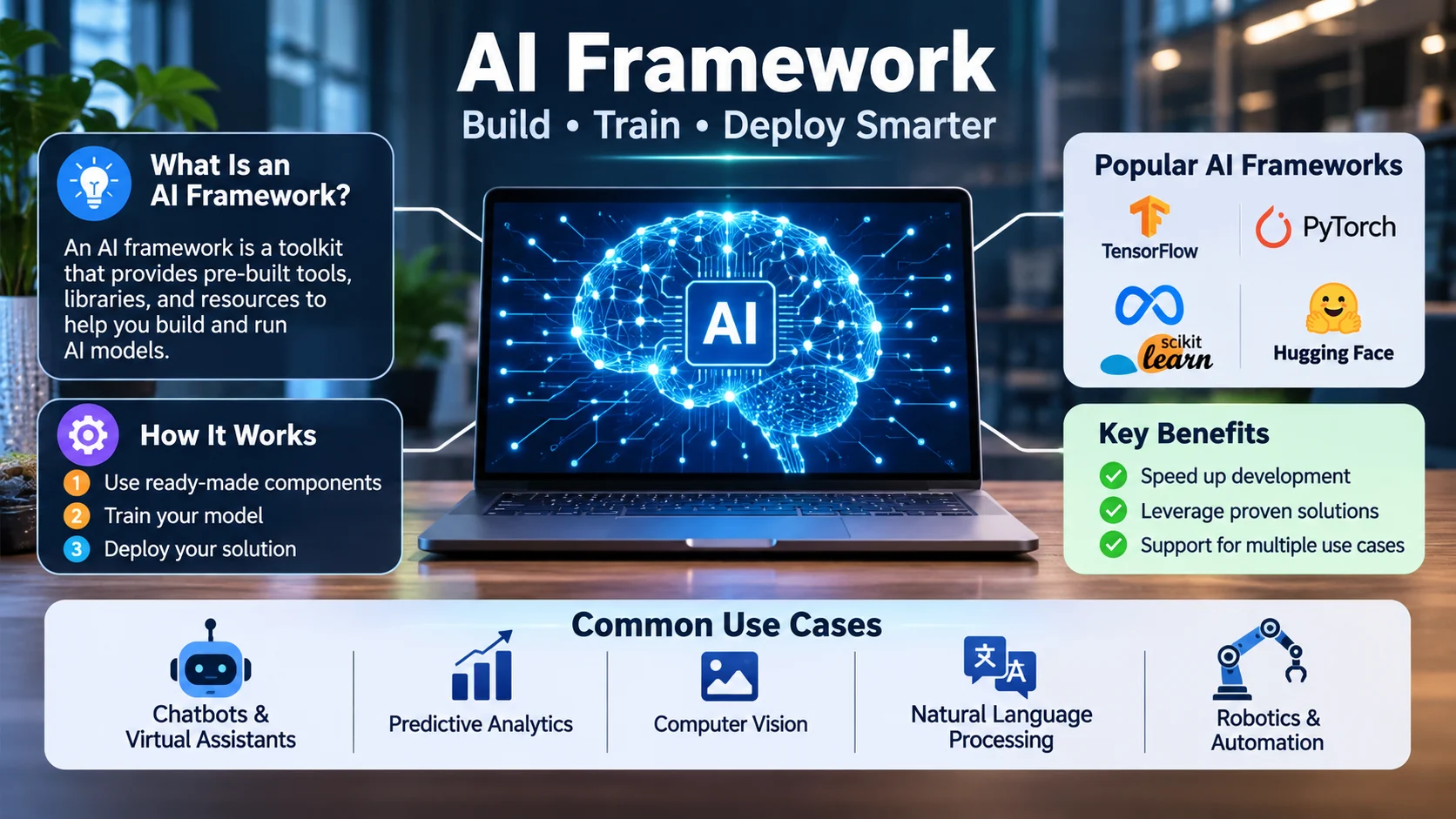
- Popular options include TensorFlow, PyTorch, Scikit-learn, LangChain, and LlamaIndex.
- The right framework depends on programming experience, project requirements, scalability, and deployment needs.
What Is an AI Framework?
An AI framework is a software environment that provides the building blocks needed to develop artificial intelligence systems. It helps developers avoid writing every function and algorithm from scratch.
Instead, developers use existing libraries, APIs, prebuilt components, and development tools. These resources make it easier to create applications that can recognize patterns, understand language, analyze information, and generate content.
For example, a developer building an image recognition application needs a system that can process images and identify objects. An AI framework provides the underlying tools for creating and training the model.
Similarly, a business developing an AI chatbot can use a framework to connect a language model with company documents, databases, and external services.
An important distinction: An AI framework is not the same as an AI model.
- An AI model performs a specific task, such as generating text or recognizing images.
- An AI framework provides the tools developers use to build, train, integrate, or operate AI models.
- An AI application is the finished software that people interact with.
For instance, a language model can generate answers, while an AI framework can help developers connect that model to a website, database, or customer support system.
How Does an AI Framework Work?
An AI framework organizes the different components involved in developing and running an artificial intelligence application.
Although the exact process varies, most AI development workflows involve several stages.
1. Data Collection and Preparation
AI systems need information to learn patterns or generate useful responses.
Developers collect data from sources such as:
- Databases and spreadsheets
- Images and videos
- Text documents
- Websites and APIs
- Sensors and business systems
The collected information may require cleaning, formatting, labeling, or transformation before developers can use it.
2. Model Development
Developers select an appropriate algorithm or pre-trained model based on the project.
For example, a machine learning application might use a classification algorithm. An image recognition system might use a convolutional neural network.
Frameworks provide ready-made functions and components for implementing these models.
3. Model Training
Training allows a machine learning model to identify patterns in available data.
The framework manages important operations, including calculations, optimization, and model parameter updates.
Developers can adjust training settings to improve performance and reduce errors.
4. Testing and Evaluation
A model must be evaluated before developers rely on its predictions.
Testing helps identify problems such as inaccurate predictions, overfitting, inconsistent outputs, and poor performance on unfamiliar data.
Common evaluation methods include accuracy, precision, recall, and F1 score. The appropriate metric depends on the application.
5. Deployment and Monitoring
After testing, developers integrate the model into an application or production environment.
They may expose it through an API, connect it to a website, or deploy it through cloud infrastructure.
Monitoring helps developers identify performance changes, errors, latency, and unexpected outputs after deployment.
Source: General AI development concepts and framework documentation.
Types of AI Frameworks
Not every AI framework serves the same purpose. Some focus on traditional machine learning, while others support neural networks, generative AI, or autonomous agents.
Understanding these categories makes framework selection easier.
1. Machine Learning Frameworks
Machine learning frameworks provide tools for developing algorithms that learn patterns from data.
Developers use them for prediction, classification, recommendation systems, and statistical analysis.
Common applications include:
- Customer behavior prediction
- Fraud detection
- Product recommendations
- Sales forecasting
- Spam detection
Popular example: Scikit-learn provides tools for classification, regression, clustering, preprocessing, and model evaluation.
2. Deep Learning Frameworks
Deep learning frameworks support artificial neural networks with multiple processing layers.
These frameworks are useful for applications involving large datasets and complex patterns.
Common applications include:
- Image and facial recognition
- Speech processing
- Natural language understanding
- Medical image analysis
- Autonomous systems
Popular examples include TensorFlow and PyTorch.
3. Generative AI Frameworks
Generative AI frameworks help developers build applications powered by models that generate text, images, code, audio, and other content.
They provide components for connecting models, managing prompts, processing information, and integrating external services.
Typical applications include:
- AI writing assistants
- Document summarization
- Conversational chatbots
- Code generation tools
- Content creation applications
Examples include LangChain and LlamaIndex.
4. AI Agent Frameworks
AI agent frameworks help developers create systems that can use language models to perform tasks through tools and predefined workflows.
Depending on their design, agents can plan actions, access information, call APIs, and coordinate with other agents.
For example, an AI research agent might search approved sources, extract information, organize findings, and prepare a report.
Popular options include LangGraph, CrewAI, Microsoft Agent Framework, and OpenAI Agents SDK.
These frameworks are particularly useful when an application needs more than a single model response.
Popular AI Frameworks and Development Tools
Several AI frameworks have become important parts of modern artificial intelligence development. Each offers different capabilities, programming interfaces, and levels of flexibility.
The following comparison focuses on their primary purposes rather than declaring one universally superior.
1. TensorFlow
TensorFlow is an open-source machine learning platform developed by Google. It supports model development, training, evaluation, and deployment.
Best suited for: Machine learning applications, deep learning, and production model deployment.
Website: tensorflow.org
2. PyTorch
PyTorch is an open-source machine learning framework widely used for deep learning research and development. It offers flexible tensor operations and automatic differentiation.
Best suited for: Neural networks, experimentation, computer vision, and research.
Website: pytorch.org
3. Scikit-learn
Scikit-learn is a Python library for traditional machine learning. It provides algorithms for classification, regression, clustering, and data preprocessing.
Best suited for: Beginners, data analysts, and traditional machine learning projects.
Website: scikit-learn.org
4. Hugging Face Transformers
Hugging Face Transformers provides tools for working with pretrained models across text, vision, audio, and multimodal tasks.
Best suited for: Developers building applications with pretrained AI models.
Website: huggingface.co
5. LangChain
LangChain provides components for building applications around large language models. Developers can connect models, tools, prompts, and middleware.
Its related framework, LangGraph, supports stateful workflows and more controlled agent execution.
Best suited for: LLM applications, AI assistants, and agent workflows.
Website: langchain.com
6. LlamaIndex
LlamaIndex helps developers connect language models with external information. Its tools support document ingestion, indexing, retrieval, and agent workflows.
Best suited for: Document-based chatbots, knowledge assistants, and retrieval-augmented generation.
Website: llamaindex.ai
7. CrewAI
CrewAI is an agent orchestration framework designed around agents, tasks, and collaborative workflows.
Developers can assign different responsibilities to agents and coordinate their work.
Best suited for: Task-oriented multi-agent applications.
Website: crewai.com
These tools serve different development needs. Their official documentation describes their respective capabilities and integrations.
AI Framework Comparison | Which Tool Should You Choose?
The following table summarizes the differences between several widely used options.
| Framework | Primary purpose | Target users | Main strength |
|---|---|---|---|
| TensorFlow | Machine learning and deep learning | Developers and businesses | Model development and deployment |
| PyTorch | Deep learning | Researchers and developers | Flexible model development |
| Scikit-learn | Traditional machine learning | Data analysts and developers | Accessible ML algorithms |
| Hugging Face Transformers | Pretrained AI models | AI developers | Model ecosystem |
| LangChain | LLM applications | Application developers | Model and tool integration |
| LlamaIndex | Data-connected AI | Developers and businesses | Data retrieval and RAG |
| CrewAI | Agent orchestration | AI developers | Coordinating multiple agents |
How Do You Choose Between Them?
Your project should determine your choice.
- Choose TensorFlow or PyTorch when developing neural networks.
- Choose Scikit-learn for traditional machine learning.
- Choose Hugging Face when working with pretrained models.
- Choose LangChain when connecting language models with tools and application logic.
- Choose LlamaIndex when your application needs access to documents and external knowledge.
- Choose CrewAI when coordinating multiple AI agents is central to the project.
For more advanced agent systems, LangGraph and Microsoft Agent Framework are also worth evaluating. Microsoft describes its Agent Framework as the successor to AutoGen and Semantic Kernel. Microsoft Learn+1
Main Features of an AI Framework
Although capabilities vary, most AI frameworks provide several important development features.
Reusable Components
Frameworks offer prebuilt functions, algorithms, and libraries. Developers can reuse these components instead of implementing everything independently.
This reduces repetitive coding and makes projects easier to maintain.
Model Training and Optimization
Machine learning frameworks provide tools for training models and adjusting their parameters.
Some also support GPU acceleration, distributed training, and optimization techniques.
API and Third-Party Integrations
Many modern frameworks connect with external services through APIs.
For example, an AI application might use a language model from one provider and a vector database from another.
These integrations make it possible to build more flexible applications.
Data Processing and Management
AI frameworks often include tools for preparing, transforming, retrieving, and organizing information.
These capabilities are important because poor-quality data can reduce model performance.
Model Evaluation and Monitoring
Testing and monitoring help developers understand how an AI system behaves.
Depending on the framework, developers may use evaluation tools, logging, tracing, and performance monitoring.
Deployment Support
Some frameworks provide deployment tools or integrations for cloud platforms, servers, mobile devices, and edge environments.
However, deployment capabilities differ. A development library does not automatically provide a complete production hosting solution.
What Are AI Frameworks Used For?
AI frameworks support applications across different industries. Their usefulness depends on the available data, chosen models, and development requirements.
Healthcare
Healthcare organizations use AI technologies to analyze medical images, support research, and process clinical information.
Frameworks help developers build and evaluate systems for tasks such as image classification and medical data analysis.
However, healthcare applications require additional validation, privacy controls, and professional oversight.
Finance and Banking
Financial institutions use machine learning applications for:
- Fraud detection
- Credit risk analysis
- Transaction monitoring
- Financial forecasting
- Customer segmentation
AI frameworks provide the development tools behind many of these applications.
Education
Educational platforms can use AI to create personalized learning experiences.
Examples include automated feedback, learning recommendations, language assistance, and intelligent tutoring applications.
E-commerce
Online businesses use AI systems to understand customer behavior and improve shopping experiences.
Common applications include product recommendations, demand forecasting, customer support chatbots, and inventory prediction.
Manufacturing
Manufacturers can apply AI to equipment monitoring, defect detection, production forecasting, and quality control.
Computer vision and predictive maintenance models can help identify problems before they cause significant disruption.
Marketing and Content Creation
Marketing teams use generative AI applications to create content, analyze customer feedback, and develop campaign ideas.
Frameworks help developers connect language models with marketing databases, content management systems, and other business tools.
Benefits of Using an AI Framework
AI frameworks offer several advantages for individuals, developers, and organizations.
Faster development: Prebuilt libraries and reusable components reduce the time required to create AI applications.
Lower development complexity: Frameworks simplify complicated operations such as model training, data processing, and API integration.
Scalability: Some frameworks support distributed computing and cloud deployment, helping applications handle larger workloads.
Flexibility: Developers can often integrate different models, databases, and external services.
Community support: Popular open-source frameworks benefit from documentation, tutorials, community discussions, and third-party integrations.
Easier experimentation: Developers can test different algorithms, models, and configurations without rebuilding their entire applications.
However, these benefits depend on the framework, project architecture, and available infrastructure.
Limitations and Challenges of AI Frameworks
AI frameworks simplify development, but they do not eliminate the challenges associated with artificial intelligence.
Understanding their limitations helps developers avoid unnecessary costs and technical problems.
Learning Curve
Some frameworks require knowledge of Python, machine learning, mathematics, or software engineering.
Beginners may find advanced features difficult to understand without programming experience.
Hardware Requirements
Training deep learning models can require substantial computing resources.
Large models may need powerful GPUs, significant memory, and specialized infrastructure. These requirements can increase development and operating costs.
Integration Complexity
Connecting different models, APIs, databases, and external services can become complicated.
Compatibility issues may appear when components use different versions, data formats, or authentication methods.
Maintenance and Updates
AI frameworks receive updates that can change APIs, dependencies, and supported features.
Developers must maintain their applications and test compatibility when upgrading.
Performance and Latency
A framework does not guarantee fast AI responses.
Performance depends on several factors, including model size, hardware, network conditions, API latency, and application architecture.
Security and Privacy Concerns
AI applications may process sensitive customer information, business documents, or personal data.
Developers must understand where information goes, how providers handle it, and whether third-party integrations retain submitted data.
Using an open-source framework does not automatically make an application private or secure.
AI Frameworks and Generative AI: Understanding RAG and AI Agents
Modern AI development increasingly involves applications powered by large language models.
These applications require more than simply connecting a model to a user interface. Developers often need retrieval systems, external tools, memory, and workflow management.
Three technical concepts are particularly important.
What Is Retrieval-Augmented Generation (RAG)?
Retrieval-Augmented Generation, commonly called RAG, combines information retrieval with a generative AI model.
Instead of relying entirely on information learned during training, the application retrieves relevant information from an external knowledge source.
The model then uses that information to produce an answer.
For example, imagine a company wants to build an assistant that answers questions about its employee handbook.
A RAG application can:
- Read and process company documents.
- Divide documents into smaller sections.
- Convert those sections into searchable representations called embeddings.
- Retrieve relevant sections when someone asks a question.
- Send the retrieved information to a language model.
- Generate an answer using the available context.
Frameworks such as LlamaIndex and LangChain provide components for developing these systems.
What Are AI Agents?
AI agents are systems that use AI models to perform tasks through tools and structured workflows.
Unlike a basic chatbot, an agent may interact with external applications, retrieve information, and perform multiple steps.
For example, a business research agent might:
- Search approved information sources.
- Extract relevant business information.
- Compare available data.
- Prepare a structured report.
Agent frameworks provide tools for managing these interactions.
However, agent autonomy introduces additional risks. Agents can select incorrect tools, misinterpret instructions, or perform unintended actions. Important operations should include permissions, testing, and human approval where appropriate.
What Is Model Routing?
Model routing allows an application to select different AI models for different tasks.
For example, a simple classification request might use a smaller model, while a complex research task might require a more capable model.
This approach can help manage inference costs and response times.
However, developers must evaluate model quality, compatibility, and total costs before implementing routing.
How to Choose the Right AI Framework
Selecting an AI framework requires more than comparing popularity or feature lists.
The right choice depends on what you want to build and how you plan to operate it.
Consider these factors before making a decision.
Define Your Project Requirements
Start by identifying the application’s main purpose.
Are you developing a prediction model, image recognition system, chatbot, document assistant, or autonomous agent?
Each project requires different development capabilities.
Check Programming Language Support
Python is widely used in AI development, but some frameworks also support JavaScript, TypeScript, Java, and C#.
Choose a framework that works with your existing development environment.
Evaluate Model Compatibility
Check whether the framework supports the models you intend to use.
Some frameworks work with multiple model providers, while others focus on particular ecosystems.
Consider whether you need:
- Commercial AI APIs
- Open-source model weights
- Locally hosted models
- Fine-tuned models
- Multimodal models
Consider Deployment Requirements
A framework suitable for experimentation may not be ideal for a production application.
Check its support for cloud deployment, local infrastructure, monitoring, scaling, and integration with existing systems.
Understand Total Costs
Many AI frameworks are open-source, but building and operating an AI application can still cost money.
Consider:
- GPU and cloud infrastructure expenses
- Paid model API usage
- Vector database costs
- Data storage
- Monitoring services
- Developer and maintenance time
An open-source license does not mean every service connected to the framework is free.
Review Documentation and Community Support
Good documentation makes development easier.
Check installation instructions, examples, tutorials, troubleshooting resources, GitHub activity, and community discussions.
A framework with a large ecosystem can offer more integration options, but ecosystem size alone does not guarantee suitability.
Open-Source vs. Proprietary AI Frameworks
Another important consideration is whether to use an open-source or proprietary framework.
Both approaches have advantages and limitations.
| Factor | Open-source frameworks | Proprietary frameworks |
|---|---|---|
| Source code | Generally available under a license | Usually restricted |
| Customization | Often extensive | Depends on provider |
| Cost | May be free to use | May require subscriptions or usage fees |
| Support | Community or commercial support | Often provider-led |
| Infrastructure | Can offer local deployment options | May depend on hosted services |
| Control | Greater potential for customization | Depends on provider restrictions |
Open-source options such as PyTorch and LangChain allow developers to inspect and modify available source code under their respective licenses.
Proprietary platforms may offer managed infrastructure, commercial support, and integrated development environments.
Neither option is automatically better. The decision should reflect technical requirements, budget, security needs, and long-term maintenance plans.
Privacy, Security, and Data Protection
Privacy deserves particular attention when building AI applications.
A framework may be open-source, but the application could still send information to external model providers, cloud platforms, or third-party services.
Developers should investigate the entire data flow.
Important questions include:
- Does the application send personal information to an external API?
- Does the model provider retain submitted prompts or files?
- Can developers configure data retention?
- Are sensitive documents stored in a vector database?
- Who can access application logs?
- Are API keys and authentication credentials properly protected?
- Can users request deletion of their information?
SOC 2 and Zero Data Retention Are Different
SOC 2 is an independent assurance framework for evaluating controls related to areas such as security and availability.
Zero Data Retention (ZDR), on the other hand, refers to specific data-handling arrangements under which eligible submitted data is not retained by a provider after processing, subject to the applicable terms and exceptions.
These concepts are not interchangeable.
A provider’s SOC 2 report does not automatically establish that it offers ZDR. Developers should examine the provider’s actual retention policy and contractual terms.
Common Mistakes When Selecting an AI Framework
Choosing a framework without considering the application can create unnecessary technical problems.
Avoid these common mistakes:
Choosing based on popularity alone: A popular framework may not support your specific requirements.
Ignoring deployment costs: Free development tools can still require expensive infrastructure and paid model APIs.
Using agents for simple tasks: A straightforward function or deterministic workflow may be more reliable than an autonomous agent.
Ignoring data quality: Poor or incomplete information can lead to inaccurate model outputs.
Overlooking vendor dependency: Applications built around provider-specific APIs may require substantial changes when switching providers.
Skipping evaluation: A model that performs well in a demonstration may fail under real-world conditions.
Ignoring maintenance: Framework updates and changing model APIs can create compatibility problems over time.
Latest Developments in AI Frameworks
AI frameworks continue to evolve as developers move from individual machine learning models toward more complex AI applications.
Several developments are particularly important.
Growth of AI Agent Development
Agent frameworks are becoming more important as developers build applications that can use tools, coordinate workflows, and perform multi-step tasks.
LangGraph, CrewAI, and Microsoft Agent Framework illustrate different approaches to agent development.
Greater Focus on Workflow Control
Developers increasingly need systems that combine AI reasoning with predictable software operations.
Modern frameworks provide workflow orchestration, state management, retries, and human approval mechanisms.
Better Integration With External Data
RAG and context retrieval remain important for applications that need access to private or frequently updated information.
Frameworks such as LlamaIndex and Haystack provide components for connecting models with documents, databases, and other data sources.
Growing Importance of Evaluation and Observability
Building an AI application is only part of the process.
Developers also need to understand why a model produced a particular response, where errors occurred, and whether performance changes after deployment.
Tools for tracing, testing, and monitoring are therefore becoming important parts of the AI development ecosystem.
These developments indicate a broader shift toward building AI systems that are easier to control, evaluate, and maintain. LangChain+3
Who Should Use an AI Framework?
AI frameworks serve different audiences depending on their technical experience and project requirements.
| Audience | Potential application | Suitable starting point |
|---|---|---|
| Students | Learning machine learning | Scikit-learn |
| Data scientists | Predictive modeling | Scikit-learn, PyTorch |
| AI researchers | Neural network experiments | PyTorch |
| Software developers | LLM applications | LangChain |
| Business technology teams | Document assistants | LlamaIndex, Haystack |
| AI engineers | Autonomous workflows | LangGraph, CrewAI |
| Enterprises | Integrated AI systems | Framework selected for existing infrastructure |
Beginners can start with Scikit-learn because it provides accessible tools for learning traditional machine learning.
Developers interested in generative AI can explore LangChain or LlamaIndex. Those building complex agent workflows may benefit from studying LangGraph or Microsoft Agent Framework.
Nontechnical users do not necessarily need an AI framework. No-code AI platforms and ready-made applications may be more appropriate.
Frequently Asked Questions About AI Frameworks
1. What is an AI framework used for?
An AI framework is used to develop, train, test, and deploy artificial intelligence applications. Developers use frameworks for machine learning, image recognition, natural language processing, chatbots, and AI agents.
2. Which AI framework is best for beginners?
Scikit-learn is a good starting point for beginners learning traditional machine learning. PyTorch is another option for those interested in deep learning, while LangChain is useful for exploring applications built around large language models.
3. Is TensorFlow an AI framework?
Yes. TensorFlow is an open-source machine learning framework developed by Google. It provides tools for building, training, evaluating, and deploying machine learning and deep learning models.
4. What is the difference between an AI framework and an AI model?
An AI model is a trained system that performs tasks such as generating text, recognizing images, or making predictions. An AI framework provides the software tools and components developers use to build, train, integrate, and deploy these models.
5. Are AI frameworks free to use?
Many popular AI frameworks, including TensorFlow, PyTorch, and Scikit-learn, are available as open-source software. However, developers may still pay for cloud infrastructure, GPU resources, commercial APIs, storage, and other connected services.
Conclusion
An AI framework provides the foundation for developing modern artificial intelligence applications. It simplifies tasks such as model training, data processing, application integration, and deployment.
The right choice depends on the project’s purpose. TensorFlow and PyTorch support deep learning, Scikit-learn helps with traditional machine learning, while LangChain and LlamaIndex support generative AI applications.
Before choosing a framework, evaluate its features, compatibility, documentation, infrastructure requirements, and long-term costs. Understanding these factors helps developers build practical AI solutions without unnecessary complexity.