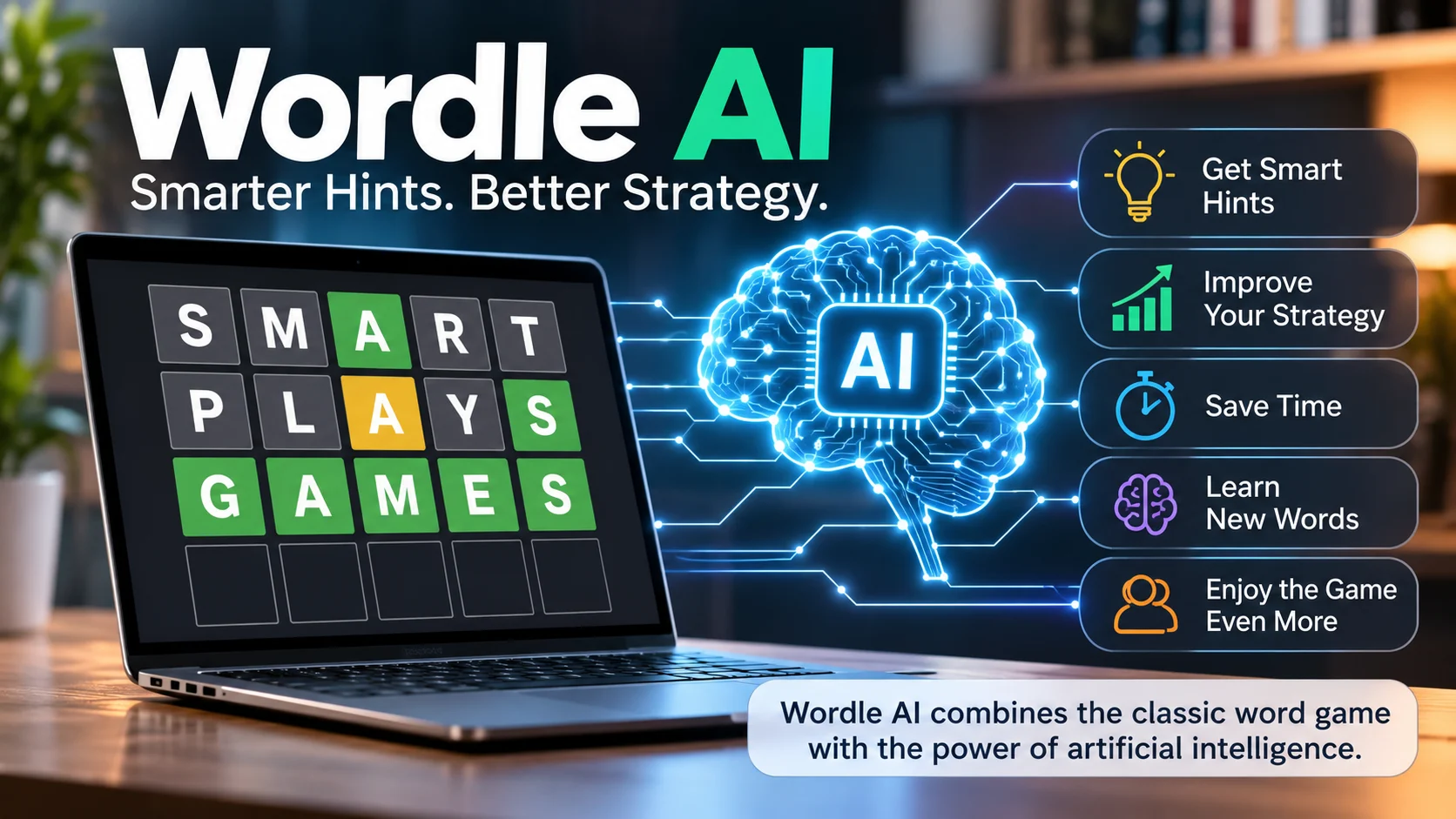
Quick Answer: Wordle AI refers to artificial intelligence tools and algorithms that analyze Wordle puzzles, evaluate possible answers, and recommend strategic guesses. These systems use letter patterns, probability, information theory, and search algorithms to narrow down possible solutions within the game’s six attempts.
At a Glance: What You Should Know
- Wordle AI uses algorithms to analyze five-letter word puzzles and recommend possible guesses.
- Most effective solvers use letter frequency, probability, and information theory.
- AI can evaluate thousands of possible words and eliminate unlikely answers.
- Strong opening words include SALET, SLATE, TRACE, and RAISE, depending on the solving strategy.
- Wordle AI can help beginners understand letter patterns and improve their guessing strategy.
- AI solvers have limitations, including dictionary differences, repeated letters, and changing answer lists.
What Is Wordle AI?
Wordle AI is a broad term for software that uses artificial intelligence, mathematical algorithms, or computational logic to solve the popular word puzzle called Wordle.
It is important to understand that Wordle AI is not necessarily one specific application or company. People use the term to describe several types of tools:
- Wordle AI solvers: Analyze existing clues and suggest possible answers.
- Wordle AI assistants: Help players choose better words during a puzzle.
- Automated Wordle bots: Play the game by selecting guesses and processing feedback.
- Wordle prediction algorithms: Calculate which words are statistically more likely to be the solution.
- AI-powered puzzle experiments: Use machine learning or language models to explore word patterns and solving strategies.
The original Wordle game gives players six attempts to identify a hidden five-letter word. Each guess produces colored feedback:
| Tile color | Meaning |
|---|---|
| Green | Correct letter in the correct position |
| Yellow | Correct letter in the wrong position |
| Gray | Letter does not appear in the answer |
A Wordle AI solver interprets these clues and uses them to eliminate incompatible words.
Is Wordle AI a chatbot or a dedicated solver?
The distinction matters.
A chatbot such as ChatGPT can suggest possible words when given the puzzle clues. However, a dedicated Wordle solver usually follows a more structured process.
It maintains a list of valid candidates, checks every letter position, and calculates which guesses provide the most useful information.
Dedicated algorithms can therefore solve the puzzle without relying on a large language model (LLM).
How Does Wordle AI Work?
Most traditional Wordle solvers follow a mathematical process rather than generating random suggestions.
Their objective is simple: reduce uncertainty with every guess.
Building a list of possible answers
The solver starts with a dictionary containing potential five-letter answers.
It compares the dictionary against the available clues and removes words that cannot match the puzzle.
For example, imagine the first guess is CRANE.
The feedback shows:
- C is gray.
- R is yellow.
- A is green.
- N is gray.
- E is yellow.
The solver can now establish several conditions:
- C and N are excluded, subject to Wordle’s repeated-letter rules.
- A must remain in the third position.
- R must appear somewhere other than the second position.
- E must appear somewhere other than the fifth position.
The algorithm searches for words that satisfy all these conditions.
Analyzing letter frequency
Letter frequency helps a solver identify useful guesses.
Some letters appear more frequently in English words than others. Common examples include:
- E
- A
- R
- O
- T
- L
- S
- N
An algorithm can examine how frequently these letters appear across the remaining candidate answers.
It can also consider their positions. For example, a letter may appear frequently at the end of words but less often at the beginning.
This makes positional analysis more useful than simply counting vowels.
Calculating information gain
One of the most important concepts behind Wordle AI is information theory.
A strong guess should divide the remaining possible answers into several smaller groups.
Consider two possible guesses:
- Guess A produces only a few different feedback patterns.
- Guess B produces many different feedback patterns.
Guess B may be more useful because its result can eliminate more possibilities.
Algorithms often measure this using Shannon entropy.
In simple terms, entropy measures how much uncertainty a guess is expected to remove. A higher entropy score generally indicates a more informative guess.
However, maximum information gain does not always produce the fewest total guesses. That distinction explains why different solvers sometimes recommend different opening words.
Selecting the next guess
After receiving feedback, the solver updates its candidate list.
It then evaluates the remaining possibilities and recommends another guess.
Some algorithms select the most likely answer. Others deliberately choose a word that might not be the answer but can eliminate several possibilities.
This second approach is particularly useful when multiple candidates remain.
Repeating the process until the answer is found
The solver repeats the same process after every guess:
- Receive the colored feedback.
- Update the candidate list.
- Evaluate possible guesses.
- Select the next strategic word.
- Repeat until the answer is identified.
This process allows an algorithm to solve puzzles systematically instead of relying on intuition.
What Makes a Good Wordle AI Solver?
Not every solver uses the same strategy. Some prioritize speed, while others focus on finding the answer in the fewest possible guesses.
The most useful capabilities include the following.
Candidate filtering
A good solver should accurately remove words that conflict with green, yellow, and gray clues.
It should also handle repeated letters correctly.
For example, knowing that a word contains one occurrence of a letter does not automatically mean it contains two.
Strategic word recommendations
The solver should evaluate more than the popularity of individual letters.
It should consider how each possible guess divides the remaining answer list.
This helps avoid guesses that provide little new information.
Hard Mode support
Wordle Hard Mode requires players to use previously discovered green and yellow information in subsequent guesses.
A solver supporting this mode must respect those restrictions when recommending words.
Duplicate-letter handling
Repeated letters create some of Wordle’s most confusing situations.
For example, a guess containing two E letters can produce different colored results depending on how many E letters appear in the actual answer.
A reliable solver must reproduce Wordle’s feedback rules accurately.
Transparent explanations
The most helpful tools explain why they recommend a particular word.
Instead of presenting a single answer, they can show:
- Remaining candidate words.
- Letters already confirmed.
- Letters that have been eliminated.
- Recommended next guesses.
- The reasoning behind each recommendation.
This makes a solver useful for learning rather than simply copying answers.
Best Wordle AI Solvers and Tools
Several tools demonstrate how algorithms can help players solve Wordle puzzles. They differ in their solving methods, accessibility, and level of technical complexity.
The following are established examples rather than a ranking of every available solver.
Wordle Solver
WordleOpt
Research-based solver
- Target user: Puzzle enthusiasts and mathematically curious players.
- Main strength: Uses exact dynamic programming to calculate an optimal solving strategy under its defined game model.
- Pricing transparency: Research implementation is publicly accessible.
- Limitation: Its published mathematical results depend on a specific answer list and game model.
Research: Bertsimas and Paskov, published in Operations Research in 2024. Operations Research+1
Explore WordleOpt
Wordle Bot just showed me the near-perfect Wordle starting word | TechRadar
WordleBot
- Target user: Regular Wordle players.
- Main strength: Provides analysis of player guesses and solving decisions.
- Pricing transparency: Check current New York Times Games access requirements.
- Limitation: Its analysis is not the same as an unrestricted, guaranteed optimal solver.
A useful option for players interested in evaluating their strategy.
Visit NYT Wordle
GitHub – XenOdd/Wordle-Solver: A sleek and intuitive helper tool for the popular word game, Wordle. · GitHub
Wordle Solver by SQD
- Target user: Players who want immediate next-guess recommendations.
- Main strength: Accepts colored feedback and ranks remaining words.
- Pricing transparency: Publicly accessible browser-based tool.
- Limitation: Its results depend on the word lists and solving model it uses.
Its published interface supports candidate filtering and Hard Mode. Wordle Solver
Try the Wordle Solver
Solving the Wordle Solver | Krushi Raj Tula
OptimalWordleSolver
- Target user: Developers, programmers, and researchers.
- Main strength: Provides source code for exploring optimized Wordle-solving strategies.
- Pricing transparency: Open-source repository.
- Limitation: Requires programming knowledge to build or modify the solver.
The repository describes an optimized search approach for minimizing average game length. GitHub
Explore the GitHub repository
Wordle AI tools compared
| Tool | Main approach | Best suited for | Main limitation |
|---|---|---|---|
| WordleOpt | Exact dynamic programming | Mathematical solving | Specific game model |
| WordleBot | Guess analysis | Regular players | Not unrestricted optimal play |
| SQD Solver | Candidate filtering | Quick suggestions | Depends on word lists |
| OptimalWordleSolver | Search algorithms | Developers | Technical setup |
Important distinction: These tools are not necessarily generative AI products. Most dedicated Wordle solvers rely on deterministic algorithms, probability, and mathematical optimization rather than conversational AI.
What Is the Best Starting Word for Wordle AI?
Choosing the first word is one of the most important decisions in Wordle.
A strong opening guess tests several common letters simultaneously. It should provide useful information without wasting positions on repeated letters.
Some frequently recommended opening words include:
| Starting word | Strategic advantage |
|---|---|
| SALET | Strong mathematically optimized opening |
| SLATE | Tests several common letters |
| TRACE | Combines useful consonants and vowels |
| CRANE | Familiar and strategically useful |
| RAISE | Covers frequently occurring letters |
Why does SALET receive so much attention?
A notable academic study by Dimitris Bertsimas and Alex Paskov examined how to solve Wordle using exact dynamic programming.
Their research identified SALET as the optimal starting guess under the original game’s defined answer list and solving objective.
The resulting strategy achieved:
- An average of approximately 3.421 guesses.
- A guaranteed solution within five guesses.
- Coverage of all 2,315 possible answers in the original model.
These are mathematical results for a specific historical version of Wordle, not a guarantee about every current puzzle or every alternative solver. Operations Research+1
Why do different AI solvers recommend different words?
There is no universal starting word for every solving algorithm.
The recommended word depends on what the algorithm is trying to optimize.
For example:
- Information gain: Maximize the amount of uncertainty removed by the first guess.
- Average guesses: Minimize the expected number of attempts across all possible answers.
- Worst-case performance: Minimize the maximum number of guesses required.
- Human-friendly strategy: Recommend familiar words that are easy to remember.
These objectives can produce different rankings.
A word that generates the most information in the first move may not produce the shortest complete solving strategy.
This is why SALET, SLATE, TRACE, and RAISE can all appear near the top of different rankings. Word Challenge+3
Can ChatGPT Solve Wordle?
Yes. ChatGPT can help solve Wordle by interpreting the clues and suggesting possible answers.
However, its performance depends on how accurately it understands the feedback and follows the game’s rules.
Unlike a dedicated solver, a general-purpose language model does not necessarily calculate every possible answer before making a recommendation.
For better results, provide:
- Your previous guesses.
- The green, yellow, and gray positions.
- Any confirmed letters.
- Letters that cannot appear in the answer.
- Whether you are playing Hard Mode.
Example of using ChatGPT as a Wordle assistant
Imagine you provide these clues:
- Five-letter English word.
- A is green in position three.
- R is yellow in position two.
- E is yellow in position five.
- C and N are gray.
ChatGPT can help generate words that satisfy these conditions.
A more reliable approach is to ask it to explain the constraints before suggesting answers. You can then verify the suggestions with a dedicated solver.
Practical tip: Do not assume every AI-generated word is accepted by Wordle. A word can be valid English without appearing in the game’s accepted dictionary.
Wordle AI vs. Traditional Wordle Solvers
Both approaches can help players find answers, but they work differently.
| Comparison | Traditional solver | Generative AI assistant |
|---|---|---|
| Main technology | Algorithms and search | Large language models |
| Candidate filtering | Rule-based | Depends on instructions and model |
| Letter analysis | Systematic | Language-based reasoning |
| Probability calculations | Can be explicit | Not always reliable |
| Explanations | Depends on tool | Conversational |
| Best application | Accurate puzzle solving | Learning and discussion |
Which approach is more reliable?
For exact candidate filtering, a dedicated solver is generally the more appropriate choice.
It can apply fixed rules to a known word list and systematically eliminate incompatible answers.
Generative AI is useful when players want explanations, strategy discussions, or help understanding why certain guesses are better.
A combination can also work well: use an algorithm to identify possible answers and a chatbot to explain the strategy.
Benefits of Using Wordle AI
AI-assisted Wordle solving offers several advantages beyond simply finding the hidden word.
Faster puzzle solving
A solver can evaluate thousands of potential words much faster than a person checking them individually.
Instead of manually testing every possibility, players receive a smaller candidate list.
Better strategic decisions
Beginners often choose words based on intuition.
An AI solver can evaluate letter combinations and recommend guesses that provide more useful information.
This encourages players to think strategically.
Improved vocabulary
Wordle introduces players to unfamiliar five-letter words.
Some solvers also explain why certain words are useful, helping players understand spelling patterns and letter combinations.
Useful for learning programming
Wordle is an excellent example of how algorithms solve practical problems.
Students can use it to explore:
- Python programming.
- Probability and statistics.
- Search algorithms.
- Information theory.
- Data structures.
- Decision-making systems.
Understanding mathematical optimization
Wordle demonstrates how a computer can make better decisions by evaluating possible outcomes.
The same general principle appears in scheduling, resource allocation, decision trees, and other optimization problems.
Limitations of Wordle AI
Although Wordle solvers can be highly effective, they are not completely independent of their underlying data and assumptions.
Understanding these limitations helps users choose appropriate tools.
1. Dictionary differences
Different solvers may use different word lists.
A word accepted by one tool may not appear in another tool’s candidate database.
This can produce incorrect recommendations even when the underlying algorithm is working properly.
2. Repeated-letter mistakes
Words containing repeated letters can complicate the feedback process.
A solver must understand that Wordle evaluates duplicate letters according to their actual frequency in the hidden answer.
Poorly implemented tools may incorrectly eliminate valid possibilities.
3. Changing answer lists
The New York Times maintains its own curated answer system.
Historical answer lists and newer answer selections may differ. A solver using an outdated dataset can therefore produce incomplete results. The Washington Post+1
4. Hard Mode restrictions
A recommendation that works in normal mode may not be permitted in Hard Mode.
For example, a strategic guess might introduce five new letters but fail to reuse a previously revealed yellow letter.
Players should check whether their solver supports the correct game mode.
5. Incorrect AI-generated suggestions
General-purpose chatbots can occasionally suggest invalid words or misunderstand complicated feedback.
They may also present an answer confidently without verifying it against an actual Wordle dictionary.
Players should verify important recommendations rather than treating every response as guaranteed.
6. Reduced enjoyment
There is another limitation that has nothing to do with technology.
Using a solver to reveal every answer can remove the challenge that makes Wordle enjoyable.
For many people, the satisfaction comes from discovering the answer independently.
A better approach is to use AI as a learning assistant rather than relying on it for every puzzle.
Does Wordle AI Use Machine Learning or Large Language Models?
Not necessarily.
The term AI covers several different technologies, and Wordle provides a useful example of the distinction.
Rule-based algorithms
Traditional solvers use predefined rules to process letter positions and eliminate impossible answers.
For example, if the third letter is green, the algorithm keeps only words with the same third letter.
This is deterministic computation, not machine learning.
Information theory
Information theory helps algorithms measure how useful a particular guess might be.
It allows the solver to compare different guesses according to the uncertainty they remove.
Machine learning
A machine-learning system could study previous puzzles and player behavior to identify useful guessing patterns.
However, machine learning is not necessary to build an effective Wordle solver.
Large language models
LLMs can understand natural-language instructions and discuss possible answers.
For instance, a user can describe the board in ordinary language and ask for help identifying possible words.
However, an LLM’s language understanding does not automatically make it an exact puzzle-solving engine.
AI agents
An automated Wordle agent can take the process further.
It can:
- Read the current puzzle.
- Select a guess.
- Submit the guess.
- Interpret the resulting colors.
- Choose another guess.
- Repeat until the game ends.
Such automation may use computer vision, browser interaction, and a dedicated solving algorithm.
The important distinction is that an agent’s ability to interact with a game is separate from its ability to calculate the best answer.
Privacy, Security, and Pricing Considerations
Wordle solving is generally a low-risk activity, but users should still understand what a third-party tool does with their information.
Is Wordle AI free?
Many browser-based Wordle solvers are publicly accessible without requiring a paid subscription.
However, pricing varies between individual services.
Some tools may offer additional features, subscriptions, advertisements, or paid versions. Check the individual provider before assuming that every feature is free.
There is no single official Wordle AI subscription or universal pricing model.
Does a Wordle solver collect personal information?
A basic solver may only need the guesses and colored feedback from the current puzzle.
However, privacy practices depend on the individual website.
Before using an unfamiliar tool, check:
- Whether an account is required.
- Whether puzzle information is stored.
- Whether analytics or tracking technologies are used.
- Whether information is shared with third parties.
- Whether the tool explains its data-retention practices.
Do not assume that a website is private simply because it does not request registration.
Do developers need an API?
No. A basic Wordle solver can operate entirely with local word lists and algorithms.
An API becomes relevant when developers want to integrate a hosted language model, external dictionary, or other online service.
For a straightforward Wordle-solving application, external AI infrastructure is often unnecessary.
Who Should Use Wordle AI?
Wordle AI is useful for different audiences, depending on their goals.
| Audience | How it helps |
|---|---|
| Beginners | Understand clues and learn guessing strategies |
| Regular players | Improve solving efficiency |
| Puzzle enthusiasts | Explore mathematical solving methods |
| Students | Learn probability and information theory |
| Developers | Experiment with algorithms and programming |
| Researchers | Study optimization and decision-making |
It is particularly useful for people who enjoy understanding how computers solve problems.
However, players who prefer solving puzzles independently may benefit more from occasional hints than complete answers.
Common Mistakes When Using Wordle AI
Even a sophisticated solver can produce disappointing results when users provide incorrect information.
Avoid these common mistakes:
- Entering incorrect colors: One incorrect tile can completely change the candidate list.
- Ignoring duplicate letters: Repeated letters require careful interpretation.
- Using outdated dictionaries: Older answer lists may not match the current game.
- Confusing guesses with answers: Not every accepted guess can become the hidden solution.
- Ignoring Hard Mode: Some recommendations may violate its restrictions.
- Trusting every chatbot response: Verify suggestions against the game’s accepted words.
The most important rule is to provide accurate feedback. A solver can only produce reliable recommendations when its input is correct.
The Future of Wordle AI
Wordle demonstrates how relatively simple games can become interesting artificial intelligence experiments.
Future developments may focus on making puzzle-solving systems more interactive, explainable, and adaptable.
Several areas are particularly relevant.
More explainable solving systems
Instead of showing only the next recommended word, future tools could explain why that guess is useful.
Players could see how each possible outcome changes the remaining candidate list.
Better natural-language interaction
Language models can make puzzle assistance more accessible.
Users could describe their guesses without manually entering every tile.
Improved automated gameplay
Computer vision and browser automation could allow AI agents to recognize puzzle boards and play games independently.
More advanced optimization
Researchers can continue exploring different objectives, including minimizing average guesses, reducing worst-case attempts, and adapting to changing answer probabilities.
Academic research already demonstrates that exact dynamic programming can produce highly efficient Wordle strategies. Operations Research+1
However, these developments do not mean every Wordle tool needs a sophisticated generative AI model. Traditional algorithms remain highly effective for this particular problem.
Frequently Asked Questions About Wordle AI
1. What is Wordle AI used for?
Wordle AI helps players solve five-letter Wordle puzzles by analyzing letter positions, eliminating impossible answers, and recommending strategic guesses. It can also demonstrate how algorithms use probability and information theory.
2. What is the best AI solver for Wordle?
WordleOpt is a notable research-based option because it implements an exact dynamic programming approach. Other browser-based solvers provide candidate filtering and next-guess recommendations. The right choice depends on whether you prioritize mathematical optimization, convenience, or explanations.
3. Can ChatGPT solve Wordle puzzles?
Yes. ChatGPT can interpret Wordle clues, suggest possible answers, and explain guessing strategies. However, it can occasionally produce invalid suggestions, so a dedicated solver is preferable for exact candidate filtering.
4. What is the best starting word for Wordle?
SALET is the optimal starting word in the exact dynamic programming research by Bertsimas and Paskov, using the original 2,315-answer model. SLATE, TRACE, and RAISE are also strong choices under different solving methods and evaluation criteria.
5. Is Wordle AI free to use?
Many online Wordle solvers are available without payment. However, individual tools may have different pricing models, additional features, or subscription requirements. Always check the provider’s current terms.
Conclusion
Wordle AI demonstrates how artificial intelligence and mathematical algorithms can turn a simple word puzzle into an interesting problem-solving experiment. By combining candidate filtering, letter frequency, probability, and information theory, these tools help players identify better guesses and understand the logic behind each decision.
For everyday puzzle solving, a dedicated Wordle solver is generally more reliable than an unrestricted chatbot. WordleOpt is particularly interesting for mathematical research, while browser-based tools offer convenient assistance.
Before choosing a tool, consider its word list, Hard Mode support, solving strategy, and privacy practices. Ultimately, Wordle AI is most valuable when it helps players understand the puzzle rather than simply revealing the answer.