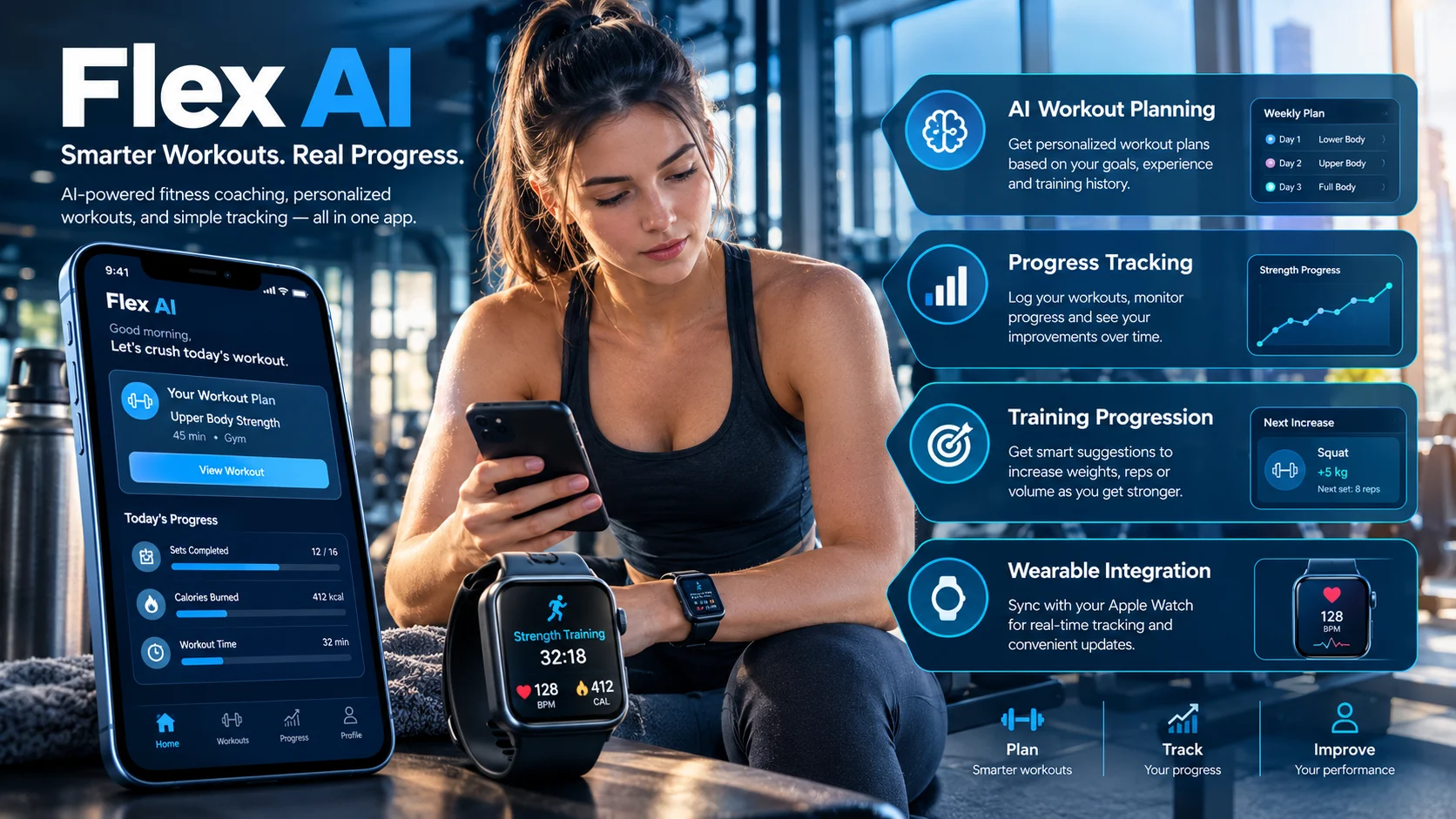
Flex AI can refer to several products, including an AI-powered fitness coach and FlexAI, a platform for running AI models and applications. The fitness app helps users plan workouts and track progress, while the infrastructure platform serves developers who need AI model inference and computing resources.
The name Flex AI has more than one meaning, which makes identifying the correct product essential before signing up. For people interested in fitness, Flex is an AI-powered workout tracker and personal trainer designed to help organize training, monitor performance, and adapt workouts to individual goals.
For developers, FlexAI at flex.ai is a different product focused on AI infrastructure, model access, and deployment. Ceros also offers a separate product called Flex AI for creative content production.
This guide explains the main products associated with the name, with particular attention to the fitness app, its advertised features, practical limitations, and the alternatives worth considering.
Flex AI at a Glance
- Fitness: Flex AI provides AI-assisted workout planning, exercise tracking, and training progression features.
- Personalization: Its fitness offering describes workouts tailored to training history, goals, recovery, and performance.
- Progress tracking: Users can monitor workout performance and review progress over time.
- Wearable integration: The fitness app advertises Apple Watch support.
- Pricing: The fitness app is listed as free to download with in-app purchases. Current subscription costs should be checked in the relevant app store.
- Important distinction: The fitness app, the FlexAI infrastructure platform, and Ceros Flex AI are separate products with different purposes.
What Is Flex AI?
For fitness users, Flex AI is a digital workout coach and gym tracker. Its advertised features include personalized workout generation, exercise logging, training progression, and AI-assisted feedback on lifting technique.
The goal is to make training easier to organize. Instead of planning every session manually, users can work with a suggested routine, record their performance, and use that information to guide future workouts.
However, an AI-generated workout is still a recommendation. It does not replace a qualified coach, medical assessment, or professional evaluation of an injury.
How the Fitness App Differs From Other Flex AI Products
The name can cause confusion when searching for reviews, tutorials, or pricing.
| Product | Main purpose | Intended audience |
|---|---|---|
| Flex AI fitness app | Workout planning, gym tracking, and AI coaching | Gym users and fitness enthusiasts |
| FlexAI at flex.ai | AI model inference, agent infrastructure, and deployment | Developers, startups, and AI engineering teams |
| Ceros Flex AI | AI-assisted creative production within the Ceros platform | Designers, marketers, and content teams |
Sources: the respective official product pages and documentation.
These products should not be treated as different versions of the same application. They solve separate problems and have different pricing models, capabilities, and technical requirements.
Key Features of Flex AI for Fitness
The fitness app’s official website and App Store listing describe several capabilities intended to help users manage their training.
1. AI-Generated Workout Plans
Flex AI advertises personalized workout generation based on factors such as training history, goals, recovery, and performance.
This can help users establish a routine without planning every exercise from scratch. For example, someone following a muscle-building program could use a suggested workout as a starting point and adjust it to their available equipment.
The quality of the result still depends on the information provided, the app’s recommendations, and how well the proposed routine suits the individual.
2. Workout and Exercise Tracking
A training log helps users record exercises, weights, repetitions, and performance across sessions.
Consistent tracking can make it easier to identify trends. A user might notice that their working weight has increased over several weeks or that a particular exercise has stalled.
The value comes from maintaining accurate records, not merely collecting workout statistics.
3. Progressive Overload
Progressive overload means gradually increasing the demands placed on the body as training capacity improves.
Flex AI advertises progression features that can suggest increases in weight or repetitions based on workout results.
These suggestions should not be followed blindly. Increasing resistance too quickly can compromise technique, especially when a user is fatigued or unfamiliar with an exercise.
A sensible progression considers performance, recovery, exercise difficulty, and the ability to maintain good form.
4. AI-Assisted Form Feedback
The official fitness website advertises AI-powered form feedback for lifting exercises.
This feature may help users identify potential technique issues, but its usefulness depends on what movements it supports and how accurately it evaluates them.
Camera angle, lighting, equipment placement, and the complexity of an exercise can affect automated assessments. Users should not interpret app feedback as a guarantee that a lift is safe or technically correct.
5. Apple Watch Integration
Flex AI advertises Apple Watch integration, allowing supported fitness tracking features to work with a compatible wearable.
Before relying on this capability, check which metrics are synchronized, whether the feature requires particular devices, and whether additional permissions or subscriptions apply.
6. Workout Sharing and Community Features
The fitness website also promotes workout sharing, challenges, and leaderboards.
These features can provide motivation for people who enjoy tracking goals with others. However, competitive rankings are not necessarily a useful measure of personal progress, particularly when users have different training histories and objectives.
How Does Flex AI Work?
An AI fitness app typically combines user-provided information, workout records, training rules, and automated recommendations.
Although the exact implementation of every Flex AI feature is not publicly established by the product descriptions cited here, the general workflow can be understood in four steps.
- Set your goals: Define the outcome you want, such as building muscle, improving strength, or maintaining a regular routine.
- Provide training information: Enter relevant details about your experience, available equipment, and training preferences.
- Follow a suggested workout: Review the exercises and planned workload, then adjust anything unsuitable.
- Record the results: Log completed sets and repetitions so that future planning can account for your progress.
This process can reduce planning effort, but the recommendations are only as useful as the information and methods behind them.
For example, a workout designed for a fully equipped gym may not suit someone training at home with resistance bands. Likewise, a program built around frequent heavy lifting may be inappropriate for a beginner who needs more time to learn technique.
What AI Can and Cannot Do in Fitness
AI can help organize training information and suggest adjustments. It can also explain common training concepts and help users maintain a consistent routine.
It cannot reliably diagnose an injury, assess every aspect of movement from limited video, or guarantee that a workout will produce a particular result.
Treat automated recommendations as planning assistance rather than medical or professional coaching.
Flex AI Pricing: Is It Free?
The Flex AI fitness app is listed as free to download with in-app purchases in Apple’s App Store.
That does not mean every feature is free. The total cost may depend on subscriptions, premium features, and the purchasing options available in your region.
Before paying, check the app’s current listing and purchase screen for:
- Subscription price: The amount charged per billing period.
- Trial terms: Whether a free trial automatically converts into a paid subscription.
- Included features: Which coaching, tracking, or progression features require payment.
- Cancellation rules: How to stop recurring charges.
- Platform differences: Whether pricing or availability differs between iOS and other platforms.
I could verify the free-download listing, but I could not establish a complete, reliable current subscription price from the available sources. It would be misleading to publish an unverified figure.
Is a Paid Plan Worth It?
The answer depends on how much help you need organizing your training.
A beginner who needs structure may benefit from a guided workout planner. An experienced lifter who already maintains a detailed training spreadsheet may have less need for automated planning.
Compare the paid features against what you actually use. A subscription is easier to justify when it solves a recurring problem, rather than simply offering a longer feature list.
Benefits and Limitations of Flex AI
An AI workout app can make training more organized, but convenience alone does not guarantee better results.
Potential Benefits
- Less planning effort: Suggested workouts provide a starting point for each session.
- Consistent tracking: Exercise logs help users review their training history.
- Progression support: Automated suggestions can help users think about when to increase repetitions or resistance.
- Personalization: Workout recommendations may account for stated goals and training history.
- Motivation: Progress charts, challenges, and shared workouts can encourage consistency.
- Wearable support: Compatible Apple Watch features may reduce the need for manual tracking in supported situations.
These are potential benefits of the advertised features, not independently verified outcomes for every user.
Important Limitations
- Recommendations can be unsuitable: Automated plans may not fully reflect an individual’s technique, recovery, or physical limitations.
- Technique assessment has limits: AI feedback should not be treated as a definitive safety judgment.
- Tracking requires consistency: Missing or inaccurate workout records can reduce the usefulness of progress recommendations.
- Compatibility matters: Some features may depend on supported devices or operating systems.
- Subscriptions can add up: Premium coaching and tracking features may cost more than the initial download suggests.
- Results are not guaranteed: Fitness progress depends on training, nutrition, sleep, recovery, and individual circumstances.
For users with injuries, persistent pain, or medical conditions that affect exercise, professional guidance is more appropriate than relying on an AI-generated plan alone.
Privacy and Security: What Should You Check?
Fitness applications may handle personal information such as workout histories, body measurements, training goals, and wearable data. The specific information collected depends on the app and the permissions you grant.
Before using Flex AI regularly, review its current privacy policy and settings.
Check These Five Areas
- Data collection: Find out which personal and workout details the app collects.
- Wearable permissions: Review which Apple Health or Apple Watch data can be accessed, where applicable.
- Data retention: Check how long records are stored and what happens when you delete your account.
- Third-party processing: Determine whether information is shared with service providers or used to improve AI systems.
- Account controls: Look for options to access, export, or delete your information.
The app’s existence on an official app store does not, by itself, prove that all data practices meet your expectations. Read the current documentation before entering sensitive information.
Flex AI Alternatives
If you’re comparing AI fitness apps, start with the features that matter most: workout planning, exercise logging, progression, wearable support, and the level of human guidance available.
The following products provide useful comparison points, although their feature sets and pricing should be checked directly.
| App or service | Target user | Main strength | Pricing transparency | Main limitation |
|---|---|---|---|---|
| Flex AI | Users seeking AI-assisted workouts and gym tracking | Combines training planning and tracking features | App Store lists free download with in-app purchases | Verify premium feature access and coaching limitations |
| Fitbod | Gym users seeking personalized strength workouts | Workout generation and exercise planning | Check current subscription options | Recommendations may not fit every training preference |
| Strong | Lifters who prioritize workout logging | Structured exercise and performance tracking | Check current free and paid feature limits | Logging tools do not replace individualized coaching |
| Hevy | Lifters who want tracking and sharing | Workout logs and community-oriented features | Check current plan and feature limits | AI coaching may not be its central focus |
This is a feature-based comparison, not a performance ranking. Availability, subscription terms, and individual features may change.
How to Choose Between Them
Choose a planner if you struggle to decide what to do at the gym. A tracking-focused app may suit you better if you already follow a routine and simply want to record progress.
If you need feedback on exercise technique, investigate exactly which movements the app supports and how it produces its assessments. For complex training needs or injury rehabilitation, a qualified professional can provide context that a general-purpose fitness app may lack.
What If You Mean FlexAI for Developers?
If your search for “flex ai” is related to software development rather than fitness, FlexAI at flex.ai is the more relevant product.
The platform describes itself as an AI infrastructure service that offers access to open-weight models through an OpenAI-compatible API, along with dedicated GPU endpoints and private deployment options. Its documentation also describes tooling for building and operating AI agents.
Main Capabilities
- Model inference: Send requests to supported AI models without managing every part of the underlying serving infrastructure.
- OpenAI-compatible API: Use a familiar API interface to reduce the work involved in adapting some existing applications.
- Dedicated GPU endpoints: Deploy workloads on dedicated computing resources when the usage pattern justifies them.
- Private deployment: Explore options such as virtual private cloud, on-premises, or air-gapped deployments, subject to the available offering.
- Usage-based pricing: Compare published model rates and GPU costs before choosing an architecture.
FlexAI Pricing for Developers
FlexAI publishes per-model pricing for serverless inference and separate rates for dedicated GPU resources. Its published pricing page includes different rates for input and output tokens, depending on the model, and hourly prices for selected GPUs.
Because these rates can change, consult the official FlexAI pricing page for current figures.
For a production workload, calculate the total cost rather than comparing a single token price. Include output volume, repeated agent calls, tool usage, traffic patterns, and the cost of reserved compute if applicable.
Also examine API compatibility, model availability, service-level commitments, and data-retention terms before moving sensitive workloads. A compatible API can reduce migration effort, but it does not guarantee that every model or application will behave identically.
Who Should Use Flex AI?
For the fitness app, Flex AI may be worth evaluating if you:
- Want help structuring gym workouts.
- Prefer keeping exercise records in one place.
- Like using performance history to guide training progression.
- Want to explore AI-assisted workout planning.
- Use compatible Apple devices and want to investigate wearable integration.
It may be less suitable if you prefer complete manual control, need specialized rehabilitation guidance, or expect AI feedback to guarantee correct technique.
For developers, the separate FlexAI infrastructure platform is relevant when building applications that need model inference or dedicated computing resources. Designers working in Ceros should evaluate Ceros Flex AI instead.
The key is to match the product to the task, not simply the name.
Frequently Asked Questions About Flex AI
1. What is Flex AI used for?
Flex AI’s fitness app is used for workout planning, exercise tracking, and AI-assisted training progression. The name also refers to separate AI infrastructure and creative tools, so confirm which product you are researching.
2. Is Flex AI free to use?
The fitness app is listed as free to download with in-app purchases. Some features may require payment, so check the current App Store listing and subscription terms.
3. Does Flex AI create personalized workout plans?
The fitness app advertises workout generation based on training history, goals, recovery, and performance. The suitability of each recommendation depends on your circumstances and the quality of the information provided.
4. Is Flex AI suitable for beginners?
It may help beginners organize workouts and track progress. New lifters should still learn proper technique and avoid following automated weight increases without considering their ability and recovery.
5. Is Flex AI the same as FlexAI at flex.ai?
No. The fitness app focuses on workout planning and tracking, while FlexAI at flex.ai provides infrastructure for running AI models and applications. They serve different audiences and have different pricing structures.
Conclusion
Flex AI can refer to several products, but its fitness app focuses on AI-assisted workout planning, exercise tracking, and training progression. These features may help gym users organize their routines and monitor their progress.
Before subscribing, verify the current pricing, included features, device compatibility, and privacy policy. Evaluate the workout recommendations carefully, especially if you’re new to lifting or have physical limitations.
If you are researching AI infrastructure instead, visit FlexAI’s official website and compare model pricing, API requirements, compute options, and deployment controls. Identifying the right product is the first step toward making an informed decision.