AI MCP usually refers to the Model Context Protocol, an open standard that connects AI applications to external tools, data sources, and services. It helps AI assistants retrieve information and perform supported actions through a common interface instead of requiring a separate custom integration for every connection.
AI MCP at a Glance
- Meaning: Model Context Protocol.
- Purpose: Connect AI applications with external tools and information.
- Main components: MCP hosts, clients, and servers.
- Core capabilities: Tools, resources, and reusable prompts.
- Common users: Developers, businesses, and AI agent builders.
- Main concern: Connections need careful permission, privacy, and security controls.
What Is AI MCP?
AI MCP refers to using the Model Context Protocol (MCP) to connect AI models and applications with external systems. Anthropic introduced MCP as an open protocol in November 2024. Its purpose is to simplify how AI assistants access information and capabilities outside their own models.
Think of MCP as a standardized connection between an AI application and another service. Instead of building a different integration for every AI tool, developers can use compatible MCP clients and servers.
For example, an AI assistant might need to search project documents, retrieve customer records, or create a task. An MCP server can expose the relevant capabilities, subject to the permissions and controls of the connected system.
Important distinction: MCP is not an AI model, chatbot, or standalone assistant. It is a protocol that helps compatible applications communicate.
How Does AI MCP Work?
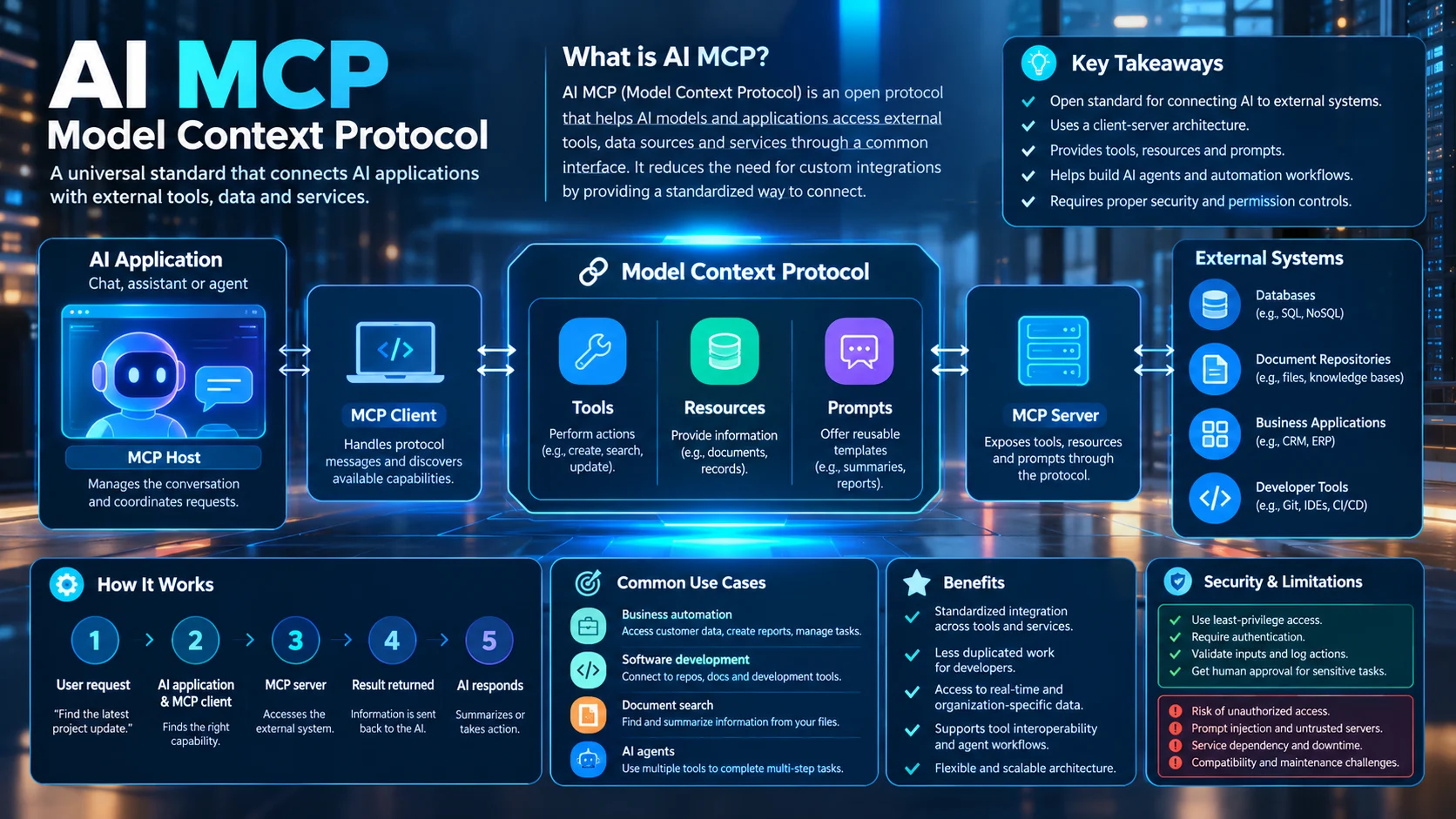
MCP uses a client-server architecture to connect an AI application with external capabilities. Each component has a specific role.
1. MCP Host
The host is the AI application the user interacts with. It manages the conversation and coordinates access to connected MCP servers.
2. MCP Client
The client is the component inside the host that communicates with an MCP server. It handles protocol messages and discovers available capabilities.
3. MCP Server
The server exposes selected tools, data, or prompt templates. It might connect to a database, document repository, business application, or external API.
A Simple AI MCP Workflow
User request
“Find the latest project update.”
AI application and MCP client
Identifies an appropriate connected capability.
MCP server
Searches an authorized project system.
Result returned to the AI
The assistant summarizes the retrieved information.
The exact sequence depends on the application and its implementation. The AI may decide which tool to call, but the application and server determine how the request is executed and what access is permitted.
What Are the Main Features of MCP?
MCP defines three important server capabilities: tools, resources, and prompts.
| Capability | What it does | Example |
|---|---|---|
| Tools | Allow supported functions to be executed | Create a task or search a database |
| Resources | Expose information for an AI application to retrieve | Read a document or project record |
| Prompts | Provide reusable templates for common tasks | Structure a code review or research request |
These capabilities serve different purposes. A tool can perform an action, a resource supplies information, and a prompt helps structure an interaction.
Not every MCP server implements all three. Available capabilities depend on the server and the connected application.
What Is AI MCP Used For?
MCP is useful when an AI application needs access to systems beyond its built-in knowledge.
Business Automation
A company can connect an AI assistant to approved business systems. Depending on the implementation, the assistant may retrieve customer information, prepare reports, or create tasks.
Software Development
Developers can connect AI coding tools to documentation, source-control systems, and development utilities. This gives the assistant access to relevant project information without requiring every integration to be built from scratch.
Document Search and Research
An MCP server can expose approved document repositories or search tools. An AI assistant can retrieve relevant material and use it to answer questions about company policies, reports, or project files.
AI Agents
AI agents can use MCP-connected tools to complete multi-step tasks. For example, an agent might retrieve a project record, summarize the status, and prepare a follow-up task.
However, MCP does not automatically make an assistant autonomous or reliable. The model, application logic, permissions, and available tools determine what the agent can actually accomplish.
Benefits of AI MCP
MCP offers several practical advantages for AI developers and organizations.
- Standardized integration: Compatible clients and servers can communicate through a shared protocol.
- Less duplicated work: Developers can reuse integrations instead of creating a separate connection for every AI application.
- Access to external information: AI assistants can retrieve current or organization-specific data when authorized.
- Tool interoperability: A compatible server may work with multiple clients, subject to protocol versions and implementation differences.
- Support for agent workflows: AI applications can combine information retrieval with supported actions.
- Flexible architecture: Teams can add or replace connected services without redesigning every part of the AI application.
The benefits depend on implementation quality. A standardized protocol reduces integration friction, but it does not eliminate configuration, testing, maintenance, or compatibility problems.
AI MCP Tools and Platform Comparison
MCP is a protocol, so the alternatives are often different integration methods rather than direct competitors.
| Platform or approach | Target user | Key strength | Pricing transparency | Main limitation |
|---|---|---|---|---|
| Anthropic Claude MCP | AI developers | MCP ecosystem and documentation | Depends on product and API plan | Supported capabilities vary |
| OpenAI API MCP | Developers and businesses | Connects models to remote MCP servers | API pricing and usage terms apply | Requires careful server permissions |
| Hugging Face | Developers and researchers | Model repositories and development tools | Depends on models and hosting | MCP integration may require additional setup |
| Custom REST APIs | Software development teams | Direct control over integrations | Depends on service and infrastructure | Each integration requires implementation work |
Official documentation confirms that Anthropic introduced MCP and that OpenAI supports MCP server connections through its API. Hugging Face offers model and development resources, but it is not itself a direct replacement for the protocol.
AI MCP Security and Limitations
MCP standardizes communication, but it does not automatically make connected systems secure.
Important risks include:
- Unauthorized access: Poorly configured permissions can expose sensitive information.
- Prompt injection: Malicious instructions hidden in retrieved content can influence an AI assistant.
- Untrusted servers: A third-party server may request sensitive data or perform unexpected actions.
- Service dependency: If a connected server becomes unavailable, dependent workflows may stop working.
- Compatibility issues: Clients and servers may support different protocol versions or capabilities.
- Ongoing maintenance: Developers must monitor permissions, server updates, and integration behavior.
OpenAI’s developer guidance recommends connecting only to trusted servers and requiring approval for sensitive actions.
For production deployments, use least-privilege access, protect credentials, validate tool inputs, log important actions, and require human approval for high-impact operations. Review each server’s data-retention policy separately because the AI provider’s privacy commitments may not cover third-party servers.
Frequently Asked Questions
1. What does AI MCP stand for?
AI MCP usually refers to the Model Context Protocol, an open standard for connecting AI applications with external tools and data sources.
2. Is MCP an AI model?
No. MCP is a communication protocol. It connects compatible AI applications to tools, resources, and services.
3. Is MCP free to use?
The protocol is open, but implementation can involve hosting, infrastructure, API usage, and third-party service costs.
4. Is MCP safe?
MCP can be used with security controls, but safety depends on server trust, permissions, authentication, and how sensitive actions are managed.
5. What is the difference between MCP and an API?
An API defines how software communicates with a service. MCP standardizes how compatible AI applications discover and interact with tools and contextual information, often using underlying APIs.
Conclusion
AI MCP, or Model Context Protocol, provides a standardized way to connect AI applications with external tools and information. It helps developers build integrations without creating a completely separate connection for every AI client. Businesses can use it for document retrieval, software development, workflow automation, and AI agents. However, MCP does not guarantee accurate results, secure data handling, or compatibility across every platform. Before adopting it, evaluate server reliability, access permissions, implementation costs, data-retention policies, and approval requirements. For developers building connected AI systems, MCP can simplify integration while still requiring careful engineering and security oversight.