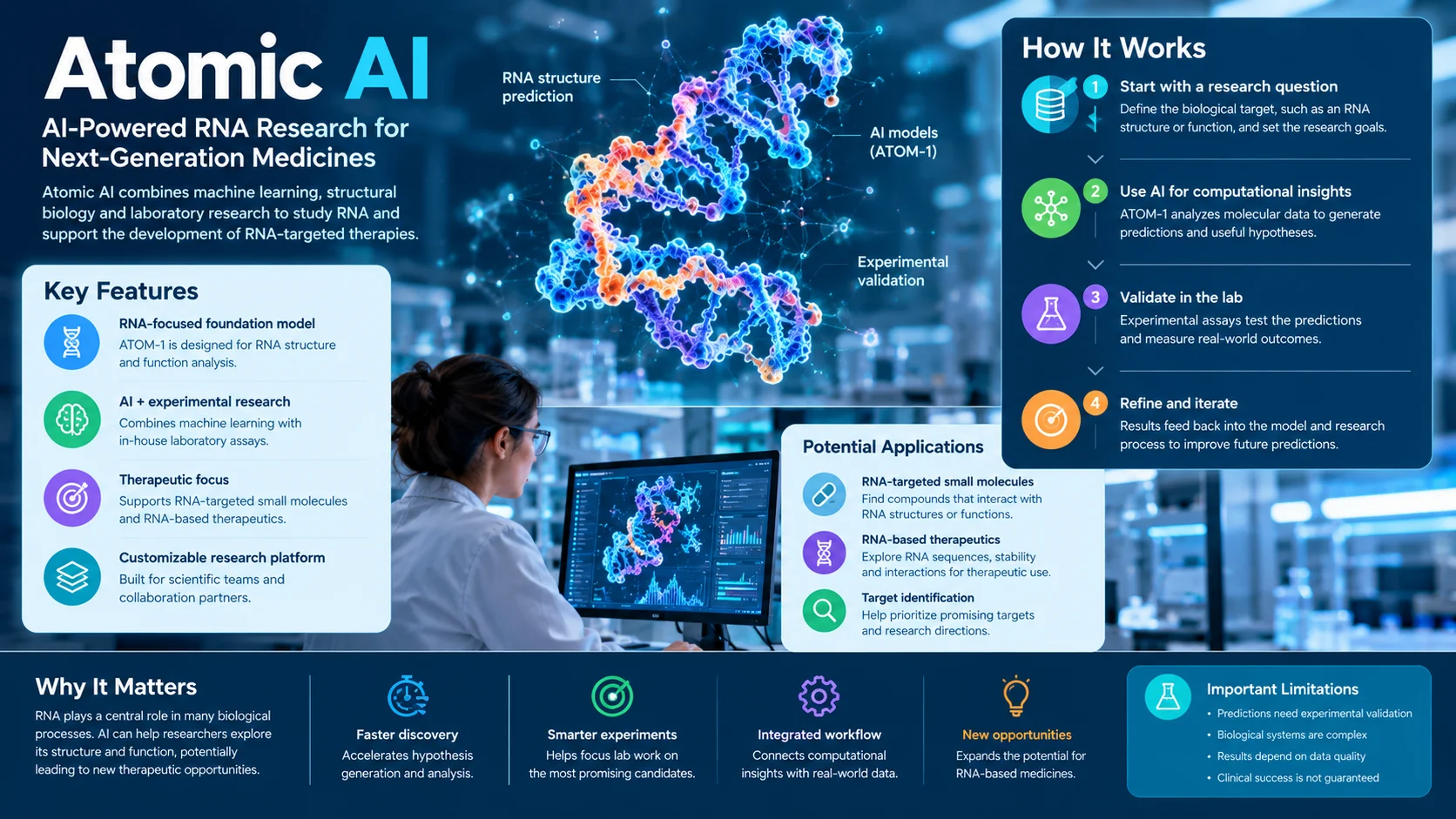
Atomic AI is a biotechnology company that combines artificial intelligence, machine learning, and structural biology to study RNA and support the development of RNA-targeted medicines. Its ATOM-1 foundation model and experimental research platform aim to improve understanding of RNA structure and function for potential therapeutic applications.
The term Atomic AI can refer to more than one product or company, so identifying the intended service matters. The biotechnology company at Atomic.ai focuses on RNA research and drug discovery, rather than providing a general-purpose chatbot.
This distinction is important for anyone researching the technology. The company works at the intersection of computational biology and pharmaceutical research, where AI models can help scientists investigate biological structures and identify potential therapeutic opportunities.
This guide explains Atomic AI’s core technology, its potential applications, the challenges of AI-driven drug discovery, and how it differs from other products using the same name.
Atomic AI at a Glance
- Primary focus: RNA research and computational drug discovery.
- Company: Atomic AI, based in San Francisco, California.
- Core technology: Machine learning combined with structural biology and laboratory experimentation.
- Named model: ATOM-1, an RNA-focused foundation model developed by the company.
- Potential applications: RNA structure and function research, RNA-targeted small molecules, and RNA-based therapeutics.
- Important limitation: Computational predictions are research tools, not proof that a treatment will be safe or effective in humans.
What Is ATOM-1?
ATOM-1 is Atomic AI’s proprietary foundation model for RNA. The company describes it as the central component of a research platform that combines machine learning with in-house laboratory assays.
To understand why this matters, it helps to distinguish RNA research from conventional software development.
RNA is a biological molecule involved in carrying genetic instructions, regulating cellular processes, and producing proteins. Its structure influences how it interacts with other molecules, making RNA an important subject in therapeutic research.
How an RNA Foundation Model Works
A foundation model learns patterns from data and can then support multiple related tasks. In biology, those patterns may represent relationships between molecular sequences, structures, and functions.
An RNA-focused model aims to help researchers investigate those relationships computationally. Depending on the model and its validated capabilities, predictions may help identify promising research directions or guide experimental design.
Atomic AI’s public website identifies ATOM-1 as its proprietary RNA foundation model. However, the public-facing description alone does not establish every technical specification, benchmark result, or experimentally validated capability.
Why RNA Structure Matters
RNA is not simply a string of genetic letters. Its molecules can fold into three-dimensional structures that affect how they behave in biological systems.
Understanding those structures can help scientists investigate questions such as:
- Which regions of an RNA molecule might interact with another molecule?
- How could a structural change affect biological activity?
- Which molecular sites might be worth testing as potential drug targets?
- How can researchers prioritize experiments when laboratory resources are limited?
These questions illustrate the broader value of computational biology. They should not be mistaken for a claim that ATOM-1 has already answered every question or produced a clinically approved medicine.
How Atomic AI Combines Machine Learning With Laboratory Research
A central feature of Atomic AI’s stated approach is the integration of computational predictions with experimental biology.
The company’s platform combines ATOM-1 with purpose-built, in-house wet-lab assays. This creates a research process in which computational models and laboratory measurements can inform further investigation.
The general workflow can be understood in four stages.
1. Define a Biological Research Question
Researchers begin with a question about RNA structure, function, or a potential therapeutic target. The precise question depends on the disease area and research program.
A clear research question helps determine what data and experiments are relevant.
2. Generate Computational Predictions
Machine learning can help researchers analyze molecular information and generate hypotheses. Instead of relying entirely on manual analysis, scientists can use computational methods to explore patterns and prioritize possible directions.
Predictions remain hypotheses until supported by suitable evidence.
3. Test Predictions Experimentally
Wet-lab assays measure biological properties under controlled experimental conditions. These measurements help researchers determine whether a computational prediction agrees with observed behavior.
Experimental validation matters because biological systems are complex. A model may identify a promising pattern without capturing every relevant factor.
4. Refine the Research Process
Experimental results can inform subsequent modeling and research decisions. When the process is designed appropriately, each round of testing can improve the evidence available for the next round.
This approach is not unique to Atomic AI. It reflects a broader strategy in AI-driven drug discovery: combine computational efficiency with biological verification rather than treating model output as a final answer.
Main Applications of Atomic AI
Atomic AI describes its research focus as developing RNA-centric medicines, including RNA-targeted small molecules and RNA-based therapeutics.
These categories have different scientific objectives.
RNA-Targeted Small-Molecule Discovery
Many conventional small-molecule drugs target proteins. RNA can also present molecular structures that researchers may investigate as potential binding sites for small molecules.
RNA-targeted drug discovery seeks compounds that interact with particular RNA structures or influence their biological behavior.
AI may help researchers prioritize candidate molecules, examine structural relationships, and narrow the set of possibilities for experimental testing. The usefulness of any prediction depends on the model, the biological target, and subsequent validation.
RNA-Based Therapeutics
RNA-based medicines use RNA or RNA-related mechanisms to produce a therapeutic effect. Different approaches can work through different biological pathways, so they should not be treated as one uniform technology.
AI can potentially contribute to research involving RNA sequence, structure, stability, or interactions. Whether a particular model supports a specific task must be established from technical documentation and experimental evidence.
Atomic AI publicly identifies RNA-based therapeutics as part of its broader research direction. That does not, by itself, confirm the clinical status of any particular candidate.
Target Identification and Research Prioritization
Drug discovery involves many possible biological targets and experimental paths. Computational models can help organize this search by highlighting hypotheses that deserve further examination.
A useful model should do more than generate plausible predictions. Researchers need to know whether those predictions generalize beyond training data and remain useful in relevant experimental settings.
The practical value lies in helping scientists make better-informed research decisions, not in eliminating the need for scientific judgment.
Benefits and Limitations of Atomic AI
AI-driven molecular research offers opportunities, but it also faces substantial scientific constraints.
Potential Benefits
- Faster hypothesis generation: Computational analysis can help researchers explore molecular patterns and identify promising questions.
- Better experiment prioritization: Models may help focus laboratory work on candidates that warrant further investigation.
- Integrated research workflows: Combining computational predictions with experimental assays can connect model development to biological evidence.
- Specialized modeling: RNA-focused systems can be designed around problems that general-purpose language models were not built to solve.
- Potential therapeutic opportunities: Better understanding of RNA structure and function may contribute to future drug discovery.
These are potential advantages of the research approach, not independently verified performance claims about every Atomic AI program.
Important Limitations
Prediction errors: A model may produce plausible but incorrect predictions about molecular behavior.
Biological complexity: RNA function can depend on cellular context, molecular interactions, and conditions that are difficult to represent fully in a model.
Data quality: Biased, incomplete, or noisy training data can limit model performance.
Experimental cost: Laboratory testing remains necessary and can require specialized equipment, materials, and expertise.
Clinical uncertainty: Successful computational predictions do not establish safety, effectiveness, or regulatory approval in humans.
Limited public information: Not every detail of a proprietary research platform may be publicly available. Independent evaluation requires access to suitable methods, data, and validation results.
The key distinction is between a model that generates useful research hypotheses and a therapeutic candidate that has demonstrated clinical benefit. Those are very different milestones.
Atomic AI vs. Other AI Products With Similar Names
One of the most important findings when researching this keyword is that Atomic AI is an ambiguous name. Search results include unrelated software products, so users should confirm the company and domain before signing up or evaluating a product.
| Product | Primary purpose | Target audience | Key distinction |
|---|---|---|---|
| Atomic AI | RNA research and drug discovery | Biotech researchers and pharmaceutical teams | Proprietary RNA foundation model and experimental research |
| Atomic.io Atomic AI | AI-assisted customer experiences and workflow automation | Businesses using the Atomic platform | AI steps inside customer-facing Action Flows |
| Atomic Chat | Conversational AI on mobile devices | Individual users | Android app focused on running AI models locally, with additional provider options described in its listing |
| Atomic | AI-augmented knowledge management | Knowledge workers and technical users | Markdown notes organized into a connected knowledge graph |
Sources: official company and product documentation.
These products are not interchangeable. A researcher investigating RNA drug discovery should begin with Atomic.ai, while someone seeking a mobile chatbot or workflow automation platform needs a different product.
Atomic AI vs. General-Purpose AI Models
General-purpose language models can help with literature reviews, code, summarization, and research planning. However, a language model’s ability to discuss biology does not automatically make it a validated molecular prediction system.
A specialized RNA model has a different purpose. It is intended to analyze biological problems using representations and methods appropriate to RNA research.
The comparison should therefore focus on the task being performed, the evidence supporting the output, and whether the system has been validated for that task. A general chatbot may help organize research, while a specialized model may contribute to a molecular analysis workflow.
Neither should replace experimental evidence or qualified scientific judgment.
Pricing, Access, and Commercial Availability
Atomic AI’s public website describes its proprietary research platform but does not provide a standard self-service subscription price in the material reviewed for this article.
That is not unusual for specialized biotechnology platforms. Access may depend on research partnerships, collaboration arrangements, or other commercial discussions rather than a public monthly subscription.
Organizations considering the platform should ask:
- Is access available for external researchers or only through selected collaborations?
- What data, software, or experimental capabilities are included?
- Are there licensing fees or project-specific research costs?
- Can researchers independently examine model outputs and validation methods?
- What intellectual-property terms apply to discoveries made through a collaboration?
- Are there restrictions on data sharing, publication, or commercial use?
These are due-diligence questions, not claims about Atomic AI’s current contract terms.
Do not confuse pricing information for another product named Atomic AI with the biotechnology company’s commercial arrangements. Similarly named products may have entirely different pricing structures.
Privacy, Data Governance, and Research Transparency
Scientific data can include unpublished findings, proprietary molecular designs, patient-related information, or confidential commercial research. Organizations should establish how these data will be handled before using any external AI service.
For Atomic AI, prospective collaborators should review the applicable agreements and technical documentation rather than infer data practices from the company’s general research description.
Questions Researchers Should Ask
Data handling: Where are submitted sequences, experimental results, and other research data processed and stored?
Retention: How long does the provider retain submitted information, and can the organization request deletion?
Model training: Can confidential inputs be used to train or improve models?
Access controls: Which personnel can access research data, and how are permissions managed?
Research ownership: Who owns newly generated data, predictions, and intellectual property?
Independent validation: What documentation is available to assess the reliability and reproducibility of model outputs?
Security certifications, if offered, should be assessed according to their actual scope. A certification alone does not establish zero data retention or guarantee that all research information remains confidential.
Who Should Consider Atomic AI?
Atomic AI’s RNA-focused research platform is most relevant to organizations investigating the molecular biology of RNA and potential therapeutic applications.
- Biotechnology researchers: May find the platform relevant when investigating RNA structure and function.
- Pharmaceutical research teams: May evaluate it as part of a broader drug discovery workflow.
- Computational biologists: May be interested in how specialized foundation models interact with experimental data.
- Research partnerships: May explore whether the company’s capabilities align with a specific therapeutic program.
It is less directly relevant to people seeking a general chatbot, an AI writing assistant, or an off-the-shelf productivity application.
For potential research partners, the decision should depend on scientific fit, evidence quality, access conditions, data governance, and the ability to validate results.
Frequently Asked Questions About Atomic AI
1. What does Atomic AI do?
Atomic AI develops AI technology for RNA research and drug discovery. Its public website describes ATOM-1, a proprietary RNA foundation model, alongside a research platform that combines machine learning with laboratory assays.
2. What is ATOM-1?
ATOM-1 is Atomic AI’s proprietary foundation model for RNA. The company describes it as a tool for predicting RNA structure and function, although individual capabilities and performance should be assessed using technical documentation and validation evidence.
3. Is Atomic AI a free AI chatbot?
The biotechnology company at Atomic.ai is focused on RNA research rather than a general-purpose chatbot. Its public website does not list a standard self-service subscription price in the material reviewed here.
4. Can Atomic AI help discover new medicines?
AI-based RNA research may help scientists investigate molecular targets and prioritize potential drug candidates. However, computational predictions require experimental validation, and they do not establish that a candidate will be safe or effective in humans.
5. Is Atomic AI the same as Atomic.io or Atomic Chat?
No. Atomic AI at Atomic.ai focuses on RNA research, Atomic.io provides a customer-experience platform with AI-assisted workflows, and Atomic Chat is a separate mobile AI application. They serve different purposes and should be evaluated independently.
Conclusion
Atomic AI represents a specialized application of artificial intelligence in biotechnology. Its combination of RNA-focused machine learning and laboratory research aims to help scientists investigate molecular structure, function, and potential therapeutic opportunities.
The most important factors are the scientific evidence behind its predictions, the availability of independent validation, and the platform’s fit with a research program. Prospective users should also confirm access arrangements, commercial terms, and data governance requirements.
For biotechnology teams, Atomic AI may be worth investigating as a potential research partner. For users seeking a general chatbot or productivity assistant, the similarly named alternatives may be more relevant.