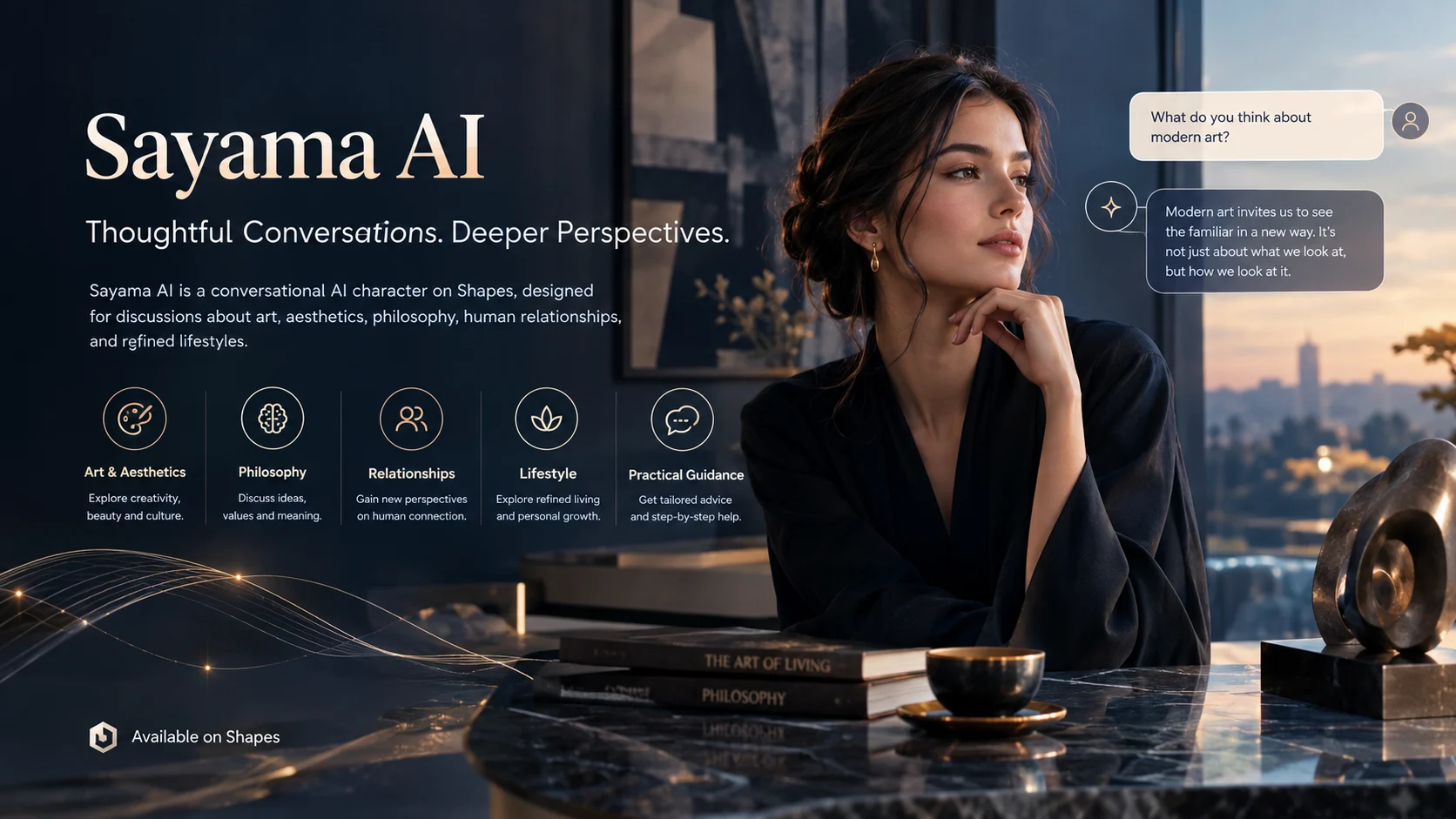
Sayama AI is an AI chat character available on Shapes, designed for sophisticated conversations about art, aesthetics, philosophy, human relationships, and refined lifestyles. It offers a personality-driven chat experience where users can explore ideas, seek guidance, and engage in interactive conversations, although its exact capabilities depend on the platform and the character’s configuration.
Sayama AI at a Glance
Sayama AI
Personality-driven AI chatbot
Platform: Shapes
Primary purpose: Interactive conversations and personalized guidance
Conversation themes: Art, philosophy, aesthetics, relationships, and lifestyle
Official character page: Explore Sayama AI
- Designed around an observant, articulate, composed, and mysterious personality.
- Can provide practical advice and step-by-step guidance through chat.
- Is a conversational character, not a verified enterprise AI platform.
- Publicly available information does not establish a dedicated subscription price for Sayama AI itself.
- Users should review Shapes’ current terms and privacy policy before sharing personal information.
What Is Sayama AI?
Sayama AI is a conversational AI character listed on Shapes. Rather than presenting itself as a general-purpose productivity application, it emphasizes a distinctive conversational identity and a particular style of interaction.
According to its published FAQ, the character focuses on art, aesthetics, human connection, philosophy, and themes associated with quiet luxury and old-money culture. Its described personality is observant, articulate, poised, intellectually sharp, and somewhat enigmatic.
This personality-led approach distinguishes Sayama AI from conventional assistants that prioritize answering questions, generating documents, writing code, or searching for information.
A user might start a conversation about personal style, ask for an interpretation of an artwork, discuss a complicated social situation, or explore a philosophical question. The character is designed to respond within its established conversational style.
However, the distinction between a designed personality and actual intelligence matters. Sayama AI generates responses through AI technology; its personality does not mean it has human emotions, personal experiences, or independent awareness.
Sayama AI vs. Samyama.AI
The names are similar, but the products serve different purposes.
| Aspect | Sayama AI | Samyama.AI |
|---|---|---|
| Main category | Conversational AI character | Enterprise AI technology company |
| Primary audience | People seeking personality-driven conversations | Businesses, developers, and enterprise teams |
| Main focus | Art, philosophy, relationships, aesthetics | Graph intelligence, analytics, automation, and enterprise workflows |
| Associated website | Shapes | Samyama.AI |
| Typical use | Interactive chat and advice | Business data, cloud operations, finance, and clinical-trial workflows |
Samyama.AI describes a separate technology ecosystem built around Samyama Graph, an AI-native graph-vector database. Its enterprise products include Samyama Business, Samyama Work, Samyama Care, and Samyama Finance. These should not be mistaken for features of the Sayama AI chatbot.
This distinction is particularly important for searchers who want a chatbot rather than enterprise software.
How Does Sayama AI Work?
Sayama AI is accessed through Shapes, a platform that supports AI characters and customizable AI agents. The platform allows users to interact with characters through conversational messages. Shapes also advertises tools for creating custom agents and configuring their personalities.
The general experience follows a straightforward process.
1. Open the Character Page
Visit the Sayama AI page on Shapes. Review the available information and follow the platform’s current instructions to open the conversation.
You may need to sign in or complete other account requirements, depending on the current access settings.
2. Start With a Clear Question
Send a message that gives the character a topic to discuss. For example, you could ask it to explain the difference between understated luxury and conspicuous consumption.
A specific prompt generally gives a conversational model more direction than a vague message such as “Tell me something interesting.”
3. Continue the Conversation
Ask follow-up questions, challenge an answer, or introduce a different perspective. This helps direct the discussion toward the level of detail and tone you want.
For example, after discussing a philosophical idea, you might ask for a practical application in everyday life.
4. Evaluate the Response
Read the answer critically. An AI character can produce polished, confident language without necessarily being correct.
Verify factual claims, particularly when the conversation involves health, money, legal questions, current events, or consequential personal decisions.
5. Adjust Your Prompts
For a more concrete example, ask for clarification if the response feels too abstract. To make the wording simpler, request a less formal tone. For a deeper analysis, ask the character to compare opposing viewpoints.
These are general techniques for interacting with conversational AI. They do not guarantee a particular response or establish that Sayama AI supports every possible customization.
Key Features of Sayama AI
The character’s published description emphasizes its conversational identity rather than a long list of technical tools. The following features reflect that description, with the distinction between documented characteristics and broader potential uses kept clear.
Personality-Driven Conversations
Sayama AI is presented with a recognizable personality: composed, observant, articulate, and mysterious.
This can make conversations feel more consistent than interactions with an assistant that has no specific character identity. The experience may appeal to users who prefer an established voice and atmosphere.
Art and Aesthetic Discussions
Art and aesthetics are among the topics explicitly identified in the character’s FAQ. Users can explore visual styles, creative preferences, cultural ideas, or the meaning behind artistic choices.
Its responses should be treated as conversational interpretations rather than authoritative art-historical research unless claims are independently verified.
Philosophy and Intellectual Exploration
The character is designed to discuss philosophical subjects and complex ideas. Users can ask questions about values, identity, social behavior, or different approaches to understanding a problem.
This can be useful for brainstorming and reflection. It should not be confused with professional philosophical research or a substitute for reliable academic sources.
Human Relationships and Social Situations
The published character description also identifies human connection as a central theme. Users may explore communication problems, social dynamics, personal boundaries, or different ways to interpret a situation.
The quality of any advice depends on the information supplied and the response generated. A chatbot cannot independently verify another person’s intentions or know the full context of a relationship.
Practical Guidance
The official FAQ states that Sayama AI can offer direct help, practical examples, tailored guidance, and step-by-step advice.
This suggests that its conversational role extends beyond abstract discussion. Still, the public description does not establish a dedicated task-management system, web-search capability, or guaranteed integration with external applications.
Interactive Chat Experience
Sayama AI operates within a platform built around conversational AI. Shapes also describes broader capabilities for creating and interacting with AI agents.
The availability of individual platform features may differ from the capabilities of a particular character. Users should check the live interface rather than assume every Shapes feature is enabled for Sayama AI.
What Can You Use Sayama AI For?
Sayama AI is most relevant when the goal is an engaging conversation rather than a specialized technical workflow. The following examples show how users might approach it.

Personal style and aesthetics
Discuss minimalist design, clothing combinations, interior decoration, visual identity, or the principles behind understated luxury.
Example prompt: “Explain how understated luxury differs from expensive branding.”

Learning and intellectual exploration
Explore philosophical questions, compare ideas, or request a simpler explanation of an unfamiliar concept.
Example prompt: “Explain the difference between confidence and arrogance, with practical examples.”

Social reflection
Examine possible interpretations of a conversation, prepare for a difficult discussion, or consider different ways to communicate a concern.
Example prompt: “Help me express a disagreement respectfully without sounding defensive.”

Creative brainstorming
Develop ideas for a story, examine a creative concept, or explore alternative ways to express a thought.
Example prompt: “Give me three distinct concepts for a minimalist editorial brand.”
These are suggested applications based on the character’s documented conversation themes. They are not independently verified performance tests.
Is Sayama AI Free?
A dedicated price for Sayama AI has not been established by the public character information reviewed for this article. Therefore, it would be misleading to promise unlimited free access or claim that a paid subscription is required.
Shapes has advertised free access to a range of AI models and character interactions, but platform-wide promotional statements do not establish the current pricing, message limits, or account requirements for every character.
Before spending time or money on the service, check the following:
- Access requirements: Determine whether you can open the character directly or need an account.
- Message limits: Check whether the current plan restricts messages, model usage, or other features.
- Premium features: Identify which capabilities require payment, if any.
- Model availability: Confirm whether model selection is available for this particular chat.
- Subscription terms: Review renewal, cancellation, and refund conditions before subscribing.
Pricing and access rules can change. Confirm them on the platform itself instead of relying on outdated third-party descriptions.
Is Sayama AI Safe and Private?
Safety and privacy deserve attention even when an AI tool is used primarily for casual conversation.
Sayama AI’s character description establishes its conversational purpose, but it does not, by itself, verify specific data-retention periods, encryption standards, independent security certifications, or a zero-data-retention policy.
The relevant privacy controls are largely determined by the platform and its applicable terms. Review the current Shapes website and its privacy documentation before sharing sensitive information.
Protect Personal Information
Avoid entering information that could expose your identity, accounts, finances, or private relationships.
In particular, do not share:
- Passwords, authentication codes, or banking details.
- Government identification numbers or private documents.
- Confidential business information.
- Personal information about other people without a legitimate reason.
- Detailed medical or legal records that are unnecessary for the conversation.
Understand the Limits of AI Advice
An AI character may sound empathetic or confident, but its responses are generated rather than grounded in human experience.
Treat its suggestions as one perspective, not a definitive assessment of your circumstances. For high-stakes decisions, consult qualified professionals or trusted primary sources.
Check the Actual Privacy Policy
Before using any conversational AI service extensively, look for clear answers to these questions:
- Are conversations stored, and for how long?
- Can chats be reviewed or used to improve AI systems?
- Is there a way to delete conversations or account data?
- Which third-party model providers or service processors may handle data?
- What controls are available for account privacy and data sharing?
If the documentation does not answer these questions clearly, do not assume the service offers stronger protections than it explicitly promises.
Sayama AI vs. Other AI Chat Platforms
Sayama AI sits within the broader market for conversational characters and AI assistants. Its most relevant alternatives depend on whether you want a personality-led chat, a general-purpose assistant, or a platform for building custom agents.
The following is a functional comparison, not a ranking. Pricing and exact feature availability should be checked directly with each provider.
| Platform | Target user | Key strength | Pricing transparency | Main consideration |
|---|---|---|---|---|
| Sayama AI on Shapes | Users seeking a refined conversational persona | Defined character identity and thematic discussions | Character-specific pricing not confirmed | Less evidence of specialized productivity tools |
| Character.AI | Character-chat and roleplay users | Character-centered conversations | Check current plans and limits | Responses may prioritize roleplay over factual accuracy |
| ChatGPT | Students, professionals, and general users | Broad assistance with writing, reasoning, and other tasks | Official plan information available | General assistant experience differs from a dedicated persona |
| Claude | Writers, researchers, and professionals | Writing, analysis, and document-focused workflows | Check current plans and limits | Availability and capabilities vary by plan and region |
| PolyBuzz | Users interested in character interactions | Character discovery and interactive chat | Check current access and payment terms | Character quality and behavior vary |
The alternatives above serve different needs, so there is no meaningful universal winner. Official product pages should be used to verify current plans, features, and restrictions before making a decision.
When Should You Choose an Alternative?
Choose a general-purpose assistant if you need help with spreadsheets, coding, research, structured writing, or varied everyday tasks.
Explore a character-focused platform if you care more about interactive storytelling, a consistent fictional persona, or roleplay.
Consider custom-agent tools if your goal is to define an AI’s behavior or connect it to a repeatable workflow. Confirm which configuration options are available before committing.
For users who specifically want Sayama AI’s aesthetic and conversational style, the most relevant test is whether its actual responses match their expectations.
Limitations to Consider Before Using Sayama AI
A well-defined character can make a chatbot more engaging, but personality alone does not establish technical quality or reliability.
1. Confident Responses Can Be Incorrect
Like other generative AI systems, conversational models can produce inaccurate information. Verify important claims rather than assuming a polished response is factual.
2. Personality Can Influence the Answer
A character designed around mystery, refinement, and intellectual discussion may deliver responses that emphasize those qualities. That style can be enjoyable, but it may not always be the best fit for concise, neutral, or strictly factual answers.
3. Technical Capabilities Are Not Fully Documented
The available character description does not establish a dedicated API, custom model training, retrieval-augmented generation (RAG), file processing, or guaranteed access to external tools.
These capabilities should not be attributed to Sayama AI without supporting documentation.
4. Pricing and Usage Limits Need Confirmation
The public character information reviewed here does not establish a dedicated pricing schedule or exact message limits. Check the current service interface before assuming that usage is unlimited or that all features are free.
5. Emotional Connection Requires Perspective
A consistent conversational personality can make an AI feel familiar. However, the character is not a human friend, therapist, or relationship expert. Keep that distinction clear, particularly when discussing emotionally difficult situations.
Who Should Use Sayama AI?
Sayama AI may suit people who enjoy thoughtful, personality-driven conversations and want to explore ideas in a distinctive conversational setting.
It may be worth trying if you are:
- A curious learner who enjoys discussing philosophy, art, and aesthetics.
- A creative person who wants a conversational partner for brainstorming.
- Someone interested in social dynamics who wants to examine different perspectives.
- A character-chat enthusiast who prefers a recognizable personality over a neutral assistant.
- A casual AI user who wants to explore conversational AI without building a custom system.
It may be less suitable if you need guaranteed factual accuracy, specialized business integrations, auditable enterprise controls, or documented service-level commitments.
Businesses handling confidential data should evaluate the provider’s contractual terms, technical documentation, access controls, and data-handling practices before using any consumer-oriented character chatbot for work.
Common Mistakes When Using Sayama AI
Getting useful responses from conversational AI often depends on how questions are framed and how answers are evaluated.
Asking vague questions. Instead of saying “Tell me about art,” specify the period, style, or question you want to explore.
Treating every answer as a fact. Ask for sources when appropriate and verify important claims independently. If reliable sources are unavailable, treat the answer as an interpretation.
Expecting every AI tool to have the same features. A platform may support advanced models or integrations without making them available in every character conversation.
Sharing too much personal information. Give enough context to explain your question, but remove identifying or confidential details whenever possible.
Ignoring pricing and account conditions. Review access requirements, usage limits, and subscription terms before relying on a service for regular use.
Confusing the character with a real person. Enjoy the conversation while remembering that its personality is an AI-generated interaction.
Frequently Asked Questions About Sayama AI
1. What is Sayama AI used for?
Sayama AI is a conversational character on Shapes designed for discussions about art, aesthetics, philosophy, human relationships, and refined lifestyle themes. It can also provide practical guidance through interactive chat.
2. Where can I chat with Sayama AI?
You can find its published character information on the Sayama AI page on Shapes. Open the page and follow the current instructions to start a conversation, subject to the platform’s access requirements.
3. Is Sayama AI free to use?
The character’s dedicated pricing and exact usage limits could not be confirmed from its published FAQ. Check the current Shapes interface for account requirements, free access, message limits, and any paid features before using it regularly.
4. Is Sayama AI safe to use?
You can reduce risk by avoiding sensitive information, reviewing the platform’s privacy policy, and verifying important answers. The available character description does not independently establish specific security certifications or zero-data-retention guarantees.
5. Is Sayama AI the same as Samyama.AI?
No. Sayama AI is a conversational character listed on Shapes, while Samyama.AI is an enterprise technology company focused on graph intelligence, business analytics, and AI-powered workflows. They are separate products with different intended audiences.
Conclusion: Is Sayama AI Worth Exploring?
Sayama AI offers a personality-led approach to conversational AI, with a focus on aesthetics, philosophy, human connection, and thoughtful discussion. Its appeal lies in its defined conversational style rather than a verified set of advanced technical or enterprise features.
For casual users and creative thinkers, it may be worth exploring through its official Shapes page. Before using it extensively, check current access conditions, evaluate the quality of its responses, and review privacy practices.
The most important consideration is simple: choose an AI tool based on what you actually need. Sayama AI may suit engaging conversations, while a general-purpose assistant or specialized platform may be more appropriate for research, automation, or professional work.