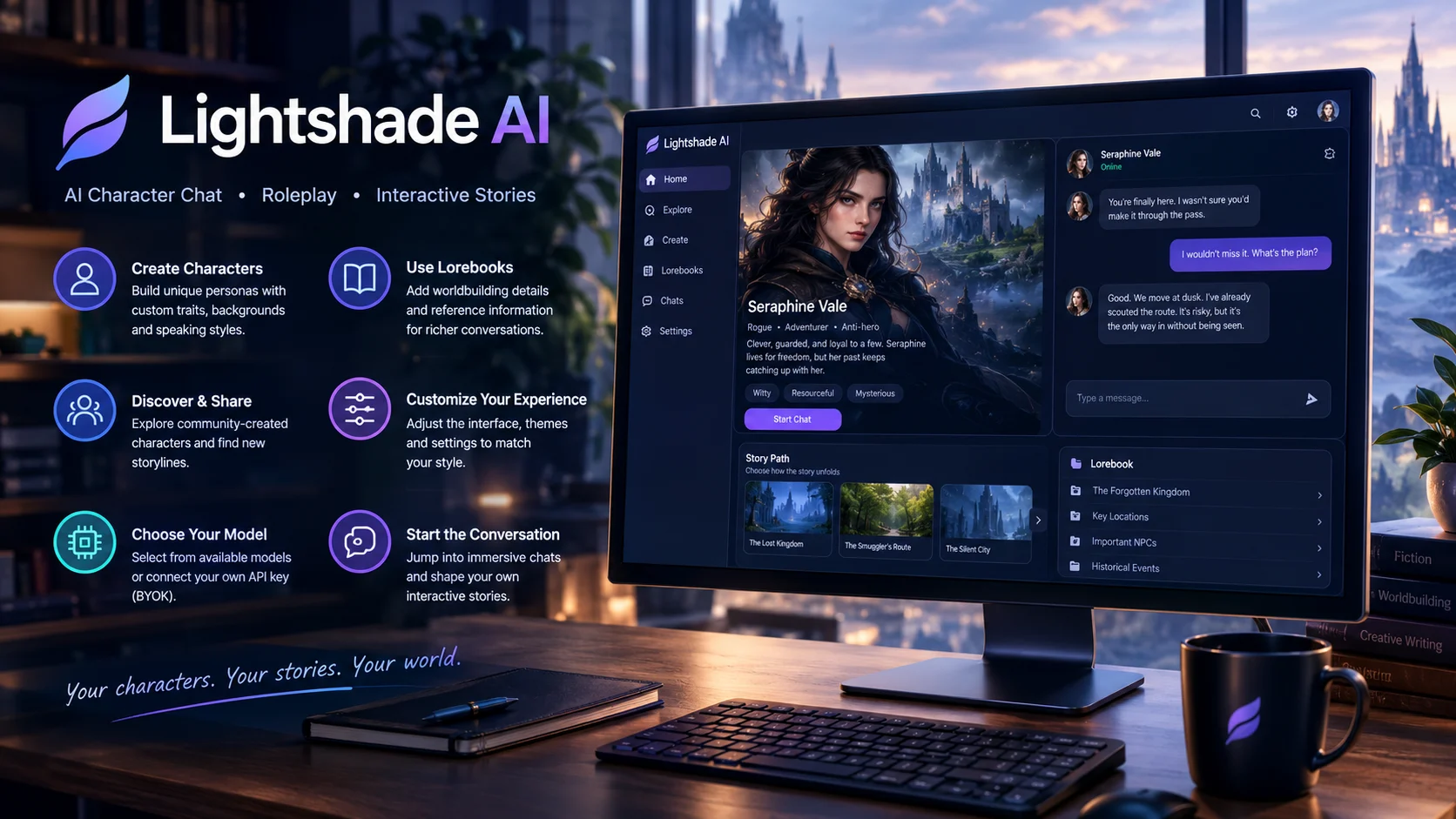
Lightshade AI is an AI character-chat and roleplay platform designed for users who want to create personalized characters, develop fictional scenarios, and customize their conversations. Its reported features include character discovery, persona settings, lorebooks, interface customization, and model configuration, but users should verify current availability, pricing, and privacy terms before committing.
At a Glance
- Primary purpose: AI character conversations, interactive storytelling, and roleplay.
- Character customization: Personas and character descriptions help shape interactions.
- Worldbuilding: Lorebooks can provide relevant background information during conversations.
- Model flexibility: Model configuration and Bring Your Own Key (BYOK) options have been reported, but current support should be confirmed.
- Main consideration: Conversation quality depends on the model, instructions, context, and platform configuration.
- Before signing up: Check current costs, data handling, usage limits, and available models.
Editorial note: This review distinguishes reported platform capabilities from independently verified facts. Features and policies can change, and the findings below should not be treated as a guarantee of current availability.
What Is Lightshade AI?
Lightshade AI is a platform for chatting with AI-generated characters and building interactive fictional experiences. Instead of using an AI chatbot mainly to answer questions, users can create personalities, establish fictional settings, and continue conversations within a chosen scenario.
The platform’s website has been associated with Lightshade.cloud. Independent coverage published in September 2026 describes features such as customizable chat layouts, user personas, lorebooks, character discovery, and model configuration. These details provide a useful starting point, although they are not a substitute for checking the current product directly.
Lightshade AI belongs to the broader category of AI roleplay platforms. These services use generative AI to produce dialogue and narrative responses based on a character’s description, previous messages, and the instructions supplied by the user.
Who is Lightshade AI designed for?
The platform may appeal to several types of users:
- Roleplay enthusiasts who enjoy interactive conversations with fictional characters.
- Creative writers who want to explore dialogue, character motivations, and alternative storylines.
- Worldbuilders who need consistent descriptions of fictional places, relationships, and histories.
- Character creators who want to publish original personalities and develop an audience.
- AI hobbyists who prefer experimenting with different language models and settings.
It is less suitable for someone looking primarily for a research assistant, a productivity chatbot, or a verified source of factual information. Those tasks require different tools and evaluation criteria.
How Does Lightshade AI Work?
At a basic level, AI character chat combines a character definition with a conversation history and a language model. The model uses this information to generate a response that attempts to match the character and the ongoing scene.
Lightshade’s reported features fit this general pattern, although the precise implementation and current model availability should be confirmed through the platform.
1. Create a profile and persona
A profile identifies the user within the platform. A persona provides additional information that can shape how fictional characters perceive and interact with that user.
For example, a user might define a persona as a detective who lives in a fictional city. That description gives the model background information to use when responding to relevant scenes.
A useful persona describes important traits without including unnecessary personal information.
2. Choose or create a character
Users can explore available characters or develop their own, depending on the platform’s current features and account access.
A character definition can include:
- Name and background
- Personality traits
- Speaking style
- Relationships with other characters
- Goals, motivations, and fears
- The setting in which the story begins
Specific instructions generally give a model more useful guidance than vague descriptions. A character described as reserved, observant, and reluctant to trust strangers has a clearer behavioral direction than one described simply as interesting.
3. Start a conversation
After choosing a character, the user sends a message and receives an AI-generated reply. The exchange continues as the model uses the available conversation context.
The result depends on more than the character description. The selected model, prompt quality, available context, and platform settings can all influence the writing.
4. Add background information with lorebooks
Independent reporting describes Lightshade’s lorebook system as a way to store reference material and introduce relevant entries when specified keywords appear.
A lorebook might contain details about a fictional kingdom, a character’s family, or the rules of a fantasy world. When the conversation touches on relevant information, the system can supply that background to the model.
This is useful for long-running stories, but a lorebook is not automatically the same as persistent memory. Keyword-triggered reference material helps the model access selected facts. It does not guarantee that every previous conversation will be remembered or that every detail will remain consistent.
5. Configure the AI model
Lightshade has also been reported to support shared models and a Bring Your Own Key approach. Under BYOK, users connect an API key from a supported AI provider and may be billed directly by that provider.
This option can offer more control over model selection, but it introduces additional setup and cost considerations. Current supported providers and models should be checked before relying on this feature.
Key Features of Lightshade AI
The following table summarizes the main capabilities described in available reporting. Availability may differ as the platform changes.
| Feature | What it does | Why it matters |
|---|---|---|
| AI character chat | Generates dialogue for fictional characters | Supports interactive storytelling |
| Character customization | Defines personality, background, and behavior | Gives conversations a clearer direction |
| User personas | Provides identity and background details for roleplay | Helps shape character interactions |
| Lorebooks | Supplies relevant fictional reference information | Supports worldbuilding and continuity |
| Character discovery | Helps users explore community-created characters | Makes it easier to find scenarios |
| Interface customization | Adjusts aspects of the chat’s appearance | Improves personal usability |
| Model configuration | May allow selection of available AI models | Gives users some control over response style |
| BYOK | Connects a user’s own supported API key | Can provide alternative model access and billing |
The most meaningful distinction is the combination of character-focused interaction and reported customization options. However, the existence of a feature does not guarantee that it works equally well across every model or account.
Character creation and personalization
Character design is central to AI roleplay. A well-written definition can establish how a character speaks, what they know, and how they react to different situations.
For stronger results, creators should specify observable behavior rather than relying on broad personality labels. For instance, a character who avoids direct answers when nervous is easier to portray consistently than one described only as mysterious.
Interface customization
Independent coverage describes controls for themes, text sizes, chat layouts, and visual effects. These settings can make long conversations more comfortable to read and easier to personalize.
Interface customization should not be confused with AI capability. Changing fonts, colors, or animations does not necessarily improve the model’s reasoning, memory, or writing quality.
Creator tools and discoverability
Reporting also describes character discovery pages and creator analytics. Such tools can help creators understand how their published characters are being used.
However, analytics are most useful when creators have enough real activity to interpret. A dashboard with very little traffic cannot reliably establish which characters will succeed over time.
Benefits of Using Lightshade AI
Lightshade AI may offer several practical advantages for users interested in character-based conversations.
Greater control over fictional characters
Detailed character definitions and reusable reference material give creators a structured way to develop personalities and settings. This can be useful for stories involving recurring characters, complicated relationships, or fictional histories.
More personalized conversations
A thoughtfully designed persona can help establish the user’s role in a story. Combined with character instructions, this may make interactions feel more specific than a generic chatbot exchange.
The outcome still depends on model behavior. No character definition can guarantee natural dialogue or perfect consistency.
Flexibility for AI enthusiasts
If BYOK and model selection remain available, technically curious users may be able to experiment with different providers instead of relying entirely on a platform’s shared model options.
This flexibility comes with a trade-off: users may need to understand API keys, provider restrictions, billing, and model compatibility.
Support for creative experimentation
Roleplay can be used to test dialogue, develop story openings, explore fictional conflicts, and brainstorm character decisions. Writers can also use conversations to discover alternative directions for a scene.
AI-generated content should still be reviewed for continuity, originality, and quality before being incorporated into a finished work.
Limitations and Things to Consider
Lightshade AI should not be evaluated solely on the strength of its feature list. Reliability, model quality, access, and data handling are equally important.
Model availability may change
An AI roleplay interface can depend on models supplied by external providers or shared through the platform. A model that works today may later become unavailable, change its terms, or encounter service interruptions.
An independent review describes Lightshade’s shared-model availability as subject to change.
Before building a long-term workflow around one model, check which alternatives are available and whether your characters and conversations can be exported.
Character consistency is not guaranteed
Language models can contradict earlier statements, repeat dialogue, forget details, or change a character’s behavior unexpectedly.
Lorebooks and detailed prompts can reduce some problems, but they cannot guarantee perfect recall. Long stories are especially challenging when important details fall outside the model’s active context.
Access and reliability need checking
Community reports have mentioned errors and changes in model availability during 2026. These reports are anecdotal and do not establish the platform’s current uptime, but they illustrate why a live test matters.
Check whether registration is open, whether messages generate successfully, and whether the features you need are accessible on your device.
The learning curve may be higher than expected
A basic character chat can be straightforward. Configuring an API key, selecting a model, writing effective character definitions, and managing lorebooks requires more effort.
Users who want to start chatting immediately may prefer a platform with fewer configuration steps.
AI responses can be inaccurate
Character chat is designed primarily for generated interaction, not factual verification. A model may invent historical details, misstate real-world facts, or confidently provide incorrect explanations.
Use trusted sources for medical, legal, financial, academic, or other high-stakes decisions.
Is Lightshade AI Free?
The answer depends on the current access model, the features available to your account, and whether you use a shared model or your own API key.
An independent review published in September 2026 describes shared-model access as free at the time of testing, while also noting that long-term model availability was not guaranteed. This is a dated third-party report, not a guarantee of today’s pricing.
There are two costs to distinguish:
- Platform costs: Any subscription, usage allowance, paid feature, or other fee charged by Lightshade itself.
- Model costs: Charges from an external AI provider when you use your own API key.
With BYOK, a platform may not charge for the underlying model calls, but the model provider can still charge according to its API pricing. Costs can depend on the model, the length of conversations, and the amount of input and output processed.
Before spending money, confirm:
- Whether a free option is currently available.
- Which models are included without an API key.
- Whether usage limits apply.
- Which provider rates apply to BYOK.
- Whether API spending limits can be configured with your provider.
- Whether any subscription and API charges are separate.
Do not assume that a free interface means unlimited AI generation.
Is Lightshade AI Safe and Private?
Privacy deserves careful attention on any AI character-chat platform. Conversations may contain personal thoughts, private creative writing, or information that users would not want shared publicly.
I could not establish a current, independently audited privacy standard for Lightshade AI from the sources reviewed. Therefore, users should not assume that conversations are confidential simply because a character or persona is marked private.
What should users check?
Before sharing sensitive information, review the platform’s current privacy policy and terms of service. Look for clear answers to these questions:
- Conversation storage: Are messages saved, and for how long?
- Model providers: Are conversations sent to external AI services?
- Training use: Can submitted messages be used to improve AI models?
- Account deletion: Can you delete your account, characters, and chat history?
- Public visibility: Which profile details, characters, and conversations can other users see?
- API key handling: How are keys stored, protected, and removed?
These are verification questions, not claims that Lightshade currently follows any particular data practice.
Does BYOK guarantee privacy?
No. Bring Your Own Key changes how model access and billing may work, but it does not automatically make a conversation private.
Depending on the implementation, messages may still pass through the platform before reaching an external provider. The provider’s own data policies also matter. An API key should never be treated as a substitute for reviewing those policies.
Similarly, a SOC 2 report, if a company has one, would not automatically establish zero data retention. These are different questions requiring separate evidence.
Practical advice: Use a unique password, protect API keys, avoid entering real financial or identification details, and verify the current privacy terms before using Lightshade for sensitive conversations.
Lightshade AI Alternatives and Competitors
Lightshade is not the only option for interactive AI storytelling. The right alternative depends on whether you prioritize convenience, character discovery, customization, or control over the underlying model.
The following comparison describes each platform’s general positioning. Pricing, availability, and individual features should be checked directly because they can change.
| Platform | Target user | Main strength | Pricing transparency | Main limitation |
|---|---|---|---|---|
| Lightshade AI | Users interested in customizable character chat | Reported persona, lorebook, and model controls | Verify current platform and API costs | Current access and model availability need checking |
| Character.AI | Mainstream character-chat users | Character creation and community discovery | Official help center covers subscriptions and billing | Responses can invent facts, and customization differs from model-level control |
| SillyTavern | Technical users and roleplay enthusiasts | Detailed prompts, characters, personas, and model connections | Interface is free and open source; model access may cost extra | Requires setup and a separate AI backend |
Character.AI documents its character-creation tools and explains that generated characters can produce inaccurate information.
+1 SillyTavern’s official documentation describes support for character cards, personas, world information, and local or cloud-based model connections.
Character.AI
Character.AI is worth considering if you want a familiar character-chat experience with community-created personalities. Its official creator documentation covers character names, greetings, descriptions, definitions, and sharing.
It may suit users who prefer a managed service over configuring their own AI provider. Check its current content policies and subscription terms before switching.
Website: character.ai
SillyTavern
SillyTavern takes a different approach. It is an open-source interface that connects to supported AI backends instead of supplying one universal model for every conversation.
Its documentation covers character prompts, personas, world information, and API connections. Users can also explore local models, although installation, hardware requirements, and configuration can be challenging.
It may be suitable if you want extensive control and are comfortable managing the technical setup.
Website: SillyTavern
How to choose between them
Start with your most important requirement:
- Easy access and character discovery: Compare Lightshade with Character.AI.
- Advanced configuration: Explore Lightshade’s currently available settings and SillyTavern’s documentation.
- Predictable spending: Compare platform subscriptions with API usage charges.
- Privacy control: Investigate data handling, provider policies, and local-model options rather than relying on marketing claims.
No platform should be considered superior for every user without comparable testing.
Who Should Use Lightshade AI?
Lightshade AI may be worth exploring if you enjoy creating fictional characters, writing interactive scenes, or experimenting with AI models.
It is particularly relevant to users who want more control over character definitions and storytelling context than a basic chat interface provides. People interested in reusable fictional settings may also appreciate the reported lorebook functionality.
However, beginners should consider the setup process, while advanced users should investigate model compatibility and API costs.
It may not be the right choice if you need guaranteed long-term service availability, verified enterprise security, factual research, or a platform with clearly documented privacy guarantees.
Tips for Getting Better Results from Lightshade AI
You do not need advanced AI knowledge to improve a roleplay conversation. A few practical adjustments can make character interactions more coherent.
Write specific character instructions
Describe how the character behaves, speaks, and reacts under pressure. Include relevant motivations and boundaries instead of relying on a list of personality adjectives.
Establish the scene clearly
Give the model a location, situation, and immediate objective. A clear opening scene provides more useful direction than a vague instruction to begin roleplaying.
Keep lorebook entries focused
Separate major facts into concise entries with relevant keywords. Avoid filling each entry with unrelated background information.
Test models with the same prompt
If multiple models are available, use the same character and opening message for each. Compare dialogue quality, consistency, response length, latency, and cost.
This is more informative than judging a model from a single unusually good or bad response.
Keep a backup of important creative work
Save character descriptions, worldbuilding notes, and valuable story passages outside the platform. This reduces the risk of losing work if access changes or a service becomes unavailable.
Frequently Asked Questions
1. What is Lightshade AI used for?
Lightshade AI is used for AI-generated character conversations, interactive roleplay, and fictional storytelling. Reported features include character customization, personas, lorebooks, and model configuration.
2. Is Lightshade AI free to use?
An independent September 2026 review reported free access to shared models at the time of testing. Current access, usage limits, and any paid features should be verified directly, and using your own API key may incur separate provider charges.
3. Does Lightshade AI support custom AI models?
Third-party reporting and community tutorials describe model configuration and BYOK support. However, the currently supported providers, models, and setup requirements should be confirmed before purchasing API credits or connecting an account.
4. Is Lightshade AI safe for private conversations?
Its current privacy protections cannot be established from the sources reviewed. Before sharing sensitive information, check the privacy policy, conversation retention rules, third-party model providers, account deletion options, and public-sharing settings.
5. What are the alternatives to Lightshade AI?
Character.AI is an option for mainstream character conversations and community discovery. SillyTavern is an option for users who want extensive configuration and access to different AI backends. Compare current policies, costs, and setup requirements before choosing.
Conclusion
Lightshade AI is an AI character-chat platform worth investigating if your primary interest is interactive storytelling, personalized characters, and configurable conversations. Its reported combination of personas, lorebooks, and model options offers useful possibilities for creative users.
The key is to distinguish feature descriptions from verified performance. Current model access, reliability, pricing, and privacy protections matter more than a long list of advertised capabilities.
Try the available experience with a non-sensitive conversation, test character consistency, and review the platform’s current terms. If you plan to use BYOK, check the provider’s charges and data policies first.
For users who value character creation and creative control, Lightshade may be a candidate to evaluate. The final decision should depend on your needs, your budget, and what you can verify firsthand