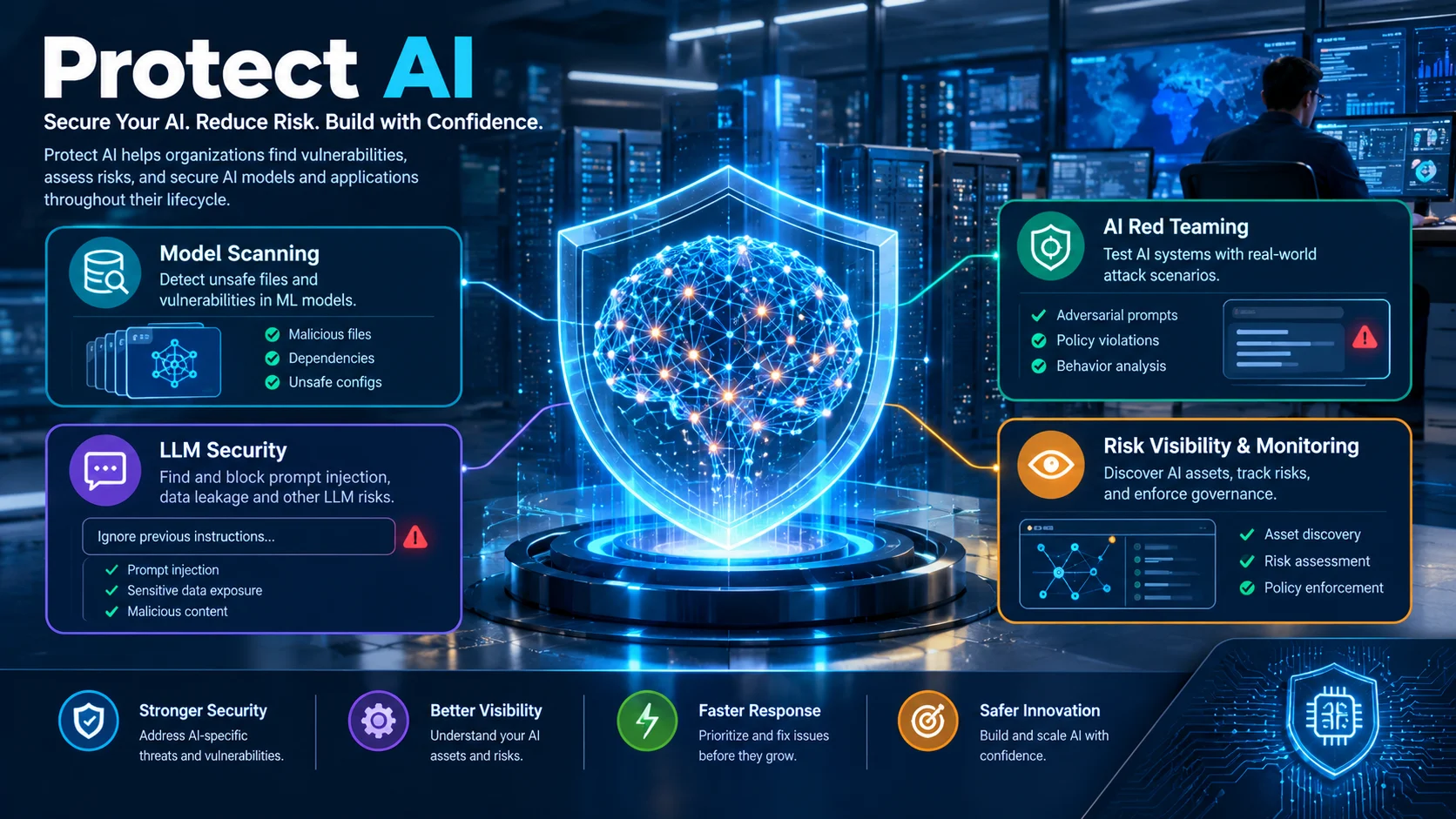
Protect AI is an AI security platform designed to help organizations identify vulnerabilities, assess risks, and protect AI models and applications throughout their lifecycle. Acquired by Palo Alto Networks in July 2025, its technology is being integrated into the Prisma AIRS security platform.
Protect AI at a Glance
Primary purpose
AI and machine learning cybersecurity.
Core capabilities
Model scanning, AI application testing, risk assessment, and runtime protection.
Target audience
Enterprise security teams, AI developers, and machine learning engineers.
Main concern
Security risks across AI models, development pipelines, and deployed applications.
Pricing
Enterprise pricing; confirm current terms with the provider.
What Is Protect AI?
Protect AI is a cybersecurity technology associated with securing artificial intelligence and machine learning systems. Its platform was developed to help organizations discover AI assets, identify vulnerabilities, test applications, and manage security risks.
Traditional cybersecurity tools often focus on networks, endpoints, applications, and cloud infrastructure. AI security introduces additional concerns, including malicious model files, prompt injection, data leakage, and weaknesses in machine learning pipelines.
Protect AI was founded in 2022 and was acquired by Palo Alto Networks in 2025. Its technology is relevant to organizations building custom models, integrating third-party AI services, or deploying generative AI applications.
What Does Protect AI Do?
The platform addresses several parts of the AI development and deployment process:
- Model security: Identify potentially unsafe machine learning model files.
- LLM security: Help detect and manage risks involving large language model applications.
- AI red teaming: Test AI systems for weaknesses through structured security assessments.
- Risk management: Improve visibility into AI assets and potential vulnerabilities.
- Runtime protection: Monitor or help defend AI applications while they operate, depending on the product and deployment.
These capabilities address different security problems. Organizations should confirm which products and integrations are currently available under Palo Alto Networks before making purchasing decisions.
Key Protect AI Features and Products
Protect AI’s portfolio has included tools for different stages of AI security. Product names and availability should be checked against the current Palo Alto Networks offering.
Model Security and Vulnerability Scanning
AI models can introduce security risks through unsafe files, dependencies, or untrusted sources. Model scanning helps identify suspicious components before they enter production environments.
Protect AI’s open-source portfolio includes ModelScan, which focuses on detecting unsafe serialized machine learning models. Scanning can reduce risk, but it cannot guarantee that every malicious or vulnerable component will be detected.
LLM Application Security
Large language models face threats that traditional application security may not fully address. These include prompt injection, attempts to expose sensitive information, and malicious instructions hidden in user-provided content.
Protect AI developed tools for inspecting LLM inputs and outputs. However, the status of individual tools matters: the official LLM Guard GitHub repository was archived on July 9, 2026, and its maintainers state that it is no longer actively developed or maintained. Organizations should assess this before adopting it for new production systems.
AI Red Teaming
AI red teaming involves deliberately testing an AI application to uncover weaknesses before attackers exploit them. Security teams can test whether a system reveals sensitive information, follows malicious instructions, or produces prohibited outputs.
Automated testing can increase test coverage, while human review helps identify issues that automated checks may miss. Results depend on the scenarios tested, the model, and the application’s configuration.
AI Risk Visibility and Governance
Organizations may deploy AI through internal development teams, external APIs, third-party models, and embedded software. This can make it difficult to maintain a complete inventory of AI assets and their associated risks.
AI security posture management helps teams discover AI resources, assess their configurations, and prioritize security work. Governance tools can also support policy enforcement and reporting, but organizations must still define their own acceptable-risk thresholds.
How Protect AI Works
A practical AI security workflow usually includes five stages:
1 Discover AI assets
Identify models, applications, datasets, dependencies, and deployment environments.
2 Scan for weaknesses
Inspect model files, configurations, dependencies, and AI application components.
3 Test AI behavior
Use security tests and red teaming to investigate prompt injection and data exposure risks.
4 Prioritize findings
Assess severity, exposure, business impact, and the likelihood of exploitation.
5 Remediate and monitor
Apply fixes, validate them, and continue monitoring deployed systems.
This workflow describes a general AI security process, not a guarantee that every stage is included in every Protect AI product or subscription. Confirm product coverage and integration requirements before implementation.
Protect AI Features and Products
Protect AI’s portfolio has historically included tools designed for various stages of AI security. However, product names and availability should always be verified against the current Palo Alto Networks offering.
Model Security and Vulnerability Scanning
AI models can introduce significant security risks through unsafe files, dependencies, or untrusted sources. Therefore, model scanning plays a critical role in identifying suspicious components before they ever enter production environments.
Specifically, Protect AI’s open-source portfolio includes ModelScan, a tool that focuses on detecting unsafe serialized machine learning models. While scanning can significantly reduce risk, it cannot guarantee that every malicious or vulnerable component will be detected.
LLM Application Security
Large language models face unique threats that traditional application security may not fully address. For instance, these include prompt injection, attempts to expose sensitive information, and malicious instructions hidden in user-provided content.
To address this, Protect AI developed specialized tools for inspecting LLM inputs and outputs. However, the status of individual tools matters: the official LLM Guard GitHub repository was archived on July 9, 2026, and its maintainers state that it is no longer actively developed or maintained. As a result, organizations should carefully assess this factor before adopting it for new production systems.
AI Red Teaming
AI red teaming involves deliberately testing an AI application to uncover weaknesses before attackers exploit them. Through this process, security teams can test whether a system reveals sensitive information, follows malicious instructions, or produces prohibited outputs.
In addition, automated testing can substantially increase test coverage, while human review helps identify subtle issues that automated checks may miss. Ultimately, results depend on the specific scenarios tested, the underlying model, and the application’s configuration.
AI Risk Visibility and Governance
Organizations frequently deploy AI through internal development teams, external APIs, third-party models, and embedded software. Consequently, maintaining a complete inventory of AI assets and their associated risks can become quite difficult.
To resolve this challenge, AI security posture management helps teams discover AI resources, assess their configurations, and prioritize security work. Moreover, governance tools can support policy enforcement and reporting, although organizations must still define their own acceptable-risk thresholds.
How Protect AI Works
A practical AI security workflow usually includes five sequential stages:
- Discover AI assets: First, identify models, applications, datasets, dependencies, and deployment environments.
- Scan for weaknesses: Next, inspect model files, configurations, dependencies, and AI application components.
- Test AI behavior: Then, use security tests and red teaming to investigate prompt injection and data exposure risks.
- Prioritize findings: Subsequently, assess severity, exposure, business impact, and the likelihood of exploitation.
- Remediate and monitor: Finally, apply fixes, validate them, and continue monitoring deployed systems.
Note that this workflow describes a general AI security process, rather than guaranteeing that every stage is included in every Protect AI product or subscription. Therefore, confirm product coverage and integration requirements before implementation.
Protect AI Pricing and Deployment
Protect AI’s enterprise offering has been listed through the AWS Marketplace, where pricing depends on the vendor’s contract terms and purchased entitlements. Because of this, a universal public price should not be assumed.
Before purchasing, be sure to ask the provider about:
- Licensing: Whether pricing depends on AI assets, applications, users, or usage.
- Deployment: Which cloud environments and architectures are supported.
- Integrations: Compatibility with existing security information and event management systems, development pipelines, and model platforms.
- Testing limits: Any limits on scans, red-team runs, or monitored applications.
- Support: Available response times, onboarding, and technical assistance.
- Renewal terms: Contract duration, usage entitlements, and renewal conditions.
In addition, the total cost can include implementation, engineering time, ongoing monitoring, and remediation. Thus, you should compare these overall costs with the exact security coverage your organization actually needs.
Protect AI Alternatives and Competitors
Protect AI operates in a specialized market that overlaps with AI application security, model security, and broader enterprise cybersecurity. Due to its acquisition, buyers should compare the current integrated offering rather than relying only on older standalone product descriptions.
| Platform | Target Users | Key Strength | Pricing Transparency | Main Limitation |
| Palo Alto Networks Prisma AIRS | Enterprise security teams | Integrated AI security capabilities | Contact vendor for applicable terms | Enterprise deployment may require planning and integration |
| Lakera | Teams securing generative AI applications | LLM application and runtime security | Verify current plans with the vendor | Coverage depends on product and integration |
| HiddenLayer | Security and ML teams | Machine learning security and threat detection | Confirm commercial pricing | Evaluate compatibility with your AI stack |
| Microsoft Defender | Organizations using Microsoft security products | Integration with Microsoft’s security ecosystem | Depends on product and licensing | AI-specific coverage depends on the selected service |
Keep in mind that these are relevant alternatives, not a performance ranking. Although their capabilities overlap in some areas, they are not identical.
How to Choose Between Them
To choose the right option, start with your biggest security gap. For example, a company deploying public-facing AI assistants may prioritize prompt injection and sensitive-data leakage. On the other hand, an organization building custom machine learning models may focus more on model provenance, unsafe files, and development pipelines.
Next, test the tools against the same realistic scenarios. In doing so, compare detection quality, false positives, integration effort, alert handling, and the time required to resolve findings.
Finally, confirm who supports the product, which capabilities are included in the contract, and how the vendor handles security updates. After all, a long list of features is less valuable if the tools do not fit your existing workflow seamlessly.
Benefits and Limitations of Protect AI
Potential Benefits
- AI-specific security coverage: Addresses risks that may not be adequately covered by traditional security checks alone.
- Earlier vulnerability detection: Scanning and testing can help teams discover weaknesses prior to deployment.
- Improved visibility: AI asset discovery can help organizations understand exactly where AI is being used.
- Development workflow integration: Security checks can be incorporated into model development and deployment processes where supported.
- Structured risk management: Findings can help security teams prioritize remediation and governance activities.
However, these are intended benefits of AI security tooling, not a guarantee of results in every environment.
Important Limitations
- No complete protection: No single security platform eliminates every AI vulnerability or attack.
- Integration complexity: Existing models, cloud services, and development pipelines may require configuration or custom work.
- False positives and missed threats: Scanners can flag harmless behavior or fail to identify certain vulnerabilities.
- Changing product availability: Acquisition and integration can change product names, licensing, support, and roadmaps.
- Ongoing maintenance: AI models and attack methods change, so security controls need regular testing and updates.
Additionally, organizations should distinguish security testing from AI governance. For instance, a vulnerability scanner does not automatically establish legal compliance, prevent inaccurate outputs, or resolve ethical concerns.
Who Should Use Protect AI?
Protect AI’s original product portfolio was aimed primarily at organizations with substantial AI security needs:
- Enterprise security teams managing risks across AI applications and infrastructure.
- Machine learning engineers building and deploying custom models.
- AI application developers integrating LLMs into products or internal workflows.
- Risk and compliance teams seeking better visibility into AI assets and security controls.
- Security researchers investigating vulnerabilities in AI models and supporting infrastructure.
In contrast, individual users who only want to experiment with chatbots or generate images are unlikely to need a dedicated enterprise AI security platform.
Therefore, before choosing it, confirm the current product offering, support arrangements, licensing, and overall compatibility with your organization’s systems.
Frequently Asked Questions
1. What is Protect AI used for?
Protect AI focuses on securing AI models, machine learning pipelines, and generative AI applications. Specifically, its technology supports vulnerability detection, security testing, and AI risk management.
2. Is Protect AI part of Palo Alto Networks?
Yes. In fact, Palo Alto Networks completed its acquisition of Protect AI on July 22, 2025.
3. How much does Protect AI cost?
Pricing depends on the specific product and contract. For example, the AWS Marketplace listing specifies vendor-based contract pricing rather than one universal price.
4. Is Protect AI suitable for small businesses?
It may suit smaller businesses with meaningful AI security requirements; however, enterprise pricing and implementation needs can be significant barriers. Therefore, assess your risks and budget first.
5. Does Protect AI guarantee AI security?
No. While security tools can detect and reduce certain risks, they cannot eliminate every vulnerability. Consequently, organizations still need strong access controls, continuous monitoring, regular testing, and incident response plans.
Conclusion
Protect AI helps organizations secure machine learning models, AI applications, and generative AI systems against modern cybersecurity threats. Since being acquired by Palo Alto Networks in July 2025, its technology has become part of the company’s broader AI security offerings. Furthermore, while its tools help security teams identify vulnerabilities and assess risks, they cannot eliminate every threat on their own. Therefore, before investing, compare available features, integration options, deployment requirements, and pricing. Ultimately, testing the solution against real-world security scenarios will help determine whether it truly meets your organization’s needs.