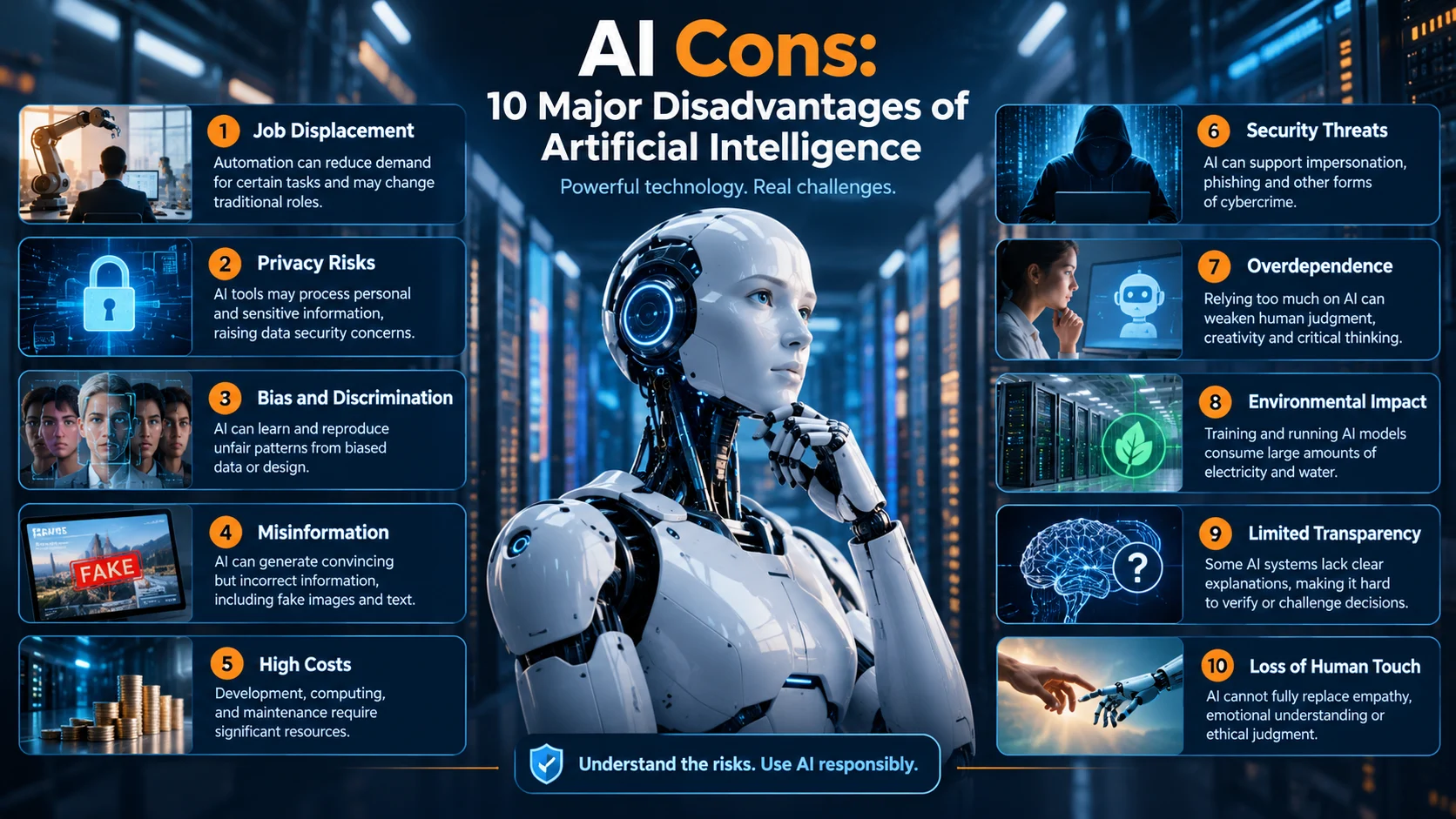
AI cons are the disadvantages and risks of artificial intelligence, including privacy concerns, biased decisions, misinformation, job displacement, and high implementation costs. Understanding these limitations helps individuals and businesses use AI responsibly while reducing potential harm.
Artificial intelligence (AI) can save time and automate tasks, but it also creates real challenges. Its outputs can be inaccurate, its systems can reflect existing biases, and its use can expose sensitive information.
Understanding the disadvantages of AI helps students, workers, businesses, and policymakers make informed decisions. Here are the 10 main AI cons, their practical effects, and ways to manage them.
AI Cons at a Glance
- Job displacement: Automation can reduce demand for certain tasks and roles.
- Privacy risks: AI systems may process sensitive personal or business data.
- Bias: Models can produce unfair results based on biased data or design.
- Misinformation: AI can generate convincing but incorrect information.
- High costs: Development, computing, maintenance, and training require resources.
- Overdependence: Excessive reliance on AI can weaken human judgment and skills.
What Are the Main Disadvantages of AI?
1. Job Losses and Employment Changes
AI can automate repetitive tasks in customer service, administration, data entry, and content creation. As a result, some businesses may need fewer workers for specific activities.
However, automation does not affect every occupation equally. AI can also create new roles and change existing jobs by increasing demand for technical and analytical skills.
How to reduce the risk: Workers can develop skills in critical thinking, communication, digital tools, and AI-assisted workflows.
2. Privacy and Data Security Risks
Many AI applications process user messages, uploaded files, and other information. If organizations handle this data poorly, sensitive details may be exposed or misused.
Users should read privacy policies before submitting personal or confidential information. Businesses should also review data retention practices, access controls, and contractual protections.
3. Bias and Discrimination
AI systems learn patterns from training data. When that data contains historical inequalities or incomplete representation, the resulting system may produce unfair outcomes.
This problem can affect recruitment, lending, healthcare, and other important decisions. Regular testing and human oversight can help identify biased results before they cause harm.
4. Incorrect Information and Hallucinations
Generative AI can produce answers that sound convincing but contain false facts, fabricated references, or outdated information. A confident response does not necessarily mean the information is correct.
This limitation makes independent verification essential, particularly for medical, legal, financial, and academic topics.
Practical solution: Check important claims against reliable sources and never rely solely on AI for high-stakes decisions.
5. High Implementation and Maintenance Costs
Developing and operating AI systems can require computing power, software, skilled employees, and ongoing maintenance. Businesses may also need to integrate AI with existing systems and train their staff.
Although some AI tools offer free access, advanced features and large-scale deployments can involve substantial expenses.
Before investing, organizations should compare the expected benefits with the total cost of implementation and long-term operation.
6. Lack of Human Judgment and Empathy
AI can analyze information and generate recommendations, but it does not replace human understanding, emotional awareness, or accountability.
For example, an automated customer service system might respond correctly to a complaint while overlooking the customer’s frustration. Human involvement remains important when situations require empathy, context, or ethical judgment.
7. Cybersecurity Threats and Misuse
AI can help create realistic phishing messages, impersonation attempts, and deceptive images or videos. These capabilities may make certain forms of fraud more convincing.
AI systems can also introduce security weaknesses when organizations deploy them without suitable controls.
Businesses should combine employee training, secure authentication, access restrictions, and incident-response procedures to reduce these risks.
8. Overdependence on Artificial Intelligence
Relying too heavily on AI can reduce opportunities to practice independent thinking, writing, research, and problem-solving.
For students, copying generated answers without understanding them can interfere with learning. Similarly, employees who accept automated recommendations without reviewing them may overlook errors.
A better approach is to use AI as a supporting tool while maintaining independent judgment.
9. Environmental Impact
AI systems require electricity to train and operate models. Data centers may also use water for cooling, depending on their design and location.
The environmental impact varies according to model size, usage, hardware efficiency, and the energy sources powering the infrastructure.
More efficient models and improved data-center operations can reduce resource consumption. However, the actual impact should be assessed using relevant measurements rather than assumptions.
10. Limited Transparency and Accountability
Some AI systems make recommendations without providing clear explanations of how they reached their conclusions. This can make mistakes difficult to identify and challenge.
The problem becomes more serious when automated decisions affect employment, access to services, or financial opportunities.
Organizations should document their AI systems, test their performance, and establish clear responsibility for consequential decisions.
Advantages vs. Disadvantages of AI
| Advantages | Disadvantages |
|---|---|
| Automates repetitive tasks | May displace certain jobs |
| Processes large amounts of data | Can produce inaccurate results |
| Supports faster analysis | May reproduce bias |
| Helps generate ideas and content | Can raise copyright questions |
| Operates at scale | May require significant resources |
| Supports decision-making | Cannot replace human accountability |
AI’s value depends on the task, the quality of its outputs, and the safeguards surrounding its use.
How Can We Reduce the Disadvantages of AI?
Individuals and organizations can manage many AI risks through practical measures:
- Verify outputs: Check facts, calculations, and references before relying on generated answers.
- Protect data: Review privacy policies and avoid sharing sensitive information unnecessarily.
- Maintain human oversight: Require qualified people to review high-impact decisions.
- Test for bias: Evaluate results across different groups and situations.
- Train employees and students: Teach responsible use, critical thinking, and AI literacy.
- Monitor costs and resources: Measure financial expenses and environmental impacts where relevant.
These steps cannot eliminate every risk, but they can make AI use more responsible and reliable.
Frequently Asked Questions
1. What are the biggest cons of AI?
The biggest AI cons include job displacement, privacy risks, bias, misinformation, and high implementation costs.
2. Can AI replace human jobs?
AI can automate certain tasks and change job requirements, but its impact varies by occupation and industry.
3. Is AI safe to use?
AI can be useful, but users should verify its outputs, protect sensitive data, and review important decisions.
4. Does AI have environmental disadvantages?
Yes. AI systems consume energy, and some data centers use water for cooling. Their impact varies by infrastructure and usage.
5. How can we reduce AI risks?
Verify information, protect private data, test for bias, and maintain human oversight of important decisions.
Conclusion
Artificial intelligence offers valuable benefits, but its disadvantages deserve careful attention. Job displacement, privacy concerns, biased outputs, misinformation, and implementation costs can affect individuals and organizations. These risks depend on how AI systems are designed, deployed, and monitored. Responsible use requires human oversight, fact-checking, data protection, and continuous evaluation. By understanding the main AI cons, users can make better decisions about when to trust AI, when to verify its results, and when human judgment should take priority.