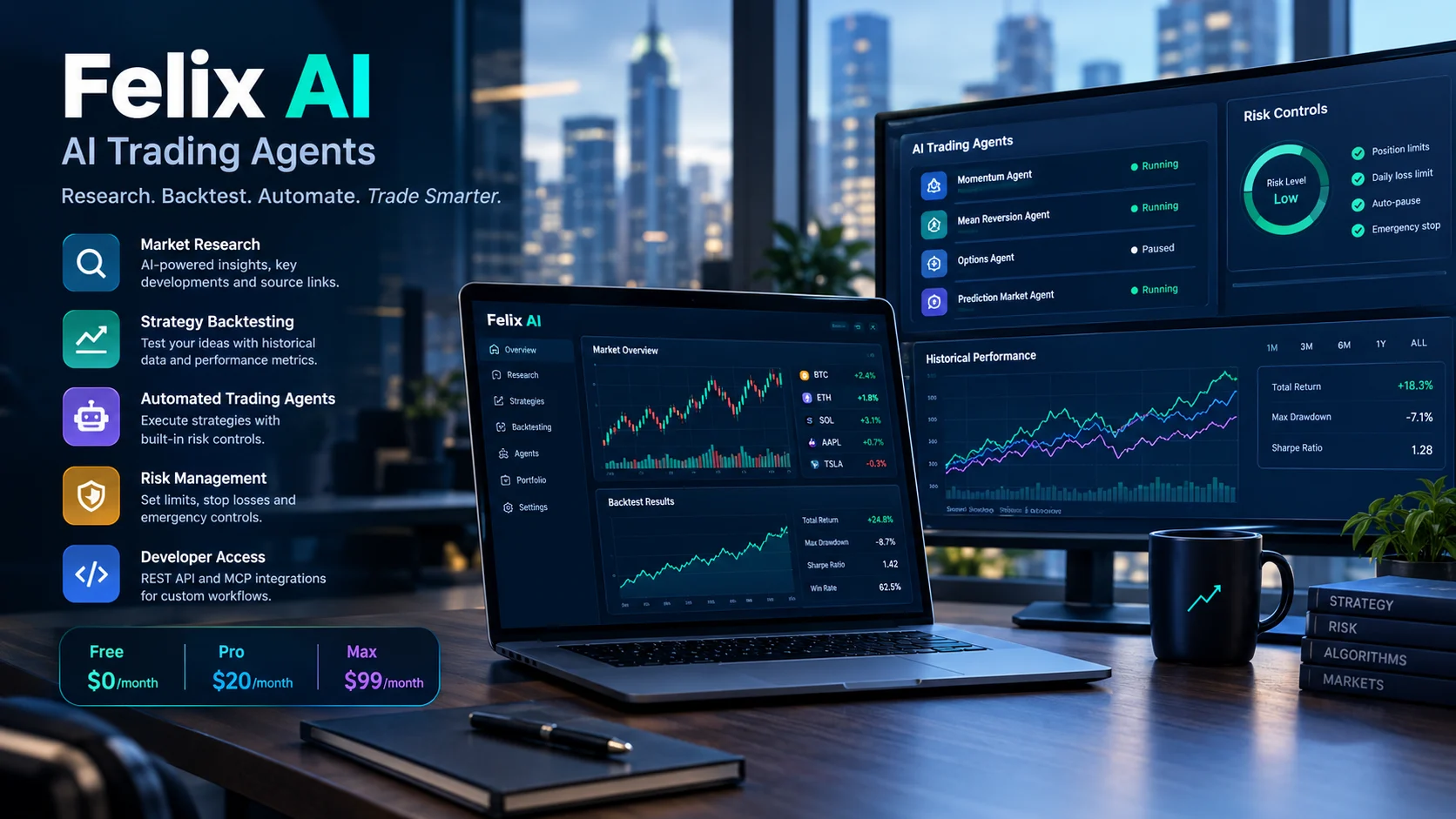
Quick Answer: Felix AI, available through Felix Trade at felix.trade, is an AI-assisted trading platform that combines market research, strategy backtesting, automated trading agents, and risk controls. It helps users develop and test trading rules before deploying agents on supported third-party venues, but it cannot guarantee profits or prevent trading losses.
Felix AI at a glance
AI-assisted strategy development
Turn trading ideas into defined entry and exit rules without necessarily writing code.
Historical backtesting
Evaluate historical returns, drawdowns, trading costs, and performance against a benchmark.
Automated trading agents
Run strategies within configured capital and risk limits on supported venues.
Risk management
Configure agent budgets, position limits, loss thresholds, and emergency controls.
Developer access
Use the REST API and Model Context Protocol (MCP) to connect software and AI agents.
Published subscription plans
The documentation lists Free, Pro at $20 per month, and Max at $99 per month. Trading capital, venue fees, and other costs are separate considerations.
Sources: official Felix Trade website and documentation. Your own quant trading desk+2
What is Felix AI?
Felix AI is the AI-assisted trading functionality offered by Felix Trade. The platform brings market research, strategy creation, historical testing, and automated execution into one workspace.
Instead of requiring traders to research markets, write every trading rule, test the strategy separately, and build execution infrastructure themselves, Felix aims to connect these steps.
Its core idea is straightforward: develop a trading hypothesis, translate it into rules, evaluate its historical performance, and deploy an agent with defined limits.
Felix also provides infrastructure for developers who want to connect their own applications or AI agents through an API or MCP integration. Your own quant trading desk+1
An important distinction is that Felix AI is not a guaranteed-profit trading bot. It is software for researching and executing strategies. Actual results depend on the strategy, market conditions, execution costs, venue reliability, and risk management.
The official documentation also distinguishes Felix from a broker, exchange, bank, and investment adviser. Users remain responsible for their trading decisions and associated risks. felix.trade+1
How does Felix AI work?
Felix combines several stages of a systematic trading workflow.
1. Research the market
Investigate a stock, cryptocurrency, or other supported research topic. Review the available data, market developments, and relevant sources.
2. Define a strategy
Translate a trading idea into specific entry conditions, exit conditions, and position limits.
3. Backtest the rules
Apply the strategy to historical data and examine returns, drawdowns, trading costs, and performance relative to a benchmark.
4. Configure a trading agent
Assign capital, establish position and loss limits, and authorize the actions the agent can perform.
5. Monitor and adjust
Review agent activity, open positions, balances, and risk conditions. Pause agents or use available emergency controls when necessary.
This workflow summarizes the platform’s documented capabilities. Exact setup and execution options depend on the account and supported venue. Your own quant trading desk+2
A simple example
Suppose a trader wants to test a Bitcoin trend-following strategy using two moving averages.
The trader could define a rule that enters a position when the shorter moving average crosses above the longer moving average. An opposite crossover could trigger an exit.
Before committing funds, the trader would examine how the rules performed historically, including transaction costs and the size of past losses. If the results justify further testing, the trader could configure an agent with a limited budget and maximum position size.
This example illustrates a general trading strategy, not a claim that Felix recommends it or that it will be profitable. A moving-average strategy can lose money during sideways markets, sharp reversals, or other unfavorable conditions.
Key features of Felix AI
The platform’s most relevant features fall into five categories.
1. AI-assisted market research
Felix provides research briefs covering market developments, relevant figures, potential catalysts, and source links. The goal is to help traders investigate a market before creating a strategy.
Source links matter because AI-generated research can contain errors or overlook important context. Users should verify material figures against original filings, market data, and other reliable sources.
2. Strategy backtesting
Backtesting applies a set of trading rules to historical market data. Felix documents performance measures such as total returns, annualized returns, maximum drawdown, win rate, and trading costs.
The platform also advertises walk-forward and sensitivity testing on eligible plans. These methods help assess whether a strategy remains useful when tested across different periods or parameter settings. Your own quant trading desk+1
However, a strong historical result does not establish future profitability. A strategy can appear successful because it was optimized for past conditions, used incomplete assumptions, or ignored realistic execution constraints.
3. Automated trading agents
Trading agents execute defined strategies without requiring the user to submit every order manually.
Felix documents controls for allocated capital, maximum position size, and daily loss limits. It also offers controls for pausing agents and restricting new positions. Felix docs+1
These controls can reduce certain operational risks, but they do not eliminate market risk. An agent may still enter a losing trade, encounter an unavailable venue, or fail to close a position at the expected price.
4. Portfolio and activity monitoring
The platform brings trading activity and account information into a shared interface. This can make it easier to review several strategies and understand how they are operating.
Users should still reconcile important balances and positions with the relevant venue or blockchain records. Aggregated data can be delayed, and a displayed balance is not necessarily the same as immediately withdrawable funds.
5. API and MCP integrations
Felix provides a REST API and MCP support for developers. These integrations allow external software and AI agents to interact with the platform’s trading infrastructure. felix.trade+1
This is useful for developers who want to build custom workflows instead of relying entirely on a graphical interface.
API access also creates additional responsibilities. Developers need to manage credentials, request permissions, handle errors, respect rate limits, and protect against duplicate orders or interrupted execution.
Supported markets and trading venues
Felix’s documentation identifies four third-party venues: Polymarket, Hyperliquid, Lighter, and Derive. The platform also describes research coverage across stocks, cryptocurrency, options, and prediction markets. felix.trade+1
These are two different things: research coverage does not guarantee live trading access.
| Venue | General market category | What to verify |
|---|---|---|
| Polymarket | Prediction markets | Eligible markets, settlement rules, and access restrictions |
| Hyperliquid | Crypto trading, including derivatives | Supported instruments, margin requirements, and liquidation rules |
| Lighter | Crypto derivatives | Available contracts, trading costs, and order restrictions |
| Derive | Options and derivatives | Contract specifications, liquidity, and settlement conditions |
These categories describe the venues generally, not a guarantee that every instrument or feature is currently enabled through Felix. Check the live capability matrix and venue documentation before funding an account. felix.trade+1
Availability can also depend on jurisdiction, account setup, venue requirements, and the specific instrument. Users in Pakistan or other jurisdictions should check current eligibility before depositing funds.
Felix AI pricing: Free, Pro, and Max
Felix publishes three subscription tiers in its official documentation. The following figures were verified against the published plans page on October 28, 2026. Felix docs
For exploring the platform
- Up to 3 concurrently running agents
- 300,000 AI tokens per day, rising to 600,000 after the first deposit
- Backtesting history of up to one year
- No walk-forward or robustness tests
- Timer-based agent execution
Pro
$20/month
For more extensive testing and automation
- Up to 10 concurrently running agents
- 1 million AI tokens per day
- Full backtesting history
- Walk-forward and robustness tests
- Price alerts and market-triggered agent activity
Max
$99/month
For users running multiple strategies
- Up to 50 concurrently running agents
- 3 million AI tokens per day
- Full backtesting history
- Walk-forward and robustness tests
- Price alerts and market-triggered agent activity
Source: Official Felix Trade pricing documentation.
What the subscription price does not tell you
The monthly plan is only one part of the total cost of trading.
Before choosing a tier, consider these additional factors:
- Execution fees: Trading venues may charge their own fees. Felix also documents execution fees, so review the current schedule.
- Slippage: The executed price may differ from the expected price, particularly in volatile or illiquid markets.
- Capital requirements: A subscription does not provide risk-free trading capital.
- AI usage limits: Daily token allowances apply to AI usage. The documentation says AI chat stops when the allowance is exhausted, while existing agents continue trading.
- Billing and refunds: Plan payments are made from the Felix balance. The published terms describe auto-renewal and generally do not provide refunds except where legally required.
- Agent limits: Downgrading to Free does not automatically stop existing agents, but the reduced limit can prevent you from starting additional ones. Felix docs+1
Practical advice: Start by checking whether the Free tier supports your intended strategy and venue. Calculate subscription and trading costs together rather than assuming a more expensive plan will produce better returns.
Is Felix AI safe? Security, privacy, and custody
Security requires more than a claim that a trading bot is safe. It involves who controls the funds, which actions an agent can authorize, how credentials are protected, and what happens when something fails.
Felix describes its architecture as non-custodial. Its documentation says an owner-controlled key authorizes account-level actions, while restricted signing infrastructure handles permitted agent operations. It also describes the use of AWS Nitro Enclaves for agent signing. Felix docs+1
What the documented controls mean
- Owner-controlled authority: Felix says the owner key controls the account’s balance and permissions.
- Restricted agent permissions: Agent operations are constrained by signed mandates and configured limits.
- Scoped API keys: Keys can have different permissions, such as read, trade, manage, or transfer.
- Emergency controls: Pausing an agent prevents new orders from that agent, while broader controls can stop new positions or revoke API keys.
- Recovery responsibility: Users must protect and back up their recovery phrase. Felix states that it cannot recover a lost owner key. Felix docs+1
These are documented design claims, not independent proof that the platform is free from vulnerabilities. A smart-contract defect, compromised device, malicious dependency, incorrect configuration, or venue outage can still cause losses.
Emergency controls also have limits. For example, pausing an agent does not automatically close its existing positions. A kill switch cannot necessarily reverse an already broadcast blockchain transaction or close a position on an unavailable venue.
What about data privacy?
Felix’s privacy policy, effective August 30, 2026, describes the collection of account identifiers, wallet addresses, trading activity, prompts, strategy code, agent settings, and operational logs. It also describes the use of third-party infrastructure, AI model providers, blockchain data providers, and trading venues. felix.trade
Consequently, non-custodial does not mean that no user data is collected or that every interaction stays on the user’s device.
Before using the service, read the current Felix privacy policy and security documentation. Check how account synchronization, AI processing, and connected services affect your data.
I found documentation describing the security architecture, but that alone does not establish independent certification, a comprehensive security audit, or Zero Data Retention (ZDR). Do not assume those assurances exist without separate evidence.
Limitations and risks of Felix AI
Felix combines several useful trading functions, but its design does not remove the underlying difficulties of automated trading.
Historical results can be misleading
Backtests depend on data quality, assumptions, and strategy design. A model may perform well historically but fail when market behavior changes.
Look for realistic fees, slippage, liquidity assumptions, and out-of-sample testing. Be cautious when a strategy has been tuned repeatedly against the same historical period.
Automated execution can magnify losses
Automation makes it possible to execute a strategy consistently, but it can also repeat an incorrect rule quickly.
Position limits and loss thresholds help constrain certain risks. They cannot guarantee that an asset will remain liquid or that an exit will execute at the expected price.
Third-party venues introduce dependencies
Felix relies on external trading venues and related infrastructure. Network congestion, venue outages, liquidity shortages, settlement problems, and changes in trading rules can affect execution.
A strategy that works on one venue may behave differently on another because fees, order types, and liquidity differ.
Token quotas and API limits matter
AI usage limits can affect research and strategy-development workflows. Developers also need to account for API rate limits, authentication failures, and unavailable dependencies.
A system should handle these failures deliberately. It should not assume that a timed-out request means an order was never submitted.
Results and marketing examples require scrutiny
Felix’s website displays example backtests and strategy statistics. Its site also states that trading screens use illustrative figures rather than actual account results. Run your own quant desk
Treat these examples as demonstrations of the interface or methodology, not proof of expected investment performance. Verify assumptions and reproduce results independently before risking money.
Felix AI alternatives and competitors
Felix is aimed at users who want research, backtesting, and automated execution in a connected trading workflow. Other platforms address parts of that workflow, but they are not interchangeable.
Concepts / Strategies
TradingView
Best suited to chart-based strategy analysis
TradingView offers charts, technical indicators, and strategy testing through Pine Script. Its strategy tester supports historical analysis and forward testing, while execution capabilities depend on the chosen broker or integration.
Pricing: Some features require paid plans. TradingView
Visit TradingView
How to Build a Stock Trading Bot with Python – DEV Community
Alpaca
Best suited to developers who want trading APIs
Alpaca provides APIs for building trading applications and supports paper trading for testing algorithms without routing orders to a live exchange. Developers still need to build or supply their own strategy logic.
Pricing: Paper trading is available free; live trading, market data, and account eligibility have separate terms. Alpaca US+1
Visit Alpaca
Crypto Trading Bot for Individuals | Trade Like a Pro | Cryptohopper
Cryptohopper
Best suited to crypto-focused bot automation
Cryptohopper is an alternative to investigate if your main requirement is automating cryptocurrency trades through supported exchange integrations. Compare its current bot features, exchange coverage, and subscription limits with Felix’s strategy-development workflow.
Pricing: Check its official plans for current tiers and limits.
Visit Cryptohopper
Feature comparison
| Platform | Target user | Main strength | Pricing transparency | Main limitation |
|---|---|---|---|---|
| Felix Trade | Systematic traders and developers | AI-assisted research, backtesting, agents, and risk controls | Published Free, Pro, and Max plans | Supported live markets and execution conditions vary |
| TradingView | Chart-focused traders | Technical analysis and strategy testing | Public plans with tier-dependent features | Automated execution depends on supported integrations |
| Alpaca | Developers and algorithmic traders | Trading APIs and paper trading | Documentation for APIs and account options | Strategy development and execution logic may require coding |
| Cryptohopper | Crypto traders | Automated bot workflows | Check current subscription details | Depends on supported exchanges and selected bot features |
The comparison is based on documented product capabilities, not independent performance testing. None of these platforms should be assumed to produce better trading returns than the others.
Who should use Felix AI?
Felix may be worth evaluating if you want to:
- Develop systematic strategies: Convert trading ideas into rules you can evaluate consistently.
- Test strategies before deployment: Review historical returns, drawdowns, and transaction costs.
- Automate repetitive trading tasks: Run agents within predefined permissions and risk limits.
- Build custom trading software: Connect applications or AI agents through REST API or MCP.
- Manage several strategies: Monitor multiple agents through one trading workspace.
The platform may be less suitable for someone who wants guaranteed income, does not understand the possibility of financial loss, or expects AI to make every trading decision correctly.
It may also be unnecessarily complex for investors who only want to buy and hold assets over the long term. A strategy-testing and execution platform offers little value if you do not need automation.
Practical checklist before using Felix Trade
Before funding an account, work through these checks:
- Confirm that your country and intended trading venue are supported.
- Read the current terms, risk disclosure, and privacy policy.
- Confirm the exact trading instruments available for live execution.
- Reproduce a strategy’s historical results and inspect its assumptions.
- Include venue fees, platform fees, slippage, and other applicable costs.
- Set a small initial budget and conservative position limits.
- Understand how to pause agents, revoke credentials, and handle open positions.
- Back up your owner recovery phrase securely. Never share it with support.
- Review the cancellation terms and the consequences of reaching AI usage limits.
These steps help you evaluate the platform’s practical suitability rather than relying on marketing examples or a single backtest result.
Frequently asked questions about Felix AI
1. Is Felix AI free to use?
Yes. Felix Trade offers a Free plan at $0, while Pro costs $20 per month and Max costs $99 per month. Trading fees and capital requirements may apply separately.
2. Can Felix AI trade automatically with real money?
Yes. Felix supports automated trading agents on compatible third-party venues. However, trading automation carries financial risks and does not guarantee successful execution or profits.
3. Is Felix AI safe for cryptocurrency trading?
Felix documents non-custodial controls, restricted agent permissions, and emergency mechanisms. Nevertheless, market volatility, software vulnerabilities, and platform failures can still cause losses.
4. Does Felix AI guarantee profitable trading strategies?
No. Backtesting evaluates strategies using historical data, but actual results can differ because of market changes, slippage, liquidity, and trading costs.
5. Does Felix AI support developers?
Yes. Felix provides REST API and MCP integrations for connecting applications and AI agents to its trading infrastructure. Developers should verify permissions, rate limits, and supported venues.
Conclusion
Felix AI combines AI-assisted market research, strategy backtesting, automated trading agents, and risk controls in one platform. Additionally, its Free, Pro, and Max plans offer different usage limits and features. However, automated trading remains risky, and historical performance does not guarantee future returns. Before committing funds, verify supported exchanges, calculate total costs, test strategies independently, and establish strict limits on potential losses.