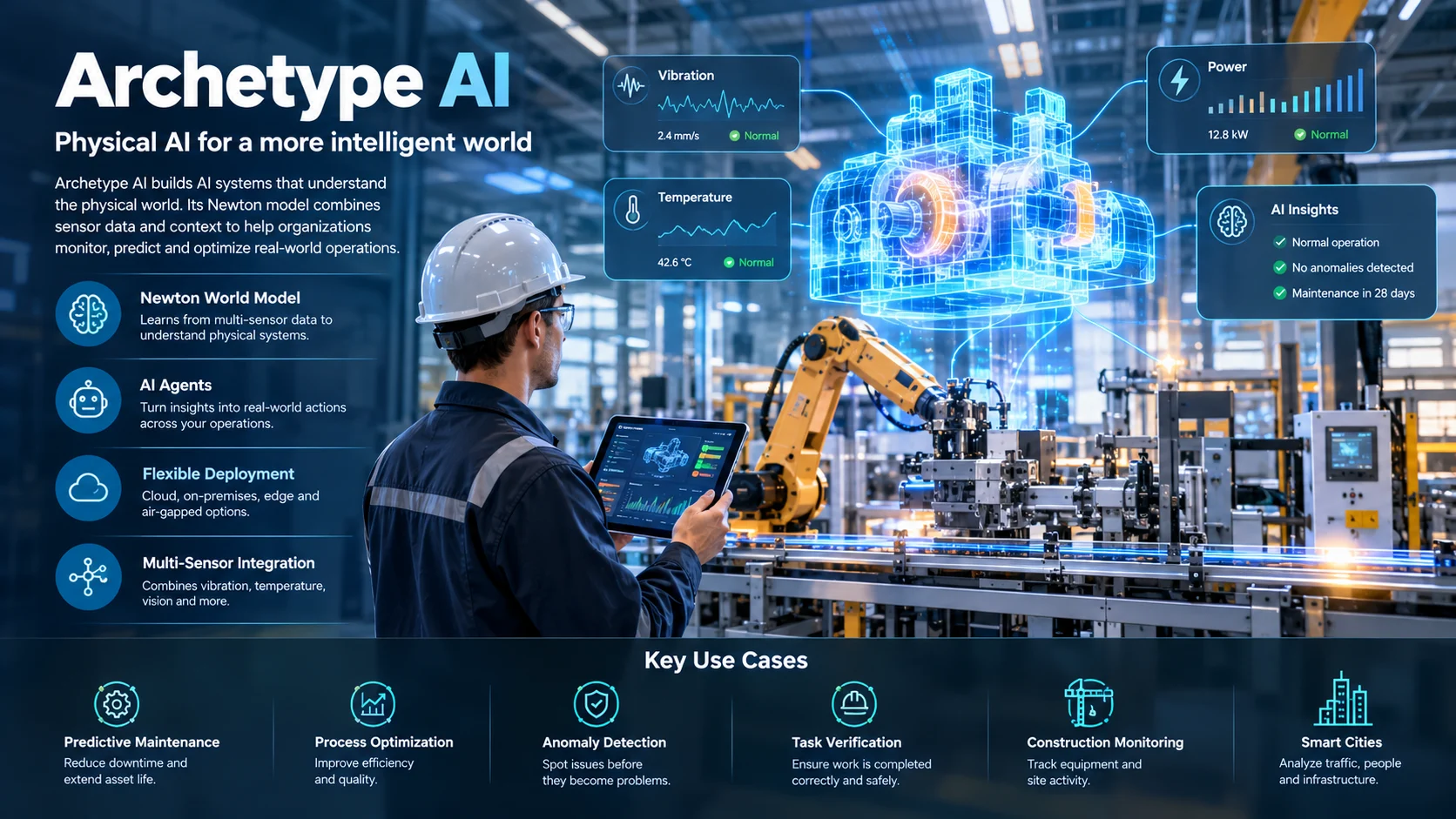
Archetype AI is a technology company developing Physical AI systems that interpret real-world sensor data to help organizations understand machines, processes, and physical environments. Its core technology, Newton, combines sensor measurements with contextual information to support monitoring, anomaly detection, prediction, and AI agents for industrial operations.
Traditional AI systems often work with text, images, and digital records. Archetype AI focuses on helping machines interpret the physical world through vibration, temperature, electrical signals, and video. This approach is particularly relevant to Augury predictive maintenance, where monitoring machine health can help identify potential failures before costly downtime occurs. Unlike systems built for individual machines, Archetype AI aims to deliver reusable intelligence that adapts across different physical environments.
Its Newton model and Archetype Platform help organizations turn operational data into actionable insights for industrial monitoring, predictive maintenance, and operational decision-making. However, real-world performance depends on data quality, model accuracy, deployment requirements, and measurable business outcomes. Understanding how Archetype AI compares with solutions such as Augury is essential for evaluating its practical value, limitations, and potential role in modern industrial operations.
Archetype AI at a Glance
- Company: Archetype AI develops artificial intelligence for understanding physical environments.
- Core technology: Newton, a proprietary physical world model.
- Main offering: A platform for building and deploying Physical AI agents.
- Primary applications: Industrial monitoring, anomaly detection, predictive maintenance, process optimization, and task verification.
- Deployment options: The company describes cloud, private cloud, on-premises, edge, and air-gapped deployment options.
- Intended users: Industrial organizations, developers, operations teams, and businesses working with sensor-rich environments.
What Is Archetype AI?
Archetype AI is a company building AI technology designed to understand physical systems rather than focusing exclusively on digital information.
Its central idea is that machines, buildings, vehicles, factories, and other physical environments produce large amounts of measurable data. When interpreted together, these measurements can reveal patterns that individual sensors may not capture.
For example, an industrial motor might produce vibration, temperature, electrical-current, and power-consumption data. Each measurement provides useful information, but analyzing them together can provide a more complete picture of the motor’s operating condition.
Archetype AI aims to make this analysis more accessible through its Newton model and a platform that turns model capabilities into deployable AI agents.
What Does Physical AI Mean?
Physical AI refers to artificial intelligence designed to understand, predict, or interact with real-world systems.
It can involve industrial equipment, robotics, vehicles, infrastructure, environmental sensors, and human activity. Unlike a conventional chatbot that primarily generates text, a Physical AI system may analyze continuous measurements and help determine what is happening in an operational environment.
Physical AI does not automatically mean a robot. A system that detects unusual vibration in a pump or identifies a change in factory operations can also qualify as Physical AI.
Archetype AI’s approach emphasizes understanding physical behavior through sensor data, then using that understanding to support decisions and operational workflows.
What Is Newton?
Newton is Archetype AI’s proprietary physical world model. It is designed to learn patterns in physical systems using sensor measurements and contextual inputs.
According to the company, Newton can combine data from different sensor types, identify unusual behavior, make predictions, and explain findings in natural language. The model is intended to adapt across machines and environments instead of requiring an entirely separate model for every application.
The company introduced Newton publicly in April 2024. In June 2025, it announced Newton TimeFusion, described as a 2.0-billion-parameter multimodal model combining natural language and time-series sensor data. That specification applies to the announced TimeFusion model, not necessarily every Newton product or deployment.
For businesses, the central question is practical: can Newton extract useful operational information from existing measurements without requiring an excessive amount of custom development?
How Does Archetype AI Work?
Archetype AI’s technology can be understood as a process that turns raw measurements into operational understanding.
1. Collect Data From Physical Systems
Industrial equipment generates continuous streams of information. Common examples include:
- Vibration and acceleration measurements.
- Temperature and electrical-current readings.
- Power consumption and equipment telemetry.
- Video from cameras monitoring work areas.
- Contextual information, including text descriptions and operational records.
The value of these inputs depends on what the organization wants to understand. A predictive-maintenance system may need different signals from a construction-site efficiency application.
Archetype AI describes Newton as capable of working with multiple sensor modalities and contextual information. Actual compatibility should be confirmed for the intended hardware, data format, and deployment environment.
2. Combine Signals to Identify Patterns
Sensor fusion means analyzing information from multiple sources together.
Imagine that a machine’s vibration increases slightly while its temperature and power consumption also change. Each signal alone may appear unremarkable, but their combined pattern could indicate a developing problem.
Newton is designed to identify relationships across such measurements. This can help teams investigate unusual operating conditions that simple thresholds or isolated sensors might miss.
However, detecting a pattern does not automatically establish its cause. Engineers may still need to examine the equipment, validate the diagnosis, and rule out other explanations.
3. Interpret Results in Human Language
Industrial monitoring systems often produce charts, alarms, and numerical measurements that require specialist interpretation.
Archetype AI aims to connect physical measurements with natural-language explanations. This allows users to ask questions about operating conditions and receive insights in a more accessible format.
For example, an operator might ask which operating conditions changed before a machine began behaving unusually. The system’s usefulness depends on the quality of its analysis and whether the available evidence supports the explanation.
4. Build an AI Agent Around the Model
The Archetype Platform allows organizations to build, test, and deploy Physical AI agents. These agents apply the model to specific operational tasks, such as monitoring machine conditions or checking whether a procedure was completed correctly.
The company’s platform documentation describes tools for evaluation, optimization, visualization, APIs, and Python development. It also describes prebuilt agents for common industrial problems.
This separates the underlying model from the workflow that uses it. A company can build different agents for different operational needs while drawing on the same underlying platform.
Key Features of the Archetype AI Platform
Archetype AI combines its Newton model with development tools and deployment infrastructure. Its offering is aimed at organizations that need to move from an AI prototype to a working operational system.
Newton Physical World Model
Newton is designed to learn patterns from sensor measurements and apply that understanding to different physical systems.
The company’s stated approach emphasizes reuse across equipment and industries. In practice, businesses should test how well the model adapts to their own sensors, operating conditions, and failure patterns.
Prebuilt Physical AI Agents
Archetype AI lists several ready-to-deploy agents for common operational tasks. These include operational state monitoring, anomaly discovery, rare-event detection, task verification, and manual generation.
Prebuilt agents can reduce initial development work, but they still need to fit the customer’s process. An agent’s suitability depends on the task, available data, acceptable error rates, and integration requirements.
Natural-Language Development
The platform supports natural-language instructions alongside APIs and a visual Agent Toolkit. The aim is to let teams prototype and modify agents without building every workflow from scratch.
This may make experimentation easier for operational teams. Developers will still need to validate outputs, configure integrations, and establish safeguards for consequential actions.
Deployment Flexibility
Archetype AI describes deployment options that include cloud infrastructure, private cloud, on-premises systems, edge hardware, and air-gapped environments.
Edge deployment places computation near the equipment generating the data. This can help reduce dependence on sending every measurement to a remote service, although actual latency and resource requirements depend on the deployment.
Air-gapped deployment means operating within an environment isolated from external networks. Its availability can be important in sensitive industrial settings, but buyers should confirm the exact supported configuration and licensing terms.
Main Use Cases of Archetype AI
Archetype AI’s strongest fit is in environments where physical measurements can help explain operational behavior.
| Use case | How AI can help | Potential business value |
|---|---|---|
| Predictive maintenance | Identify unusual patterns that may precede equipment problems | Reduce unexpected downtime |
| Anomaly detection | Flag behavior that differs from normal operating conditions | Investigate problems earlier |
| Process optimization | Analyze conditions associated with production performance | Improve throughput and consistency |
| Task verification | Use operational data and video to check whether tasks were completed correctly | Reduce process errors |
| Construction monitoring | Analyze camera footage and contextual data to understand equipment utilization | Improve planning and resource use |
| Smart-city monitoring | Interpret traffic or pedestrian-related sensor data | Support infrastructure planning and safety analysis |
These are intended applications, not guaranteed outcomes. Actual results depend on the operating environment and must be measured against an appropriate baseline.
Predictive Maintenance
Unexpected equipment failure can interrupt production, increase repair costs, and create safety risks.
A Physical AI system may help identify early signs of abnormal operation by examining several sensor streams together. Maintenance teams can then investigate the equipment before a problem becomes more disruptive.
However, anomaly detection is not the same as reliable failure prediction. Buyers should ask how the system handles false alarms, previously unseen failures, changing operating conditions, and missed detections.
Manufacturing and Process Optimization
Production lines generate data about equipment, materials, temperature, energy consumption, and operating cycles.
Analyzing these signals together may reveal conditions associated with lower output, inconsistent quality, or inefficient equipment use. Archetype AI positions Newton as a reusable model for these types of physical-system problems.
A useful deployment should demonstrate measurable improvement, such as reduced downtime or fewer defects, rather than relying solely on the number of anomalies detected.
Construction and Equipment Utilization
Construction projects often involve multiple machines, changing site conditions, and complex coordination.
Archetype AI describes a Kajima construction-efficiency application that combines camera views to assess equipment utilization and relates observations to contextual factors such as tides and weather forecasts.
This illustrates how a physical world model can connect visual observations with operational context. It does not mean every construction site can use the same configuration without adaptation.
Smart Cities and Traffic Monitoring
Cities can use camera feeds and other sensor data to understand pedestrian movement, traffic behavior, and infrastructure conditions.
Archetype AI highlights a pedestrian-safety application developed with the City of Bellevue. The company reports that the system processed 43 GB per intersection daily and describes a potential $9 million in avoided retrofit costs. These are company-reported project figures, not independently established results for all deployments.
For public-sector buyers, evaluation should also include privacy, camera coverage, demographic performance, data retention, and the consequences of incorrect alerts.
Benefits and Limitations
Archetype AI offers an approach to industrial intelligence that differs from general-purpose conversational AI. Whether it delivers value depends on the specific use case.
Potential Benefits
- Cross-sensor analysis: Combine different measurements instead of relying on one signal at a time.
- Less custom model development: A pretrained foundation model may reduce the need to create a separate model for every machine.
- More accessible analysis: Natural-language interfaces can help operators explore findings without interpreting every chart manually.
- Flexible deployment: The advertised infrastructure options may suit organizations with different connectivity and data-control requirements.
- Reusable agents: Teams can adapt a platform to multiple operational tasks instead of maintaining entirely separate AI pipelines.
Important Limitations
Model claims require validation. The company’s statements about adaptability and reduced training requirements should be tested against representative customer data.
Sensor quality matters. Missing measurements, inconsistent timestamps, faulty equipment, and changing sensor configurations can weaken the results.
False positives create costs. Excessive alerts may overwhelm operators and undermine confidence in the system.
Causal explanations need scrutiny. A model may identify a correlation without proving why a failure occurred.
Integration takes work. Production systems often need connections to existing monitoring tools, maintenance systems, and operational procedures.
Automation introduces risk. Any agent that can change machine settings or trigger actions needs appropriate permissions, testing, monitoring, and human oversight.
The practical lesson is to treat model capabilities as something to evaluate in context, not as a substitute for operational testing.
Archetype AI Pricing: What Does It Cost?
Archetype AI does not publish a universal, standard price list on the main product pages reviewed for this article. Its commercial terms are handled through its sales process, including customer-specific fees and order forms. Businesses should request a quote for their intended deployment.
The total cost may depend on the chosen infrastructure, deployment scale, integrations, support requirements, and any customization needed. Confirm which factors apply to your proposed agreement rather than assuming every customer receives the same pricing structure.
Questions to Ask Before Buying
- Is pricing based on a subscription, deployment, infrastructure, or another commercial arrangement?
- Are there separate fees for the platform, model access, support, and professional services?
- Does the quote include edge hardware or cloud infrastructure?
- Are there limits on data volume, processing frequency, or the number of agents?
- What happens when a customer needs additional integrations or customization?
- Can the solution be evaluated using a pilot before a longer commitment?
Archetype AI states that its platform can run on customer-controlled infrastructure and describes scaling without token-based pricing or inference charges for its deployment approach. Confirm the scope of that claim in your quote, including infrastructure and support costs.
A deployment without per-token inference charges is not necessarily cost-free. Hardware, storage, engineering, monitoring, maintenance, and integration can still contribute to total cost of ownership.
Privacy, Security, and Data Control
Industrial data can reveal more than equipment health. It may expose production rates, facility operations, workforce activities, and commercially sensitive processes.
Archetype AI describes deployment options designed to keep processing within a customer’s infrastructure, including on-premises and air-gapped environments. Its platform page also displays a SOC 2 Type I reference.
These details are relevant to organizations evaluating data control, but they do not eliminate the need for due diligence.
What Businesses Should Verify
Data handling: Determine which data is collected, where it is processed, and whether any information leaves the customer’s environment.
Retention and deletion: Request explicit terms covering raw sensor data, derived data, logs, and backups.
Access controls: Confirm how users, administrators, and service personnel access the system.
Audit scope: Ask for the relevant security documentation and verify what the reported SOC 2 assessment covers.
Operational security: Review patching, incident response, logging, and procedures for managing deployed models.
Zero Data Retention: Do not infer ZDR from a SOC 2 report or an on-premises deployment option. Ask for explicit contractual terms that match your use case.
These checks matter especially when AI systems process industrial video, sensitive facility data, or information related to critical infrastructure.
Archetype AI vs. Competitors and Alternatives
Archetype AI operates in a broader market that includes predictive-maintenance software, industrial analytics platforms, sensor-monitoring products, and general-purpose AI systems.
The right comparison depends on the problem being solved. A company looking for early warning of machine failure may need a different solution from one trying to analyze diverse sensor types across several industries.
Relevant Alternatives
| Platform or provider | Target user | Key strength | Pricing transparency | Main limitation |
|---|---|---|---|---|
| Archetype AI | Industrial operators and AI development teams | Physical world model and reusable agents | Request a commercial quote | Requires validation against specific operational data |
| Tractian | Maintenance and manufacturing teams | Asset health and predictive-maintenance applications | Confirm current quotation and plan details | Scope may differ from a cross-domain physical world model |
| Augury | Industrial reliability teams | Machine health and maintenance insights | Confirm current quotation and plan details | Evaluate fit against equipment coverage and broader use cases |
| Hugging Face and custom models | Developers and research teams | Access to model repositories and customizable workflows | Model, hosting, and infrastructure costs vary | Requires more technical integration and model evaluation |
Tractian and Augury are relevant alternatives in industrial asset monitoring and reliability. Hugging Face represents a more flexible development route, rather than a direct equivalent to Archetype AI’s managed industrial platform. Competitor listings also identify Tractian and Augury among the broader alternatives in this market.
How to Compare These Options Fairly
Use a representative dataset and evaluate each candidate against the same operational problem.
Measure detection quality, missed events, false alarms, deployment time, infrastructure cost, and the amount of specialist effort required. For industrial systems, these practical measurements are often more useful than a generic AI benchmark.
Also compare how each product handles new equipment, changing operating conditions, missing data, and integration with existing maintenance workflows.
Who Should Consider Archetype AI?
Archetype AI may be worth evaluating if your organization has substantial sensor data but struggles to turn it into useful operational intelligence.
It may be relevant for:
- Manufacturers seeking better visibility into equipment and production processes.
- Energy operators monitoring assets such as pumps, turbines, and industrial equipment.
- Construction companies interested in equipment utilization and task verification.
- Smart-city teams analyzing traffic and pedestrian-related data.
- Industrial software developers building applications around sensor streams.
- Enterprise AI teams looking for deployment options that support private infrastructure.
It may be less suitable for a small business seeking a general-purpose writing assistant, a consumer chatbot, or an inexpensive tool for occasional text generation. Archetype AI is designed around physical-world data and operational use cases, not everyday conversational tasks.
Frequently Asked Questions
1. What does Archetype AI do?
Archetype AI develops Physical AI technology that analyzes sensor data and other contextual inputs to help organizations understand physical systems. Its Newton model and platform support applications such as anomaly detection, operational monitoring, prediction, and industrial AI agents.
2. What is Newton AI by Archetype AI?
Newton is Archetype AI’s proprietary physical world model. It is designed to combine information from multiple sensor types with contextual inputs to identify patterns and support natural-language analysis of real-world systems.
3. Is Archetype AI free to use?
Archetype AI’s main business platform uses a sales-led commercial approach rather than a clearly published universal price list. Prospective customers should contact the company to confirm access options, pricing, deployment costs, and any available evaluation program.
4. What industries can use Archetype AI?
Potential applications include manufacturing, energy, construction, logistics, and smart-city operations. Suitability depends on the available sensor data, the operational problem, integration requirements, and performance validation.
5. How is Archetype AI different from a general-purpose LLM?
A general-purpose large language model primarily processes and generates information such as text. Archetype AI’s Newton model is designed specifically to interpret physical-system measurements and combine sensor data with contextual information for operational tasks.
Conclusion
Archetype AI is developing a specialized approach to artificial intelligence through Newton, its physical world model, and a platform for building industrial AI agents. Its focus is turning sensor measurements into insights that help teams monitor equipment, investigate anomalies, and improve operations.
The main consideration is not simply whether the technology can analyze sensor data. Buyers should establish whether it performs reliably on their equipment, integrates with existing systems, meets deployment and privacy requirements, and delivers measurable economic value.
For organizations with sensor-rich operations, a carefully scoped pilot can help determine whether Archetype AI fits their needs. Compare its results and total deployment costs with those of established industrial monitoring tools and custom-built alternatives before making a long-term commitment.