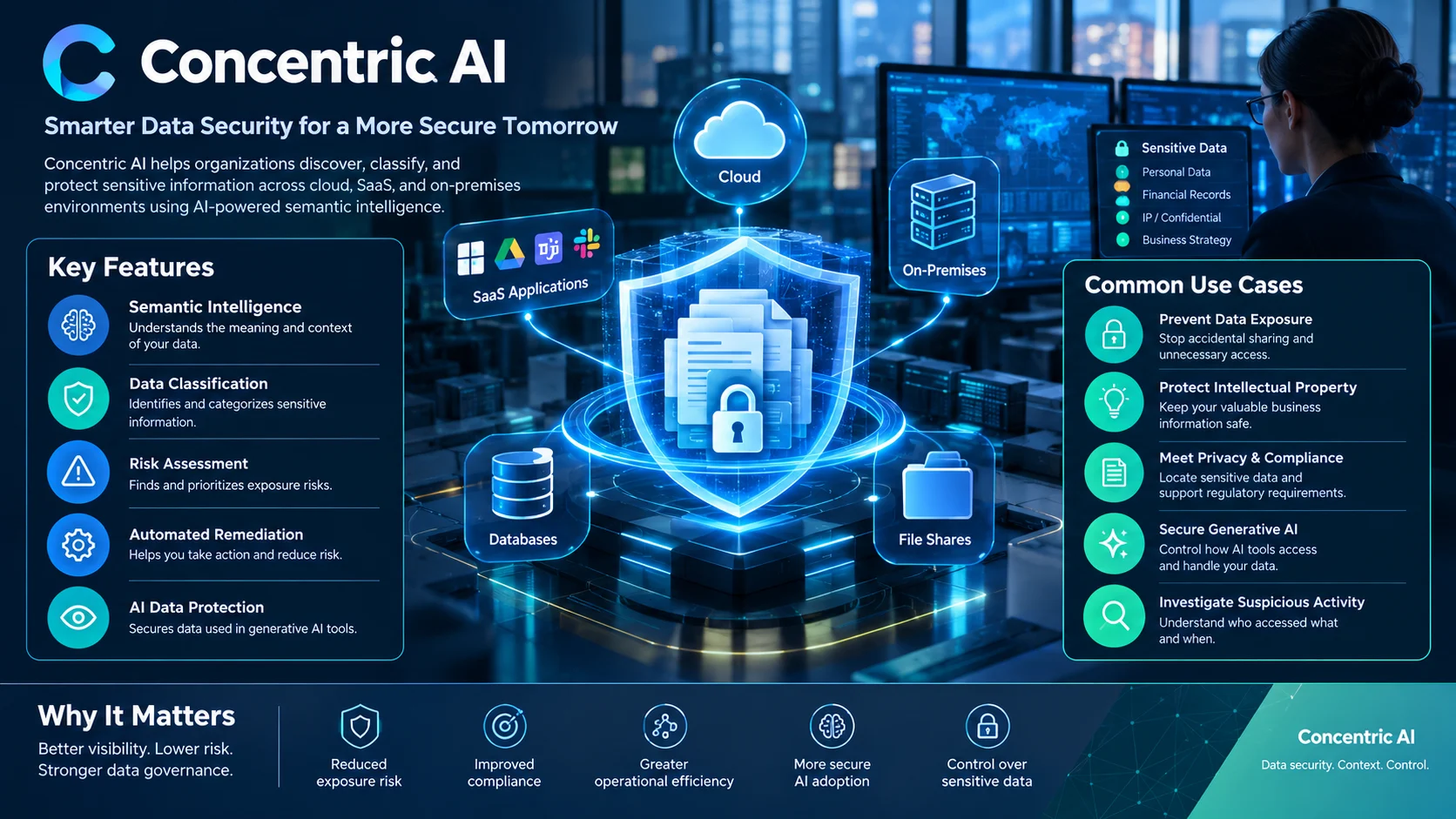
Concentric AI is an enterprise security platform that uses AI to discover sensitive data, identify exposure risks, and protect files across cloud and on-premises systems. It also helps organizations manage data access and reduce security risks when using generative AI.
Concentric AI at a Glance
- What it is: An enterprise data security and governance platform.
- Main purpose: Discover sensitive data and reduce risks caused by inappropriate access, oversharing, and misclassification.
- Core technology: Semantic Intelligence, which analyzes the meaning and context of data.
- Key capabilities: Data discovery, classification, risk assessment, remediation, and data activity monitoring.
- AI security use case: Help organizations understand what sensitive information could be exposed to AI applications.
- Pricing: Enterprise-oriented pricing; the vendor’s platform page says pricing depends on the amount of data scanned and the number of users for specific products.
Concentric AI+1
What Is Concentric AI?
Concentric AI is a cybersecurity vendor focused on data security posture management (DSPM) and data security governance. Its platform helps organizations understand what information they hold, where it resides, who can access it, and whether its current exposure creates a security risk.
This matters because business data rarely stays in one place. Companies store information in cloud applications, shared drives, databases, email systems, collaboration tools, and on-premises repositories.
Sensitive information can become exposed through excessive permissions, external sharing, outdated files, or poorly governed AI workflows. Traditional security controls may identify certain patterns but miss the broader meaning of a document.
Concentric AI aims to address this challenge by analyzing data in context rather than relying only on predefined patterns. Its platform is designed to help security teams identify important information and prioritize risks that deserve attention.
What Does Concentric AI Actually Do?
The platform addresses three practical questions:
- What sensitive data does the organization have? It discovers and classifies information, including personal data, financial records, intellectual property, and confidential business documents.
- Where could that data be exposed? It assesses access permissions, sharing arrangements, and other contextual indicators of risk.
- What should happen next? It supports remediation actions intended to reduce unnecessary exposure and improve data governance.
These capabilities help security teams move from a scattered inventory of files toward a more useful understanding of data risk.
Concentric AI is not primarily a general-purpose chatbot or an AI content generator. Its AI technology is used to understand and protect enterprise information.
How Concentric AI Works
Concentric AI organizes data security around understanding information, evaluating its exposure, and taking appropriate action. Its platform includes several capabilities, with different roles in protecting enterprise data.
1. Semantic Intelligence for Data Discovery
Concentric AI’s Semantic Intelligence technology analyzes the meaning and context of information. The company describes it as a way to identify sensitive content without depending exclusively on manually maintained rules, regular expressions, or predefined patterns.
Consider a document containing an acquisition plan. It might not include credit card numbers or national identification numbers, but it could still contain highly confidential business information.
A basic pattern-based scanner might overlook its commercial importance. Context-aware classification aims to recognize that the document contains sensitive intellectual property or strategic information.
This approach can improve how organizations categorize data, although actual results depend on document quality, supported repositories, configuration, and classification accuracy.
2. Risk Assessment and Prioritization
Discovering sensitive files is only the first step. Security teams also need to know whether those files are exposed to inappropriate users or shared in ways that create unnecessary risk.
Concentric AI describes a risk-analysis approach called Risk Distance. Its purpose is to compare data and access conditions with the expected security practices for similar information, helping identify unusual exposure patterns.
For example, a confidential financial report accessible to a large group of unrelated employees may deserve investigation. A similar report restricted to the authorized finance team may present a different level of risk.
This contextual approach helps prioritize remediation instead of treating every discovery as equally urgent.
3. Remediation and Continuous Monitoring
Once the platform identifies a risk, organizations can investigate and apply appropriate corrective actions. Depending on the product and configuration, these can include changing permissions, addressing risky sharing, or managing data through classification, movement, archival, and deletion workflows.
Automation can reduce repetitive security work, but it requires careful governance. Removing access or deleting a file may disrupt legitimate business processes if the action is not properly reviewed.
Organizations should establish approval requirements, test policies, and maintain a clear process for reversing unintended changes.
4. Protecting Data Used by Generative AI
Generative AI introduces a different data security problem. Employees can paste confidential information into chatbots, upload internal documents to AI assistants, or use unapproved applications for work.
Concentric AI offers Semantic DLP, a capability designed to inspect AI interactions and apply data protection policies. Its published product information describes controls for prompts, uploads, sensitive information, and activity involving approved and unapproved AI applications.
This is particularly relevant when an organization permits employees to use generative AI but needs to prevent sensitive information from leaving approved boundaries.
The important distinction is that Concentric AI focuses on protecting data used by AI, not building the underlying general-purpose language models.
Key Features of Concentric AI
The following capabilities reflect the company’s published product descriptions. Their availability should be confirmed for the specific package, deployment, and contract.
| Feature | What it does | Business value |
|---|---|---|
| Semantic data discovery | Identifies information using meaning and context | Helps locate sensitive and business-critical data |
| Data classification | Assigns categories to discovered information | Supports consistent governance and protection |
| Risk assessment | Evaluates exposure, access, and sharing conditions | Helps prioritize security investigations |
| Automated remediation | Supports corrective actions for identified risks | Can reduce repetitive manual work |
| Data activity monitoring | Connects data interactions with identities and events | Helps investigate potentially risky behavior |
| Semantic DLP | Inspects AI interactions for sensitive data | Helps enforce policies around AI use |
| AI data guardrails | Applies contextual policies to AI-related activity | Helps govern how AI applications interact with sensitive information |
Sources: Concentric AI’s official platform overview, DSPM documentation, and AI Data Loss Prevention overview.
Main Use Cases for Concentric AI
The platform is most relevant when organizations manage large amounts of sensitive information across multiple repositories.
Preventing Accidental Data Exposure
Employees may share documents too broadly or retain permissions that are no longer appropriate. Concentric AI can help identify such exposures and support corrective action.
This use case is relevant to businesses with large shared drives, collaborative workspaces, and distributed teams.
Protecting Intellectual Property
Product designs, research documents, source code, acquisition plans, and internal strategies can be valuable even when they contain no conventional personal identifiers.
Contextual classification can help security teams identify these assets and assess whether their access arrangements are appropriate.
Supporting Privacy and Compliance
Organizations subject to privacy and information-handling requirements need to understand where relevant data resides and how it is protected.
Concentric AI can support discovery, classification, risk assessment, and remediation workflows. However, using the platform does not automatically make an organization compliant with a particular law or regulation. Compliance also depends on policies, operational controls, documentation, and legal obligations.
Securing Generative AI Adoption
Organizations adopting tools such as Microsoft Copilot and public AI assistants need visibility into how employees interact with those applications.
Semantic DLP and related governance capabilities aim to help identify risky AI usage and apply controls to sensitive information. This can support responsible adoption without automatically prohibiting every AI application.
Investigating Suspicious Data Activity
Security teams sometimes need to determine who accessed a document, whether it was downloaded, and how it was shared.
Concentric AI’s data detection and response offering connects data sensitivity with activity information to support investigations into unusual access and sharing behavior.
Benefits and Limitations
Concentric AI addresses genuine enterprise security challenges, but organizations should evaluate its capabilities against their own environments.
Potential Benefits
- Context-aware classification: Goes beyond detecting isolated keywords or common data patterns.
- Broader data visibility: Helps organizations understand information across supported cloud, SaaS, and on-premises repositories.
- Risk-based prioritization: Connects data sensitivity with access and exposure to help teams focus their efforts.
- Remediation support: Provides workflows for addressing identified data risks.
- AI governance support: Helps organizations manage sensitive information shared with generative AI tools.
- Reduced manual configuration: The company says its semantic approach can reduce dependence on manually maintained classification rules.
These are intended product benefits, not guarantees of a particular security outcome. Independent testing in an organization’s own environment remains important.
Limitations to Consider
Classification is not infallible. AI-based systems can misclassify information. Organizations should test performance using representative documents and review high-impact decisions.
Deployment depends on integrations. Coverage depends on supported repositories, permissions, connectors, and the architecture of the customer’s environment.
Automated actions require oversight. A policy that removes access or changes file locations can interrupt legitimate work if it is poorly configured.
Commercial costs may require evaluation. Enterprise contracts can involve multiple products, data volumes, and user counts. Buyers need a clear view of the total cost.
The platform does not replace every security control. Identity management, endpoint protection, network security, incident response, and employee training may remain necessary.
Implementation still requires governance. Even when a vendor reduces the need for manual rules, organizations must define acceptable data use, ownership, approval processes, and escalation paths.
Concentric AI Pricing: What Does It Cost?
Concentric AI does not publish a universal price list for its enterprise platform on the official pages reviewed for this article.
Its platform documentation identifies different pricing models for two key offerings:
- Semantic Intelligence: Pricing is based on the amount of data scanned.
- Semantic DLP: Pricing is based on the number of users.
Actual costs may depend on the deployment scope, selected products, data volume, user count, and contract terms. The AWS Marketplace listing also describes pricing based on the duration and terms of the vendor contract, along with additional usage.
Questions to Ask Before Requesting a Quote
Ask the vendor to clarify:
- Which products and integrations are included in the quoted price?
- How is scanned data volume measured?
- Does Semantic DLP charge for every licensed user or only particular user groups?
- Are implementation, onboarding, and managed services included?
- Are there additional costs for expanded storage coverage or new repositories?
- What are the renewal, contract minimum, and price-adjustment terms?
- How are usage limits, support, and additional deployments handled?
These questions help reveal the total cost of ownership instead of focusing only on the initial quote.
Privacy, Security, and Deployment
Data security software needs access to information to classify it and assess exposure. That makes deployment architecture, permissions, retention, and administrative controls important parts of the evaluation.
How Is Concentric AI Deployed?
According to the company’s platform documentation, Semantic Intelligence is delivered as a SaaS service. It connects to cloud-based repositories through APIs and uses a virtual proxy for on-premises repositories. Semantic DLP is deployed as a browser extension.
The company also states that its platform does not require conventional endpoint agents for Semantic Intelligence. Buyers should verify the exact deployment requirements for every selected module and integration.
What About Data Retention and Compliance?
Before connecting production repositories, ask the vendor for documentation covering:
- What content and metadata the platform collects.
- Where customer data is processed and stored.
- How long collected data, logs, and investigation records are retained.
- Whether customer content is used to train or improve AI models.
- Which subprocessors and external services are involved.
- How access is controlled and how data is deleted at contract termination.
- Which independent security assessments and compliance reports are available.
Do not assume that an AI-based security product automatically offers Zero Data Retention (ZDR). Likewise, a SOC 2 report does not independently establish ZDR or guarantee that every customer configuration is secure.
Request current documentation and review the contractual commitments rather than relying solely on marketing statements.
Concentric AI Competitors and Alternatives
Concentric AI operates in a market that includes data security posture management, data access governance, data loss prevention, and AI data security. Several established vendors offer overlapping capabilities, although their product scope and technical approaches differ.
Leading Alternatives to Compare
Microsoft Purview
Microsoft’s data security and governance portfolio includes DSPM, data loss prevention, sensitivity labels, and risk investigation capabilities. It is particularly relevant for organizations already using Microsoft 365 and Azure.
BigID
BigID focuses on data discovery, classification, privacy, data security, and AI governance. Compare its coverage and remediation workflows if you need a broader data intelligence program.
Varonis
Varonis is relevant for organizations focused on data access governance, sensitive data protection, and insider-risk investigation. Evaluate its repository coverage and permission-management capabilities against your requirements.
Cyera
Cyera is another data security vendor worth evaluating for cloud data discovery, exposure management, and AI-related data risks. Compare its cloud and hybrid coverage, integrations, and remediation approach with Concentric AI’s requirements.
Competitor Comparison Table
| Platform | Primary focus | Potential fit | Pricing transparency |
|---|---|---|---|
| Concentric AI | Semantic data security, DSPM, AI data protection | Context-aware classification and AI usage controls | Quote-based; specific pricing dimensions are documented |
| Microsoft Purview | Data security and governance across Microsoft and integrated environments | Organizations invested in Microsoft’s ecosystem | Depends on service and licensing |
| BigID | Data intelligence, privacy, security, and AI governance | Broad discovery and governance requirements | Confirm current commercial terms |
| Varonis | Data access governance and data protection | Sensitive file access and insider-risk concerns | Request a tailored quote |
| Cyera | Data security and cloud data posture | Cloud-focused discovery and exposure management | Request a tailored quote |
This is a functional comparison, not an independent performance ranking. Product capabilities overlap, and individual modules, integrations, and licensing terms can change.
How to Choose Between These Platforms
Start with your existing environment and the security problem you need to solve.
- First, evaluate Concentric AI if semantic classification and identifying business-critical information are your main priorities.
- Meanwhile, consider Microsoft Purview if you want to extend your existing Microsoft security and compliance tools.
- Additionally, explore BigID if your project focuses on data intelligence, privacy, and governance.
- In contrast, Varonis may be a better fit when data access governance and investigation workflows are essential.
- Finally, assess Cyera if your primary concerns are cloud data visibility and exposure management.
These are starting points for an evaluation, not substitutes for a controlled proof of concept. A vendor’s performance with your actual repositories, permissions, and document types is more useful than a generic feature checklist.
Who Should Consider Concentric AI?
Concentric AI is most relevant to organizations that handle substantial volumes of sensitive data and need to manage its exposure across multiple systems.
Potential users include:
- Chief Information Security Officers (CISOs): Need visibility into enterprise data risks and remediation priorities.
- Security operations teams: Investigate suspicious data access, oversharing, and potential exposure.
- Data governance teams: Improve classification, ownership, and information-handling practices.
- Privacy and compliance teams: Locate sensitive information and support evidence gathering for compliance activities.
- AI governance teams: Establish controls for employee use of generative AI applications.
- Managed security service providers: May evaluate managed DSPM offerings for customers that lack dedicated internal resources.
Smaller organizations with limited data volumes or straightforward access requirements may find a dedicated feature within their existing security platform sufficient. A separate enterprise product makes more sense when it addresses a demonstrable gap.
Latest Developments in Concentric AI
Concentric AI’s published product direction increasingly connects traditional data security with governance of generative AI.
Its current platform materials describe Semantic Intelligence, Semantic DLP, AI data guardrails, and data detection and response as parts of its broader data security offering.
In September 2026, the company announced the appointments of Gary Olson as chief revenue officer and Will Saso as vice president of sales for the Americas. The announcement reflects an investment in commercial leadership, although it does not independently establish product performance or customer outcomes.
For current developments, consult the official Concentric AI website and its product announcements rather than relying on outdated third-party summaries.
Frequently Asked Questions
1. What is Concentric AI used for?
Concentric AI helps businesses discover sensitive data, identify security risks, manage access, and protect information used by AI applications.
2. How much does Concentric AI cost?
Pricing depends on the product and usage, such as data scanned or number of users. Contact the vendor for a customized quote.
3. Is Concentric AI a generative AI chatbot?
No. It is an enterprise data security platform that helps organizations classify, monitor, and protect sensitive information.
4. How does Concentric AI protect data used by generative AI?
Its Semantic DLP solution helps detect sensitive information in AI prompts and uploads and apply data protection policies.
5. What are the alternatives to Concentric AI?
Alternatives include Microsoft Purview, BigID, Varonis, and Cyera. Compare their security features, integrations, and pricing.
Conclusion
Concentric AI helps organizations discover sensitive data, reduce exposure risks, and improve security when adopting generative AI. Before choosing it, evaluate its features, pricing, integrations, and effectiveness against your organization’s needs.