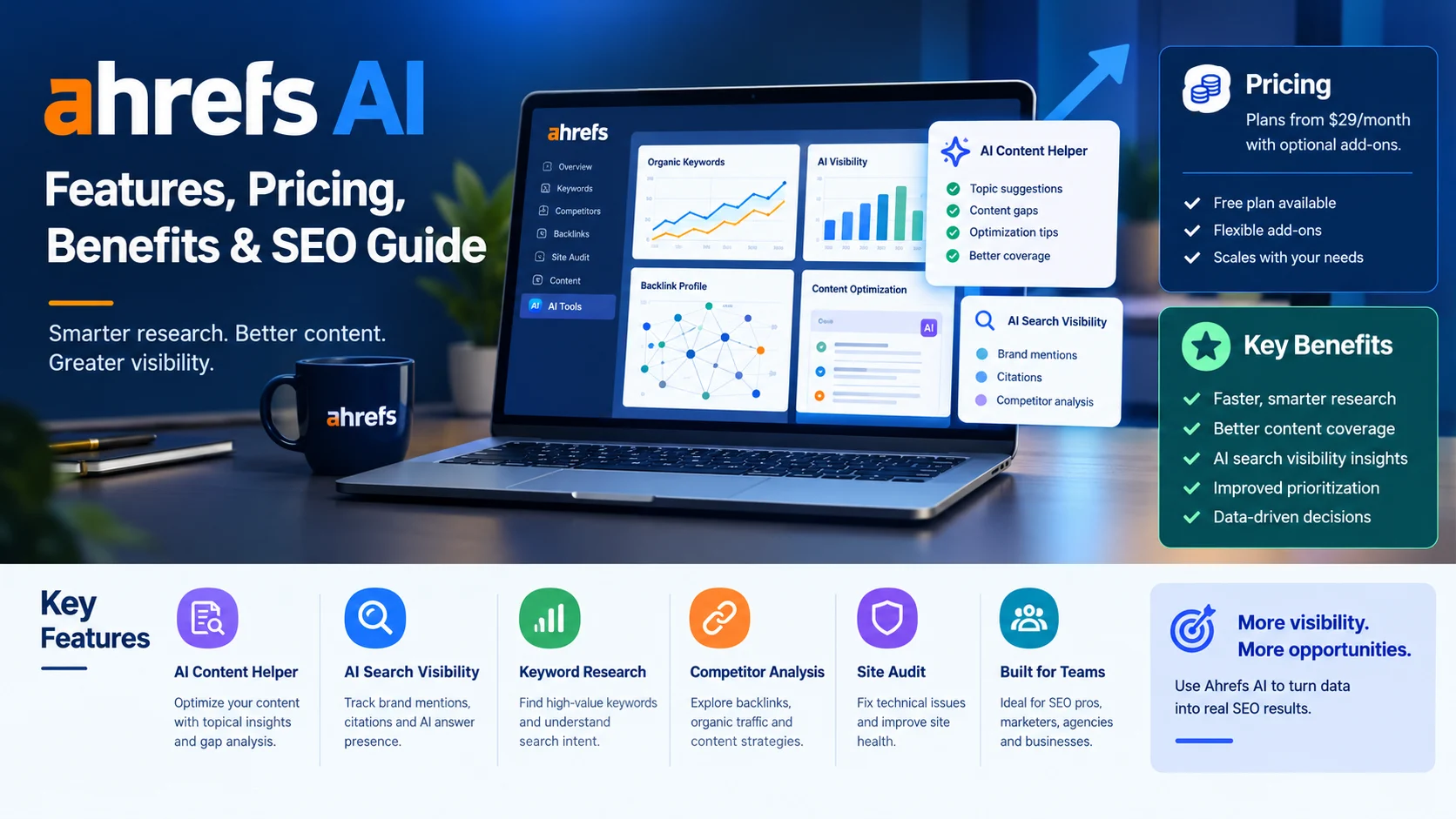
Ahrefs AI refers to the artificial intelligence features within Ahrefs, an SEO and digital marketing platform that helps users research keywords, optimize content, analyze competitors, and monitor brand visibility in AI-generated answers. Its tools include AI Content Helper, AI-assisted SEO workflows, and Brand Radar, which helps marketers investigate how brands appear across AI search experiences.
Ahrefs AI at a Glance
Content optimization
AI Content Helper evaluates topic coverage against competing pages and helps identify content gaps.
AI search visibility
Brand Radar helps monitor brand mentions, citations, and visibility in supported AI search environments.
SEO research
Keywords Explorer, Site Explorer, and Site Audit support keyword research, competitor analysis, and technical SEO.
Pricing flexibility
Some AI features are included in Ahrefs subscriptions, while advanced capabilities and additional usage may cost extra.
Best suited to
SEO teams, content strategists, digital agencies, and businesses measuring both traditional and AI search visibility.
Important limitation
AI recommendations require human judgment, and visibility metrics do not guarantee rankings, citations, or conversions.
What Is Ahrefs AI?
Ahrefs AI is an umbrella term for AI-powered capabilities integrated into the Ahrefs marketing platform. Rather than functioning as a standalone general-purpose chatbot, it applies artificial intelligence to SEO research, content improvement, website analysis, and AI search monitoring.
The distinction matters because an SEO platform and a general AI assistant solve different problems.
A general AI assistant can draft an article, summarize research, or brainstorm keywords. Ahrefs combines AI-assisted workflows with its own search, backlink, keyword, and website datasets to help marketers make more informed decisions.
According to Ahrefs’ official documentation, its AI features include content optimization, search-intent analysis, AI-assisted suggestions, translations, and tools for investigating AI visibility. Feature access depends on the tool and subscription.
How Ahrefs AI differs from an AI writing tool
An AI writing tool primarily helps produce or revise text. Ahrefs focuses more broadly on the research and optimization surrounding that content.
For example, a writer might use a language model to draft an article about email marketing. Ahrefs can help investigate the target keyword, assess competing pages, identify relevant topics, and evaluate the website’s existing search performance.
The strongest workflow combines both approaches: use AI to accelerate research and drafting, then use SEO data, subject-matter expertise, and editorial review to improve the final result.
Key Ahrefs AI Features
1. AI Content Helper
AI Content Helper is designed to improve on-page content by comparing a draft with competing pages and identifying important topics related to its target keyword.
Instead of simply encouraging writers to repeat a keyword, the tool evaluates how well their content addresses the subject. This can reveal missing explanations, incomplete subtopics, and areas where a competing page offers more useful coverage.
Ahrefs announced a newer version of AI Content Helper in September 2026. Its current documentation says users on all plans, including the free plan, can create one new document per month, with five monthly documents for Enterprise users. Additional document capacity is available through paid options.
Practical example: Suppose you’re writing a guide to technical SEO. Your draft explains crawling and indexing but overlooks log-file analysis, canonical tags, and crawl-budget considerations. A content optimization workflow can help identify these gaps for further research.
However, topical coverage is not the same as editorial quality. A document can cover every suggested topic and still be inaccurate, repetitive, or less useful than competing content.
2. Brand Radar for AI Search Visibili
Brand Radar helps marketers investigate how their brands appear in AI-generated answers and other discovery channels.
Its capabilities include exploring AI visibility, tracking selected prompts, examining AI responses and cited pages, and comparing brand presence with competitors. Supported indexes and reporting options should be checked against the current product documentation.
This is increasingly relevant because potential customers may discover products through AI-assisted search instead of clicking a conventional list of search results.
Consider a software company that wants to appear when buyers ask, “What are the best project management tools for small teams?” Its SEO team can use AI visibility research to investigate whether the brand appears, which competitors are mentioned, and which sources are cited.
The data can guide a content and digital PR strategy. It cannot guarantee that an AI system will recommend the company in future answers.
3. AI-Assisted Keyword Research
Keyword research remains central to SEO, even as search behavior evolves.
Ahrefs’ Keywords Explorer provides keyword metrics and research capabilities. AI-assisted features can help users organize or interpret search opportunities, including search intent and keyword suggestions, depending on their plan.
An effective workflow is to:
- Identify a broad topic relevant to your business.
- Research related keywords and their estimated demand.
- Examine search intent and the current results.
- Group related queries into logical content clusters.
- Prioritize opportunities based on relevance, competition, and business value.
AI can speed up the process, but it should not replace judgment. A keyword with substantial search volume may be commercially irrelevant to your audience.
4. AI-Assisted Website and Competitor Analysis
Ahrefs’ established SEO tools complement its AI capabilities.
Site Explorer helps analyze a website’s organic search performance, backlinks, and competing pages. Site Audit identifies technical issues that may affect crawling, indexing, or website quality. These tools provide evidence that can inform AI-assisted recommendations and content decisions.
For instance, an agency researching a competitor can identify pages attracting organic traffic, inspect the referring domains, and compare keyword coverage. It can then use those findings to develop a content plan rather than simply copying the competitor’s articles.
AI helps interpret and organize the work. The underlying data, careful analysis, and execution determine whether the strategy produces results.
How to Use Ahrefs AI for Better SEO Results
The value of Ahrefs AI depends less on generating more content and more on identifying the right opportunities. A structured workflow helps turn its data into practical improvements.
Step 1: Research the search intent
Start with a target keyword and examine the search results. Determine whether users want a tutorial, product comparison, definition, or solution to a specific problem.
For example, someone searching for “best CRM for small business” has different expectations from someone searching for “what is CRM software.”
Match your content format to that intent before drafting.
Step 2: Analyze competing pages
Use Site Explorer and relevant keyword reports to investigate competing websites. Look for pages attracting organic traffic, valuable referring domains, and keywords your site does not target effectively.
Do not assume every competitor’s tactic deserves imitation. Identify the reasons a page serves its audience well, then find ways to deliver a more useful answer.
Step 3: Build and optimize your draft
Create an outline based on the questions, concepts, and practical details the reader needs. Use AI Content Helper to assess topic coverage and identify potential gaps.
Add original examples, expert commentary, current evidence, and actionable instructions. These elements help distinguish your content from pages that merely repeat information already available online.
Step 4: Improve technical SEO
Run a Site Audit to investigate issues such as broken links, redirect problems, and indexing-related configuration errors.
Prioritize problems based on their actual impact. A critical indexing issue deserves attention before a minor formatting warning.
Step 5: Monitor traditional and AI visibility
Track organic rankings and relevant performance metrics. If AI search visibility matters to your business, use Brand Radar to investigate mentions, citations, and competitors across its supported indexes.
Review changes over time rather than reacting to a single observation. AI-generated answers can vary with the prompt, platform, location, and time of measurement.
Step 6: Measure business outcomes
Use analytics and conversion data to assess whether improved visibility leads to meaningful results.
Measure organic traffic, qualified leads, sales, engagement, and assisted conversions where appropriate. AI mentions are useful diagnostic signals, but they are not substitutes for business performance.
Benefits of Ahrefs AI
More efficient research
AI-assisted analysis can reduce the time spent organizing information and identifying content gaps. This gives SEO professionals more time for editorial decisions, competitor research, and strategic planning.
Better content coverage
Comparing a draft against competing pages can reveal important topics that writers have overlooked. This supports comprehensive content without relying exclusively on exact-match keyword repetition.
A broader view of brand discovery
Traditional SEO reporting focuses on search visibility and website traffic. AI visibility monitoring adds another perspective by showing where brands appear in supported AI-generated answers.
More informed prioritization
Combining keyword data, backlink analysis, technical audits, and AI-assisted recommendations helps teams decide which improvements deserve attention first.
The main benefit is better-informed work, not guaranteed rankings. Search engines and answer engines use systems outside a publisher’s control.
Limitations and Common Mistakes
Ahrefs AI can support a strong SEO process, but it has practical limitations.
1. Treating recommendations as rules. Content suggestions are prompts for investigation, not mandatory requirements. Adding every recommended topic can make an article unfocused.
2. Confusing AI visibility with traffic. A brand mention or citation does not automatically produce a website visit, lead, or sale.
3. Publishing unreviewed AI content. Generated text can contain factual errors, unsupported statements, and repetitive explanations. Editors should verify important claims and add real expertise.
4. Overlooking subscription limits. Some capabilities require higher-tier plans or paid add-ons. Check document allowances, tracked prompts, usage credits, and reporting limits before committing.
5. Assuming competitor data tells the whole story. Third-party SEO tools provide estimates and observations, not a complete record of every search, visitor, or ranking factor.
6. Chasing every new AI trend. AI search deserves attention when it aligns with audience behavior and business goals. It should not displace technical SEO, useful content, or established acquisition channels without evidence.
Ahrefs AI Pricing: What Does It Cost?
Ahrefs uses a combination of subscription plans and optional add-ons. The cost depends on the tools required, the number of projects, usage allowances, and whether advanced AI visibility or content capabilities are needed.
According to the official pricing page available in October 2026, the main plans are listed below. Prices are in US dollars, and billing terms should be checked before purchase.
| Plan or feature | Published price | What to know |
|---|---|---|
| Ahrefs Free | $0 | Limited tools and usage |
| Starter | $29/month | Entry-level research |
| Lite | $129/month | Core SEO workflows and limited AI prompt tracking |
| Standard | $249/month | Higher research limits and additional features |
| Advanced | $449/month | Expanded limits for growing teams |
| Enterprise | $1,499/month | Enterprise features; annual commitment |
| Brand Radar AI Visibility Index | From $199/month | Research brand visibility across Ahrefs’ AI prompt database |
| Custom prompt packages | From $50/month | Track selected prompts, subject to usage limits |
| Content Kit | From $99/month | Additional content optimization capabilities |
Source: Ahrefs’ official pricing page. Prices and inclusions may change. Some subscription prices reflect annual billing, and add-ons may be subject to separate terms.
Is Ahrefs AI free?
Some AI capabilities are available without buying a separate AI add-on. Ahrefs’ September 2026 documentation states that AI Content Helper allows one new document per month on all plans, including the free plan. Enterprise users receive five monthly documents, and additional capacity can be purchased.
However, free access to a feature does not mean unlimited access to the complete platform.
Before subscribing, check:
- The number of projects and tracked keywords included.
- AI prompt tracking limits and supported platforms.
- Monthly document or credit allowances.
- The cost of add-ons and additional usage.
- User seats, historical data, and API access.
- Whether the billing cycle suits your workload.
For a solo publisher, the entry-level options may be sufficient for initial research. An agency monitoring several clients across organic and AI search may need higher limits or separate add-ons.
Ahrefs AI vs. Competitors
Ahrefs is not the only platform combining AI with SEO research. The best alternative depends on whether your priority is technical SEO, content production, or monitoring AI-generated answers.
The comparison below reflects publicly described product capabilities and pricing information available in October 2026. It is an editorial comparison, not an independent performance benchmark.
| Platform / tool | Target user | Key strength | Pricing transparency | Core limitation |
|---|---|---|---|---|
| Ahrefs AI | SEO teams and agencies | SEO research, content optimization, and AI visibility | Public plans and add-ons | Costs rise with advanced features and usage |
| Semrush | In-house marketers and agencies | Broad SEO suite and dedicated AI visibility toolkit | Public plans and add-ons | Costs depend on toolkit, limits, and extra users |
| Surfer SEO | Content teams and writers | SERP-informed content optimization and AI writing | Public plans with usage limits | More focused on content workflows than full backlink analysis |
| Profound | Brands focused on AI search | AI answer engine visibility and related marketing analytics | Public pricing details vary by product and package | Advanced requirements may need custom arrangements |
Ahrefs AI vs. Semrush
Semrush is a direct competitor for many SEO workflows. Both platforms support keyword research, competitor analysis, and visibility monitoring, but their interfaces, datasets, and plan structures differ.
Semrush offers a dedicated AI Visibility toolkit, with its published Base plan listed at $99 per month when billed annually. It includes AI visibility reports, custom prompt tracking, and competitor research.
Ahrefs may appeal to teams already relying on its backlink and keyword research ecosystem. Compare the exact reports, tracking coverage, and total subscription cost rather than choosing based on a single feature.
Ahrefs AI vs. Surfer SEO
Surfer SEO focuses more directly on content creation and on-page optimization. Its features include content editing, SERP-informed recommendations, and AI writing tools.
Ahrefs offers a broader set of SEO research capabilities alongside content optimization and AI visibility analysis. Surfer may be a better fit for teams whose main bottleneck is producing and refining articles.
Ahrefs AI vs. Profound
Profound focuses on AI search visibility and analytics. It is worth evaluating if your organization needs detailed monitoring of how brands appear across answer engines.
Ahrefs combines AI visibility research with an established SEO toolkit. Profound is more specialized in AI search intelligence, so a comparison should consider reporting depth, supported platforms, data access, and the team’s existing SEO infrastructure.
Neither tool should be assumed to measure every AI response on the internet. Coverage depends on the platform, prompts, indexes, and collection methodology.
Who Should Use Ahrefs AI?
Ahrefs AI is most useful when its features solve a clear marketing problem.
- SEO specialists: Research keywords, investigate competitors, and prioritize website improvements.
- Content marketers: Identify content gaps, improve topical coverage, and refresh existing articles.
- Digital agencies: Combine SEO research and AI visibility reporting across client projects.
- SaaS and ecommerce businesses: Investigate whether their brands appear in AI answers related to products, categories, and purchase decisions.
- Publishers and affiliate websites: Find relevant search opportunities and improve content quality before publication.
It may be less suitable for someone who only wants an inexpensive AI writing assistant. In that situation, a dedicated writing tool or a general-purpose language model may offer a more direct solution.
Real-world example: An ecommerce brand
Imagine an online retailer selling ergonomic office chairs. Its marketing team wants to attract customers through traditional search and AI-assisted discovery.
The team could use Ahrefs to research product-related keywords, compare competing category pages, and identify technical SEO problems. AI Content Helper could support improvements to buying guides, while Brand Radar could help investigate whether the brand appears in relevant AI answers.
The team would then measure organic traffic, conversions, and qualified referral visits. If AI visibility increases without a corresponding business benefit, it should revisit its target prompts, content strategy, and measurement approach.
This workflow connects AI-assisted research to business outcomes rather than treating visibility as the final goal.
Technical Considerations: Data, Privacy, and Reliability
Ahrefs AI is primarily a marketing analytics and optimization solution, so buyers should focus on how its data is collected, what the tools measure, and how content is handled.
AI visibility data is not a complete record of user behavior
AI-generated answers vary. Two users asking similar questions may receive different recommendations, citations, or brand mentions.
Ahrefs’ metrics help quantify observations within its defined measurement system. For example, its documentation distinguishes brand mentions from citations and other AI visibility metrics. A mention does not necessarily mean that the response linked to the brand’s website.
When interpreting results, examine the metric definition, supported platforms, prompt selection, and reporting period. Avoid comparing figures from different providers as if they were measured identically.
AI-generated recommendations need validation
AI systems can misinterpret source material, overlook context, or generate plausible but incorrect explanations.
Validate important recommendations against the original page, search results, analytics, and relevant technical documentation. For high-stakes decisions, involve a qualified specialist.
Review privacy and access requirements
Before submitting unpublished material, customer information, or confidential business data, review the applicable Ahrefs terms, privacy policy, and account settings.
Do not assume that a subscription automatically guarantees zero data retention or that every AI-related feature has identical data-handling rules. Organizations with strict compliance requirements should obtain explicit answers about processing, retention, access controls, and contractual commitments.
Consider integration and workflow costs
An SEO platform may fit poorly if it creates duplicate work across existing reporting systems. Review integrations, export options, API access, user permissions, and the time required to maintain reports.
A feature is valuable only when the team can use its output consistently and turn it into actionable work.
FAQs
Does Ahrefs AI generate entire blog posts?
Ahrefs AI includes AI-assisted features for SEO and content workflows, but AI Content Helper is designed around optimizing content for a target keyword and improving topic coverage. It should not be confused with a promise of fully researched, publication-ready articles without human review.
Can Ahrefs AI help a website appear in ChatGPT answers?
Ahrefs Brand Radar can help users investigate brand mentions and citations across supported AI search experiences. Using those insights may inform content and digital PR strategies, but it cannot guarantee that ChatGPT or another AI system will mention or recommend a website.
Is Ahrefs AI worth paying for?
It can be worthwhile for teams that regularly use Ahrefs for SEO research and need content optimization or AI visibility data. The decision depends on usage limits, the cost of required add-ons, the quality of the insights, and whether the team can connect those insights to measurable business outcomes.
Is Ahrefs AI better than Semrush?
Neither platform is universally better. Ahrefs is worth considering for teams that prioritize its SEO research ecosystem, while Semrush offers a competing suite with dedicated AI visibility capabilities. Compare the reports, limits, integrations, and total cost against your actual workflow.
Can beginners use Ahrefs AI?
Yes, beginners can use its research and content optimization features, although understanding search intent, keyword metrics, and basic SEO principles improves the results. Start with one website and a small group of relevant keywords before investing in advanced reporting.
Conclusion
Ahrefs AI brings artificial intelligence into practical SEO workflows, including content optimization, keyword research, competitor analysis, and AI search visibility monitoring.
Its main advantage is the combination of AI-assisted workflows with Ahrefs’ established SEO research tools. Its main limitations are subscription costs, feature-specific usage limits, and the uncertainty involved in measuring AI-generated answers.
For SEO professionals and agencies, it is worth evaluating if the platform addresses recurring research or reporting needs. For occasional writers, a simpler content tool may be enough.
Before purchasing, test the features you expect to use, confirm the relevant usage allowances, and decide how you will measure success. Prioritize useful content, reliable data, and measurable business results over AI visibility metrics alone.