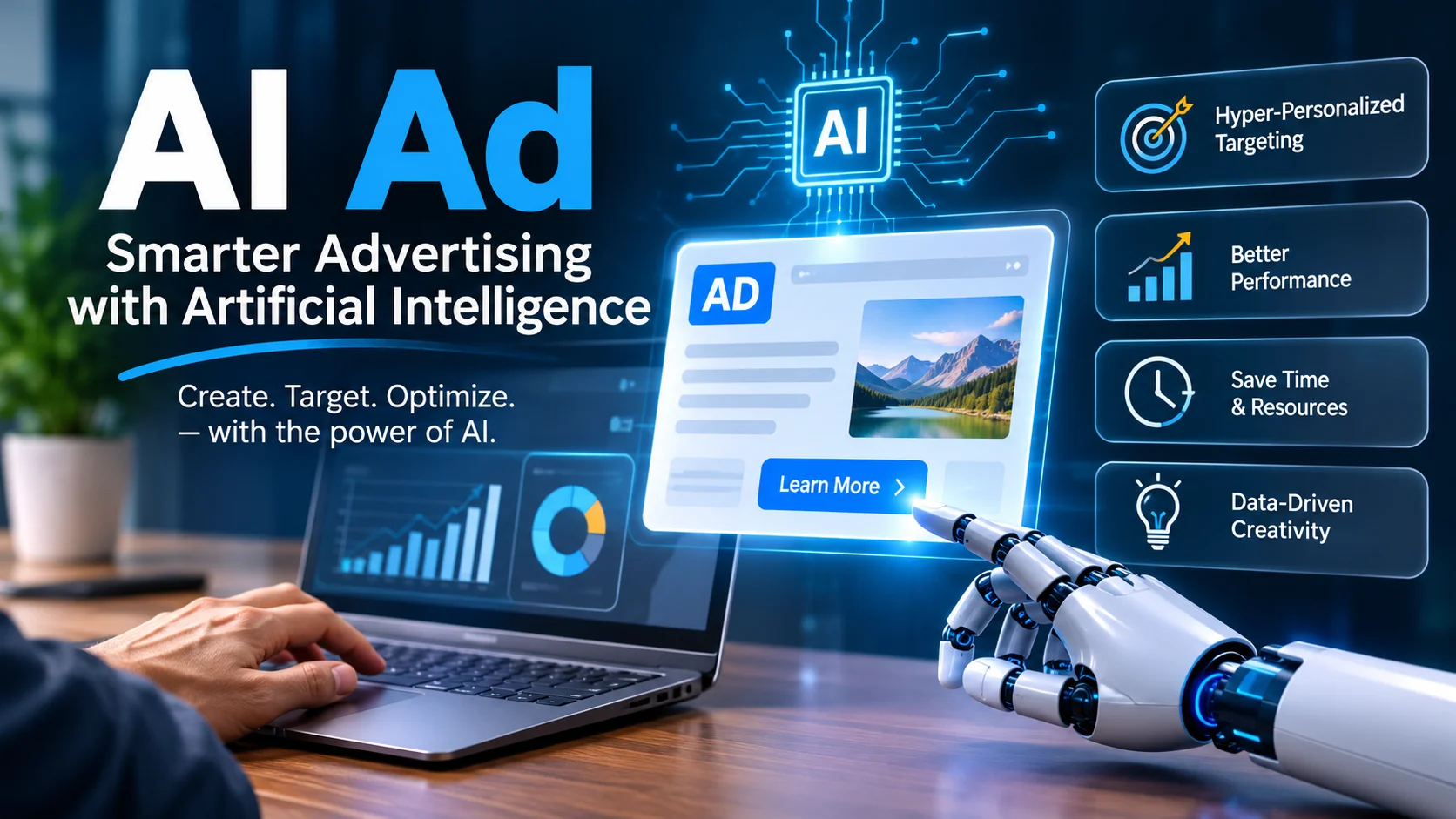
Quick Answer: An AI ad is an advertisement created, personalized, delivered, or optimized with artificial intelligence. Businesses use AI advertising tools to produce marketing content, analyze audiences, automate campaigns, and reach potential customers across digital platforms.
AI Ad | At a Glance
Key Takeaways
- AI ads use artificial intelligence to create advertising content and improve campaign management.
- AI ad generators can produce headlines, product images, promotional videos, and social media creatives.
- Platforms such as Google Ads and Meta Ads include AI-powered advertising features.
- ChatGPT Ads represent another development, allowing businesses to reach people during conversational searches.
- AI can reduce creative production time, but it cannot guarantee conversions or profitable campaigns.
- Human review remains essential for accuracy, brand consistency, advertising compliance, and customer trust.
What Is an AI Ad?
An AI ad, also called an artificial intelligence advertisement, is a digital advertisement that uses AI technology during its creation or delivery.
Traditional advertising often requires separate teams for copywriting, graphic design, video production, audience research, and campaign optimization. AI changes this process by automating parts of these activities.
For example, an online clothing store can provide an AI tool with:
- A product photograph.
- A short product description.
- Its target audience.
- A promotional offer.
- Its preferred advertising platform.
The tool can then generate several advertising concepts. These might include product headlines, promotional images, video scripts, and social media captions.
However, not every AI ad is completely generated by artificial intelligence. Some advertisements combine human-created content with AI-assisted editing, personalization, or campaign optimization.
Three Main Types of AI Advertising
The term AI advertising describes several different technologies. Understanding their differences helps businesses select appropriate tools.
Generative AI Product Photography Ads That Convert | EVKII
1. AI-generated advertisements
AI creates advertising materials, including images, headlines, product descriptions, voiceovers, and videos. These tools primarily support creative production.
AI advertising analytics dashboard helps marketer monitor campaign performance, impressions, click, conversions, revenue, targeting, audience insight, ROI, reach for data driven marketing optimization
2. AI-managed advertising
Machine learning analyzes campaign performance and helps automate bidding, audience selection, creative combinations, and budget optimization.
Google wants you to chat with ads now: AI Mode gets conversational ads and highlighted answers | Mint
3. Advertising inside AI platforms
Advertisements appear within AI-powered experiences, such as conversational assistants. ChatGPT Ads are an emerging example of this advertising model.
These categories can overlap, but they solve different advertising problems.
How Does AI Advertising Work?
AI advertising combines data analysis, machine learning, generative AI, and advertising automation.
The exact process depends on the platform. A creative generator works differently from an automated advertising campaign manager.
Most AI advertising workflows follow five main stages.
1. Understanding the Advertising Brief
The process starts with information about a product, service, or business.
The advertiser provides details such as:
- Product features and benefits.
- Target customers.
- Advertising objectives.
- Brand identity and tone.
- Campaign budget.
- Preferred advertising channels.
Some tools can also analyze a website URL to understand the advertised product.
2. Generating Advertising Content
Generative AI uses language and image models to produce advertising materials.
A large language model (LLM) can generate headlines, descriptions, promotional messages, and video scripts. Image-generation models can create product backgrounds, lifestyle visuals, and advertising concepts.
Video-generation tools can turn scripts, images, or product information into short promotional videos.
The advertiser can review and modify these outputs before using them.
3. Selecting Audiences and Advertising Channels
AI-powered advertising platforms analyze available campaign signals to help identify relevant audiences.
Depending on the platform, these signals may include:
- Previous interactions with advertisements.
- Website activity.
- Search intent.
- Customer interests.
- Conversion history.
- Campaign performance.
The system uses these signals to help deliver advertisements to potentially interested customers.
4. Optimizing Campaign Performance
Machine learning can analyze campaign data and identify patterns.
For example, an advertising platform might identify that a particular creative receives more engagement among mobile users. It can then use that information when optimizing eligible campaign delivery.
Automated systems may also adjust bids, placements, and budget distribution according to campaign objectives.
5. Measuring Results
The final stage involves measuring advertising performance.
Common metrics include:
| Metric | What it measures |
|---|---|
| CTR | Percentage of impressions resulting in clicks |
| CPC | Average cost per click |
| CPM | Cost per 1,000 impressions |
| CPA | Average cost per acquisition |
| ROAS | Revenue generated relative to advertising spend |
| Conversion rate | Percentage of users completing a desired action |
AI can help interpret these measurements, but businesses must still determine whether campaign results support their commercial objectives.
Popular AI Ad Generators and Advertising Platforms
AI advertising tools serve different purposes. Some generate creative content, while others help businesses manage campaigns or reach audiences.
The following platforms illustrate the main categories.
1. Google Ads and Generative AI
News from Google Marketing Live 2023
blog.google
Google incorporates generative AI into its advertising ecosystem, including Performance Max.
Advertisers can provide a website URL and product information. Google AI can then suggest or generate headlines, descriptions, images, logos, and video assets.
The system also supports automated asset combinations across eligible Google advertising channels.
Main applications:
- Search advertising.
- Performance Max campaigns.
- Product promotion.
- Automated creative generation.
- Campaign asset optimization.
Google states that generated assets remain optional and advertisers can review and discard unsuitable suggestions. Availability also depends on account eligibility and supported languages. Google Ads Help+1
Official website: Google Ads
2. Meta Advantage+ Creative
How to Enhance Meta Ads with Advantage+ Creative AI
madgicx.com
Meta Advantage+ includes AI-powered advertising features within the Facebook and Instagram advertising ecosystem.
Its creative enhancements can help generate text variations, modify images, create backgrounds, and adapt advertising assets for different placements.
These features are useful for advertisers who need multiple versions of an advertisement without producing every variation manually.
Main applications:
- Facebook advertising.
- Instagram advertising.
- Creative variations.
- Product promotion.
- Automated campaign optimization.
The available enhancements depend on advertising format, account, and rollout. Advertisers should inspect generated variations rather than assuming every change preserves their original message. About Facebook+1
Official website: Meta for Business
3. AdCreative.ai
AI Ad Creative Generator for High-Converting Ads | AdCreative.ai
adcreative.ai
AdCreative.ai focuses on AI-powered advertising creative production.
It helps businesses generate promotional visuals and advertising content for different marketing campaigns. Its product positioning also includes creative evaluation and tools for producing multiple advertising variations.
Main applications:
- Display advertisements.
- Social media creatives.
- Ecommerce promotions.
- Marketing design variations.
- Advertising creative production.
Its suitability depends on the number of creatives required, available credits, export options, and the level of brand customization.
Official website: AdCreative.ai
4. Canva
Canva AI 2.0 – AI that creates with you, and connects to your world | Product Hunt Launch Dashboard
hunted.space
Canva combines graphic design features with AI-assisted content creation.
Its design environment helps users create promotional graphics, social media advertisements, banners, and marketing materials without advanced graphic design skills.
Main applications:
- Social media advertising.
- Promotional banners.
- Product graphics.
- Brand templates.
- Marketing presentations.
Canva is particularly relevant to small businesses that want creative flexibility and an accessible design workflow.
Official website: Canva
5. Creatify
Product Ads: How To Turn Product URLs Into High-Converting Video Ads | Creatify
creatify.ai
Creatify focuses on AI-generated video advertisements.
Its product workflow includes converting product information into video advertising concepts. This can help ecommerce businesses produce short-form promotional content.
Main applications:
- Product video advertisements.
- Social media video campaigns.
- AI-generated presenters.
- Ecommerce marketing.
- Short-form promotional content.
Before choosing a plan, check generation credits, watermark restrictions, export quality, and commercial usage terms.
Official website: Creatify
AI Advertising Platform Comparison
| Platform | Primary purpose | Suitable users | Pricing considerations |
|---|---|---|---|
| Google Ads | Campaign automation and creative generation | Advertisers and businesses | Advertising spend |
| Meta Advantage+ | Social advertising and creative optimization | Social media marketers | Advertising spend |
| AdCreative.ai | Advertising creative generation | Agencies and ecommerce brands | Subscription and credits |
| Canva | Marketing graphics and design | Small businesses and creators | Free and paid plans |
| Creatify | AI video advertisements | Ecommerce and video marketers | Plan and generation limits |
Important: These platforms are not direct replacements for one another. Their functions overlap, but their primary purposes differ. Subscription prices and feature availability can change, so consult official pricing pages before purchasing.
AI Ads Inside ChatGPT: A New Advertising Channel
ChatGPT Starts Testing Labeled Ads: Free User Monetization Meets Trust | Windows Forum
windowsforum.com
One of the important developments in AI advertising is the introduction of sponsored advertisements inside conversational AI platforms.
Traditional search advertising generally connects advertisements with search queries. Conversational advertising introduces another opportunity: reaching customers while they explore products, compare alternatives, and discuss purchasing decisions.
How ChatGPT Ads Work
OpenAI introduced ChatGPT advertising in February 2026, initially testing the format in the United States.
The advertising experience has since expanded internationally. According to OpenAI’s October 21, 2026 announcement, ChatGPT Ads became available in 89 countries, including Pakistan, through supported advertising access options. OpenAI+1
The current advertising experience includes several important characteristics:
- Sponsored placements: Ads can appear below ChatGPT responses.
- Contextual relevance: The system considers the conversation’s context and intent.
- Advertiser information: Ad units can include a business name, headline, description, image, and landing page.
- Campaign management: Advertisers can create campaigns and review performance through Ads Manager.
- Separate answers: Advertisements remain distinct from ChatGPT’s generated responses.
OpenAI also supports different campaign objectives, including reach, clicks, and conversions, with impression-based and valid-click billing options. OpenAI Help Center+1
Businesses can explore the advertising platform through OpenAI Ads Manager.
How Are ChatGPT Ads Different From Google Ads?
| Comparison | Google Ads | ChatGPT Ads |
|---|---|---|
| Main environment | Search, display, video, and other Google properties | Conversational AI experience |
| Relevance signals | Search queries and other campaign signals | Conversation context and advertiser-provided signals |
| Advertising format | Text, image, video, and other formats | Sponsored placements with text and visual assets |
| Campaign management | Google Ads | OpenAI Ads Manager |
| Main opportunity | Reach customers across Google’s advertising ecosystem | Reach users during conversational research and decisions |
The two platforms serve different advertising environments. Neither automatically replaces the other.
For advertisers, the practical opportunity is to understand where potential customers research products and which channels influence their decisions.
Are ChatGPT Ads Available in Pakistan?
Yes. OpenAI announced an expansion to 89 countries on October 21, 2026, including Pakistan.
However, availability for advertisers does not necessarily mean every account has identical access. Businesses should check supported onboarding methods, account eligibility, payment arrangements, and campaign requirements before planning a launch. OpenAI+1
Benefits of Using AI Ads
AI advertising offers practical advantages across creative production and campaign management.
However, its benefits depend on the quality of the inputs, advertising strategy, and platform implementation.
1. Faster Advertising Production
Creating advertisements traditionally involves several production stages.
AI tools can shorten the process by generating initial copy, images, and video concepts from a single brief.
This allows marketing teams to explore more creative directions without producing every asset manually.
2. Lower Creative Production Costs
Businesses can use AI to reduce repetitive design and copywriting work.
Small companies may find this particularly useful because they often have limited marketing budgets.
However, AI subscriptions, editing, media spending, and human review still create costs.
3. More Creative Variations
Advertising performance depends partly on how audiences respond to different messages and visuals.
AI makes it easier to generate variations featuring different headlines, product benefits, images, and calls to action.
Marketers can test these variations to identify which messages attract qualified customers.
4. Improved Campaign Analysis
Machine learning can process large amounts of campaign data and identify performance patterns.
This helps advertisers understand which audiences, placements, and creative formats deserve further attention.
The quality of these insights still depends on accurate conversion tracking and reliable data.
5. Greater Personalization
AI can help businesses adapt marketing messages to different customer interests and contexts.
For example, an ecommerce business might develop separate promotional messages for first-time visitors and returning customers.
Personalization must respect applicable privacy requirements and platform policies.
6. Easier Content Localization
International businesses often need advertisements in multiple languages.
AI translation and content-generation tools can help adapt promotional material for different markets.
However, literal translation is not enough. Advertisers should review local expressions, cultural references, product claims, and legal requirements.
How to Create an AI Ad: A Practical Workflow
You do not need advanced programming skills to create an AI advertisement.
Most beginner-friendly tools provide templates, prompts, and visual editing interfaces.
Here is a practical workflow for creating a product advertisement.
Five-step AI ad creation process
- Define your advertising objectiveDecide whether you want website visits, product sales, leads, app downloads, or brand awareness.
- Provide accurate product informationUpload product images and explain the features, benefits, price, and intended audience.
- Generate creative contentUse an AI ad generator to produce headlines, descriptions, images, or video concepts.
- Review and customize the advertisementCheck spelling, product appearance, pricing, brand identity, promotional claims, and platform requirements.
- Publish and measure performanceLaunch the advertisement through your chosen advertising platform and monitor clicks, conversions, and acquisition costs.
Example: Creating an Advertisement for a Clothing Store
Imagine a small business selling casual clothing online.
Its advertising brief might look like this:
| Element | Example |
|---|---|
| Product | Men’s casual shirts |
| Audience | Young adults |
| Objective | Generate online sales |
| Main benefit | Comfortable everyday clothing |
| Creative format | Short promotional video |
| Call to action | Shop Now |
An AI tool could generate a promotional headline:
“Upgrade Your Everyday Style With Comfortable Casual Shirts.”
It could also suggest a product video showing different shirt styles and outfit combinations.
The business owner should verify that the generated visuals accurately represent the actual products. A visually attractive advertisement is not useful if it misrepresents what customers receive.
Limitations and Risks of AI Advertising
AI advertising can improve production efficiency, but it introduces risks that businesses should understand before investing.
1. Inaccurate Advertising Claims
Generative AI sometimes produces incorrect product information, promotional offers, or unsupported claims.
For example, an AI-generated advertisement might describe a product as waterproof when it only offers water resistance.
Advertisers remain responsible for reviewing the claims they publish.
2. Artificial-Looking Visuals
Some AI-generated images and videos contain unnatural movements, inconsistent product details, distorted text, or unrealistic faces.
These issues can reduce customer confidence.
Human editing and product verification remain important, especially for ecommerce advertisements.
3. Brand Consistency Problems
AI-generated creative variations may not always follow established brand guidelines.
Colors, typography, product positioning, and messaging can change between outputs.
Businesses should provide clear brand instructions and approve final advertising materials.
4. Privacy and Data Protection
AI advertising tools may process product information, customer data, campaign analytics, or uploaded creative assets.
Before using a platform, review:
- What information the service collects.
- Whether uploaded data is retained.
- Whether customer information is used for model training.
- Which third parties process the information.
- Whether enterprise privacy controls are available.
- How users can request deletion.
Do not upload confidential customer information without confirming that the platform and your intended use meet applicable privacy requirements.
5. Platform Restrictions and Disclosure
Advertising platforms have rules concerning misleading content, synthetic media, prohibited products, and impersonation.
For example, TikTok requires an AI-generated content label or another clear disclosure for qualifying significantly AI-modified advertising content. Undisclosed content can face rejection or restrictions. TikTok Advertising Policies
Requirements differ across platforms and jurisdictions. Advertisers should check the current rules before publishing.
6. Uncertain Return on Investment
Producing more advertisements does not automatically produce more sales.
Campaign performance also depends on:
- Product demand.
- Pricing.
- Landing-page quality.
- Customer experience.
- Audience relevance.
- Competition.
- Advertising budget.
AI can improve parts of the process, but it cannot fix an unattractive product or an ineffective offer.
AI Advertising Costs: What Should Businesses Expect?
There is no universal price for an AI ad.
The total cost depends on whether you use a free creative generator, purchase a subscription, hire an agency, or advertise through a paid media platform.
It is important to separate three different expenses.
| Cost category | What you pay for |
|---|---|
| AI software | Access to generation and automation features |
| Advertising budget | Distribution of advertisements across paid platforms |
| Human production | Editing, strategy, compliance, and campaign management |
Free vs. Paid AI Ad Tools
Free tools are useful for testing basic concepts, generating sample advertisements, and exploring creative possibilities.
However, free plans may restrict downloads, generation credits, video duration, or commercial features.
Paid tools may provide additional templates, higher generation limits, team collaboration, advanced editing, and commercial workflows.
Before subscribing, examine the pricing model carefully.
Some platforms charge per user, while others use monthly credits or generation limits. A low subscription price does not necessarily mean a low cost per usable advertisement.
Hidden Costs Worth Checking
Pay particular attention to:
- Monthly generation credits.
- Video generation costs.
- Download and export restrictions.
- Watermarks on free outputs.
- Credit expiration policies.
- Commercial usage rights.
- Additional charges for team members.
- API usage and integration fees.
For businesses producing advertisements regularly, calculating the cost per approved creative provides a more useful comparison than looking at the monthly subscription alone.
Privacy, Security, and Ownership Considerations
AI advertising involves more than creative production. It can also involve customer information, business assets, and third-party technology providers.
A company should understand how its chosen platform handles these materials.
Data Retention and AI Training
Check whether the provider stores uploaded images, scripts, product information, or customer records.
Also determine whether the provider uses submitted information to improve its models.
Do not assume that a commercial subscription automatically provides Zero Data Retention (ZDR).
Third-Party Model Dependencies
Some AI advertising applications use external models through APIs rather than developing their own foundation models.
This is not necessarily a disadvantage. However, it creates dependencies on model providers, API availability, pricing changes, and external service policies.
Intellectual Property and Commercial Rights
Review the provider’s terms before using generated advertisements commercially.
Pay attention to:
- Ownership of generated content.
- Commercial licensing restrictions.
- Rights to uploaded images and videos.
- Use of recognizable people or brand assets.
- Copyright and trademark concerns.
Businesses should also avoid generating advertisements that imitate real people without appropriate authorization.
Common Mistakes to Avoid When Creating AI Ads
Even a capable AI advertising tool can produce poor results when used without a clear strategy.
Avoid these common mistakes:
- Using vague prompts: Give the tool specific product details and advertising objectives.
- Publishing without reviewing: Check every headline, image, claim, and promotional offer.
- Generating too many variations: Focus on meaningful creative differences rather than producing unnecessary content.
- Ignoring mobile formats: Review advertisements on the placements where customers will see them.
- Choosing tools based only on price: Evaluate output quality, credits, editing options, and commercial rights.
- Ignoring performance data: Track conversions and acquisition costs instead of relying only on likes and impressions.
- Expecting automatic sales: Combine AI-generated content with a clear offer, competitive pricing, and an effective landing page.
The goal should be better advertising decisions, not simply a higher volume of AI-generated content.
Who Should Use AI Advertising?
AI advertising is relevant to businesses of different sizes, but its value depends on their marketing requirements.
| User group | How AI advertising helps |
|---|---|
| Small business owners | Produce promotional content with limited resources |
| Ecommerce businesses | Generate product images and promotional videos |
| Digital marketing agencies | Create creative variations for multiple clients |
| Social media managers | Prepare advertising content for different platforms |
| Content creators | Develop promotional scripts, visuals, and videos |
| Large enterprises | Support campaign automation and marketing analysis |
Is AI Advertising Suitable for Beginners?
Yes. Beginners can use accessible platforms such as Canva and Creatify to produce basic advertising materials.
They do not need programming knowledge or advanced design experience.
However, understanding basic marketing principles remains important. Beginners should learn how to identify customers, communicate product benefits, choose advertising objectives, and measure campaign performance.
How to Choose the Right AI Ad Platform
Choosing an AI advertising platform requires more than comparing features or subscription prices.
The right tool should match your advertising goals and existing workflow.
Consider these factors before making a decision:
1. Identify your primary requirement. Decide whether you need advertising copy, static images, video generation, or campaign automation.
2. Check output quality. Generate sample advertisements and evaluate whether they accurately represent your products and brand.
3. Examine pricing restrictions. Review credits, usage limits, export restrictions, and additional charges.
4. Review integrations. Check whether the platform works with your advertising accounts, ecommerce store, analytics software, and content management systems.
5. Evaluate privacy policies. Understand data retention, third-party processing, and available security controls.
6. Test before committing. Use a trial or free tier where available. Compare the quality of usable outputs rather than the number of generated designs.
7. Measure business results. Evaluate whether the tool improves production efficiency, customer acquisition, or campaign profitability.
What Is the Future of AI Advertising?
AI advertising is moving beyond simple content generation.
New developments are changing how businesses produce creative materials, manage campaigns, and connect with potential customers.
Several trends deserve attention.
Conversational Advertising
AI assistants are creating additional opportunities for sponsored product discovery.
Instead of relying exclusively on traditional search queries, advertisers can reach people during product research and conversational decision-making.
ChatGPT Ads demonstrate this emerging approach.
AI-Generated Video Advertising
Video production is becoming an important application of generative AI.
Advertisers can use AI-generated scenes, virtual presenters, voiceovers, and product demonstrations to develop promotional videos.
However, visual consistency and accurate product representation remain important challenges.
Automated Campaign Management
Advertising platforms increasingly use machine learning to optimize campaign delivery.
These systems can analyze performance signals and automate selected decisions involving creative combinations, placements, and bidding.
Human supervision remains necessary when campaigns involve sensitive products, strict budgets, or regulated claims.
Personalized Advertising Experiences
AI can help adapt advertising messages to different customer interests and shopping situations.
However, personalization must balance relevance with privacy, transparency, and user control.
Greater Attention to Authenticity
As synthetic content becomes more common, customers and advertising platforms will pay greater attention to authenticity.
Clear disclosures, accurate product information, and responsible use of AI-generated media will become increasingly important.
The long-term value of AI advertising will depend on how effectively businesses combine automation with human judgment.
Frequently Asked Questions About AI Ads
1. What is an AI ad?
An AI ad is an advertisement created, personalized, delivered, or optimized using artificial intelligence. Businesses use AI to generate advertising copy, images, videos, and campaign variations.
2. Can I create AI ads for free?
Yes. Some platforms offer free design tools or AI-assisted advertising features. Canva provides free design options, while Google Ads offers AI-powered campaign features for eligible users. However, running paid campaigns still requires an advertising budget.
3. Which AI ad generator is best for beginners?
Canva is a useful starting point for creating promotional graphics and social media ads. Creatify is another option for generating product videos. The best choice depends on your preferred ad format and budget.
4. Are AI-generated advertisements legal?
Yes, provided they follow applicable advertising laws, copyright requirements, consumer protection rules, and platform policies. Advertisers should also avoid misleading claims and unauthorized impersonation.
5. Can businesses advertise on ChatGPT?
Yes. OpenAI offers advertising through its Ads Manager and supported access options. Availability depends on the advertiser’s location, account eligibility, and campaign requirements.
Conclusion
AI advertising is changing how businesses create, distribute, and optimize digital advertisements. AI ad generators help produce promotional content, while advertising platforms use machine learning to improve campaign management and delivery. Conversational advertising also introduces new opportunities through platforms such as ChatGPT. However, businesses should evaluate output quality, privacy, pricing, platform restrictions, and actual campaign results before choosing a solution. The most effective approach combines AI efficiency with human creativity, accurate information, and a clear marketing strategy.