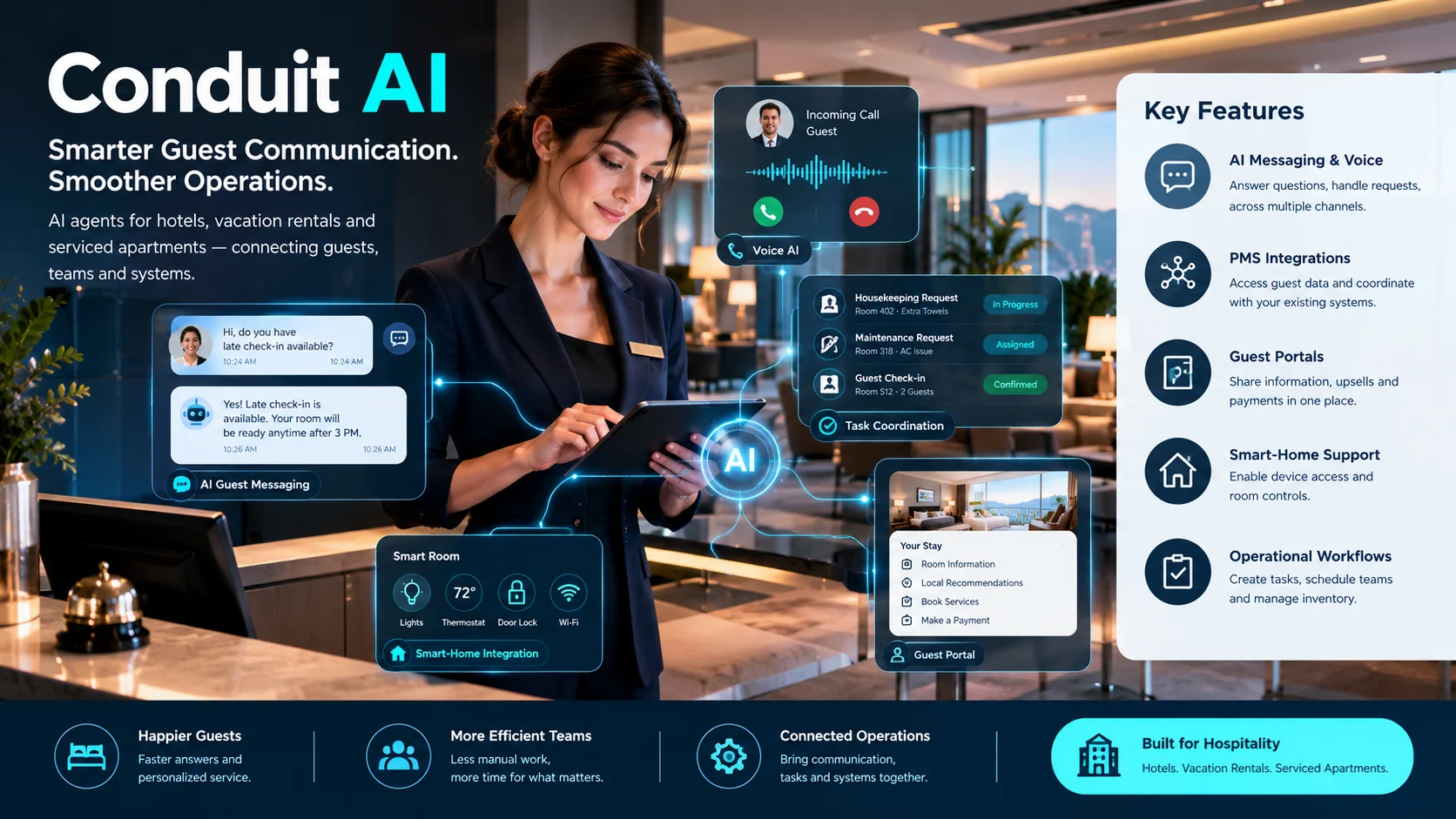
Conduit AI is a business automation platform whose hospitality-focused offering uses AI agents to manage guest communications, answer calls, and coordinate operational tasks. Its features include messaging automation, voice AI, guest portals, and integrations with property management systems, with available capabilities and costs depending on the selected plan.
Businesses increasingly use AI agents to handle repetitive customer interactions and reduce manual administrative work. Conduit AI targets this need by connecting customer communication with operational workflows, particularly in hotels, serviced apartments, and short-term rentals.
However, the name can refer to several unrelated products. The hospitality platform at Conduit.ai is different from similarly named AI clients, industrial automation systems, and other software products. Identifying the correct service is essential before comparing features or pricing.
This guide examines the hospitality-focused Conduit platform, its published plans, practical applications, potential limitations, and alternatives worth evaluating.
Conduit AI at a Glance
- Primary purpose: Automate guest communication and hospitality operations.
- Core technology: AI agents for messaging, voice interactions, and workflows.
- Target customers: Hotels, serviced apartments, and vacation rental operators.
- Key capabilities: Guest messaging, voice AI, portals, integrations, and operational coordination.
- Published pricing: Starting rates range from $18 to $48 per unit per month for the listed hospitality packages, with additional conditions and usage credits.
- Main consideration: Businesses should verify integrations, automation boundaries, usage allowances, and total costs before deployment.
What Is Conduit AI?
Conduit is a software company building AI agents that help service businesses manage communications and operational work. According to its official website, the company was founded in 2024 and is based in San Francisco. Its initial focus includes hotels and vacation rentals.
The platform aims to move beyond answering questions. Its agents can handle guest requests and, where configured integrations and permissions allow, coordinate actions across connected systems.
For example, answering a guest’s question about check-in is a communication task. Arranging a maintenance visit after a guest reports a broken appliance requires additional steps, such as creating a task and coordinating with the appropriate team.
Conduit’s broader approach connects these interactions with operational workflows. The precise actions available depend on the property’s setup, integrations, and selected plan.
Why Conduit AI Matters for Hospitality
Hospitality businesses manage a large volume of routine interactions. Guests ask about arrival times, access instructions, parking, amenities, checkout procedures, and local services.
These requests often arrive through different channels. Staff may need to switch between messaging apps, phone calls, booking systems, and internal task-management tools.
A unified AI workflow can help centralize these interactions. It can also reduce the need for staff to manually transfer every request between systems, provided the relevant integrations work as expected.
The business value depends on execution. An automated reply that does not resolve the guest’s problem may simply create more work later.
Key Features of Conduit AI
Conduit’s published product and pricing pages describe several capabilities for hospitality operators. Availability varies by package.
1. AI-Powered Guest Messaging
Conduit supports guest conversations across communication channels, with a unified inbox designed to bring interactions together.
This can help teams handle common questions without manually responding to every message. It also provides a central place to manage conversations that require human attention.
Before adopting the feature, verify which channels your property actually uses and whether each one is supported by your specific plan.
2. AI Voice Agents
Voice AI is another core part of the offering. According to the official pricing page, the Messaging package includes inbound and outbound voice capabilities.
Voice agents may help answer routine calls, provide information, and route requests. More complex interactions require careful testing, particularly when they involve reservations, payments, access problems, or urgent maintenance.
Ask the provider how the system handles unclear speech, interruptions, language changes, and situations in which a caller needs a human representative.
3. Property Management System Integrations
Property management systems, or PMS platforms, help hospitality businesses manage reservations, guest details, availability, and other operational information.
Connecting an AI agent to a PMS can make responses more relevant to a guest’s actual stay. However, integration depth matters more than the mere presence of an integration logo.
Before purchasing, confirm whether the connection can read information only or also update reservations and execute other actions. Check which permissions are required and whether those capabilities are included in your plan.
4. Guest Portals and Digital Guidebooks
Conduit’s Guest package adds guest portals and rich-media guidebooks, along with features for waivers, upsells, and payments.
These tools can centralize information guests need during their stay. Depending on the setup, a portal may also provide access to additional services or property information.
Operators should test the complete guest journey, from receiving access instructions to completing any optional purchase. They should also confirm how payment processing, refunds, and guest data are handled.
5. Smart-Home Integrations
The Guest + Devices package adds smart-home integration and device-management workflows. Published features include guest access codes and support for connected devices.
This may be useful for properties using compatible electronic locks, thermostats, or sensors.
Device automation deserves particular care because an incorrect action can affect physical access or guest comfort. Operators should establish permission limits, test failure scenarios, and maintain a manual fallback for critical systems.
6. Operational Workflows and Task Coordination
The Full Suite package adds tasks, workforce functions, scheduling, dispatch, inventory management, and agentic operational workflows.
These capabilities address work that happens after a guest reports a problem. Instead of merely acknowledging a request, an integrated workflow may help route it to the appropriate team.
For example, a guest reports that the heating is not working. A suitable workflow might record the issue, notify maintenance, and update the guest when a response is available.
The exact level of autonomy should be confirmed during implementation. Automated task creation is not the same as guaranteeing that a repair will be completed.
How Does Conduit AI Work?
Conduit combines conversational AI with integrations and workflows that allow software to take actions. Its goal is to connect the guest’s request with the business process needed to resolve it.
A typical workflow can be understood in five stages.
- Receive the request. A guest sends a message or makes a phone call.
- Interpret the intent. The AI identifies the question, request, or problem.
- Retrieve relevant information. The system uses available property information and connected business data.
- Perform an authorized action. Where the workflow and integrations support it, the agent may update a record, create a task, or coordinate a response.
- Respond or escalate. The system communicates the result or directs the conversation to a human team member.
This is a general description of an integrated AI workflow, not a guarantee that every Conduit deployment follows every step automatically.
AI Agents Versus Traditional Chatbots
Traditional chatbots primarily answer questions or follow predefined conversational paths. AI agents can combine language understanding with tools and actions to complete more involved tasks.
Consider a guest asking for an extra towel. A basic chatbot might provide instructions for contacting housekeeping. An appropriately configured agent could potentially create a request and route it to the relevant team.
The difference lies in the connected systems, permissions, and workflow design, not simply in the use of a more advanced language model.
Why Integrations Matter
An AI agent is only as useful as the information and actions available to it.
If the system cannot access current reservation details, it may struggle to answer booking-specific questions accurately. If it cannot communicate with the housekeeping system, it may be unable to confirm whether a request has been assigned.
Businesses should therefore test end-to-end tasks instead of evaluating the chatbot solely on the quality of its written responses.
Conduit AI Pricing: Plans and Costs
Conduit’s official pricing page lists hospitality packages with starting rates based on the number of units. The published rates below were available on the page reviewed for this article. They should be rechecked before publication or purchase.
| Plan | Starting price | Monthly credits per unit | Main additions |
|---|---|---|---|
| Messaging | $18 per unit/month | 40 | Unified inbox, messaging, voice AI, integrations, workflows, reporting |
| Guest | $30 per unit/month | 60 | Guest portals, guidebooks, waivers, upsells, payments |
| Guest + Devices | $36 per unit/month | 80 | Smart-home integrations and device-management workflows |
| Full Suite | $48 per unit/month | 100 | Tasks, workforce operations, scheduling, dispatch, inventory |
| Startup | $899/month | 2,000 total credits/month | Published as a startup package with the full feature set |
The Startup package is listed separately from the per-unit packages. Confirm eligibility and implementation terms directly with Conduit before comparing it with the other plans.
What Do These Prices Mean in Practice?
A per-unit price is not necessarily the same as the total cost for an entire business. Conduit’s pricing page states that rates scale beyond 50 listings.
For example, a property manager operating 20 units on the Messaging package would have a simple starting-rate calculation of $360 per month, before any applicable adjustments or additional charges.
Actual costs may depend on usage, package eligibility, and the details of the agreement. Businesses should request a written quotation that specifies the billing unit, included credits, overage treatment, taxes, and any onboarding costs.
Questions to Ask Before Buying
- What counts as one unit or listing?
- How are messaging and voice credits consumed?
- What happens when the monthly credit allowance is exhausted?
- Do unused credits roll over or expire?
- Are additional charges applied to phone calls, messaging channels, or integrations?
- Is onboarding included, and are there minimum contract terms?
- Can the business downgrade or cancel without a penalty?
These details matter because a low starting price does not necessarily translate into a low cost per successfully resolved guest request.
Benefits of Using Conduit AI
Conduit may be useful for hospitality businesses that need to coordinate guest communication across multiple systems.
Faster Handling of Routine Requests
Automating repetitive interactions can reduce the time staff spend answering the same questions. The actual improvement depends on message volume, workflow quality, and how often conversations need human intervention.
More Consistent Guest Communication
A configured AI agent can use approved property information to answer recurring questions in a consistent format. Operators still need to check that the information remains current and accurate.
Better Coordination Between Teams
Connecting communication with operational workflows can reduce manual handoffs. This is especially relevant when guest requests require housekeeping, maintenance, or another team to take action.
Support Beyond Business Hours
AI agents can handle eligible interactions outside normal staffing hours. That can help businesses respond when a guest needs basic information at night or during busy periods.
However, availability does not guarantee resolution. Complex incidents, emergencies, and unusual requests still need an appropriate escalation process.
Potential Operational Savings
Automation may reduce some repetitive administrative work, but savings should be measured rather than assumed.
A useful evaluation compares the total platform cost with staff time saved, the number of requests resolved, guest satisfaction, and the cost of correcting automation errors.
Limitations and Risks to Consider
Conduit is not a substitute for every hospitality employee or operational system. Buyers should understand the practical limits before automating important workflows.
AI Can Misinterpret Requests
Guests may use ambiguous language, switch topics, or describe problems in unexpected ways. An AI agent can misunderstand a request or generate an inaccurate response.
Test common and unusual scenarios before enabling automation at scale. Establish clear rules for uncertain answers and sensitive requests.
Automation Depends on Integration Quality
A platform may advertise integration with a business system without supporting every action that the business needs.
Check whether each integration supports reading, writing, notifications, and error handling. Confirm what happens if the external system is unavailable.
Credit Limits Can Affect Costs
The published packages include different monthly credit allowances. The available pricing information does not, by itself, establish how every type of interaction consumes credits or what all overage charges may be.
Request examples based on your expected call duration, message volume, and number of properties.
Human Oversight Remains Necessary
Guest disputes, payment issues, emergency situations, and unusual maintenance problems may require judgment that an automated workflow cannot reliably provide.
Set escalation rules and assign responsibility for monitoring unresolved requests. A reliable process should make it easy for staff to intervene when automation is uncertain.
Vendor Dependence
A business that centralizes guest communications and workflows in one platform may become dependent on its integrations and operating procedures.
Before committing, ask how data can be exported, what happens when the contract ends, and whether important workflows can be transferred to another provider.
Privacy, Security, and Data Handling
Hospitality platforms can process names, contact information, reservation details, guest messages, and operational records. Some configurations may also connect to payment systems or property-access devices.
Businesses should review Conduit’s current privacy policy, contractual terms, and technical documentation before sending sensitive information through the platform.
Focus on these areas:
- Data retention: How long are messages, recordings, and related records stored?
- AI processing: Which AI providers process the data, and under what terms?
- Access controls: Can employees access only the properties and records relevant to their roles?
- Auditability: Can managers review automated actions and identify who or what initiated them?
- Data deletion: What happens to information when a guest requests deletion or a contract ends?
- Incident handling: What notification and response procedures apply if a security incident occurs?
Do not assume that a provider’s security certification, if one applies, guarantees that no data is retained. SOC 2 and Zero Data Retention are different concepts, and neither should be inferred without specific evidence.
For systems that manage door locks or access codes, review operational safeguards separately from ordinary chat privacy. A mistaken answer and an unauthorized physical-access action have very different consequences.
Conduit AI Alternatives and Competitors
The most suitable alternative depends on whether you need AI guest messaging, voice automation, guest portals, or a broader hospitality management system.
Conduit publishes its own comparisons with hospitality platforms such as Akia, Asksuite, Besty AI, Canary Technologies, and Duve. Those comparisons are useful for identifying feature differences, but claims made on a vendor’s own comparison page should be treated as vendor claims rather than independent evaluations.
| Platform | General focus | What to compare |
|---|---|---|
| Conduit | Guest communications and operational AI | Voice, messaging, workflows, devices, and unit-based pricing |
| Akia | Hospitality guest communication and operations | Messaging, property management integrations, and staff workflows |
| Asksuite | Hotel guest communication and booking-related conversations | Pre-booking messaging, direct-booking support, and integrations |
| Canary Technologies | Digital guest management and hospitality technology | Guest experience tools, AI features, and system compatibility |
| Duve | Digital guest experience and guest-facing services | Guest apps, portals, communication, and upselling |
These products overlap, but they are not interchangeable in every deployment. Verify their current capabilities and pricing directly before making a shortlist.
How to Compare Alternatives Fairly
Use the same test cases for every vendor.
For example, ask each system to handle a late check-in question, a request for extra towels, a maintenance complaint, and a reservation change. Then check whether it retrieves accurate information, performs the required action, and escalates appropriately.
Compare the total cost for your expected usage, not just the advertised starting rate. Also examine onboarding requirements, staff training, integration reliability, reporting, and the effort required to switch providers later.
Who Should Use Conduit AI?
Conduit is worth evaluating for:
- Hotel operators managing frequent guest messages and calls.
- Vacation rental managers coordinating communications across multiple properties.
- Serviced-apartment operators handling repeated guest requests and operational tasks.
- Hospitality teams that need to connect communication with housekeeping or maintenance workflows.
- Growing property portfolios seeking a more centralized approach to guest interactions.
It may be less suitable for a small operation with low message volume, limited technical support, or no need for integrated workflows. A simpler messaging system or a basic answering service could be sufficient in those circumstances.
Businesses outside hospitality should also verify that the product supports their specific workflows rather than assuming the hospitality offering is a general-purpose AI automation platform.
How to Evaluate Conduit AI Before Deployment
A structured pilot provides better evidence than relying solely on product demonstrations.
Step 1: Establish a Baseline
Record your current message volume, call volume, response times, unresolved requests, and staff time spent on repetitive tasks.
Step 2: Select a Limited Workflow
Start with a low-risk task, such as answering routine questions about check-in or property amenities. Avoid giving an untested system broad permissions over reservations, payments, or physical access.
Step 3: Test Normal and Difficult Cases
Include incomplete questions, outdated information, unusual requests, and situations that require a human response.
Step 4: Measure Actual Outcomes
Track successful resolutions, escalation rates, incorrect responses, guest feedback, and total operating costs. Separate tasks completed automatically from tasks that merely received an automated acknowledgment.
Step 5: Expand Gradually
Increase the scope only after the system demonstrates reliable performance under realistic conditions. Keep a manual fallback and review the results regularly.
This approach helps establish whether Conduit provides meaningful value for your operation rather than assuming that automation will automatically reduce costs.
Frequently Asked Questions
1. What is Conduit AI used for?
Conduit AI is used to automate guest communications and operational workflows, particularly for hotels, serviced apartments, and short-term rental businesses. Its published features include AI messaging, voice agents, guest portals, integrations, and operational coordination.
2. How much does Conduit AI cost?
Conduit’s published hospitality pricing starts at $18 per unit per month for Messaging, $30 for Guest, $36 for Guest + Devices, and $48 for Full Suite. A separate Startup package is listed at $899 per month. Confirm current rates, usage allowances, and contract terms directly with the provider.
3. Does Conduit AI support voice calls?
Yes. Conduit’s published pricing information includes inbound and outbound voice AI in the Messaging package. Confirm the supported call workflows, usage allowances, and escalation options for your intended deployment.
4. Is Conduit AI suitable for small businesses?
It may suit small hospitality businesses that handle enough guest communication to justify automation. Suitability depends on the number of units, request volume, integration requirements, monthly costs, and the amount of human oversight needed.
5. Is Conduit AI the same as other products called Conduit?
No. Several unrelated products use the Conduit name. The hospitality platform at Conduit.ai is distinct from similarly named AI clients, industrial automation platforms, and other software products. Verify the official website and product description before signing up.
Conclusion
Conduit AI is a hospitality-focused automation platform designed to connect guest communication with business operations. Its published offering spans messaging, voice AI, guest portals, connected devices, and task coordination.
Its potential value depends on more than how naturally an AI agent speaks. Integration depth, successful task completion, human escalation, privacy safeguards, and total operating costs are equally important.
For hotels and vacation rental managers, a limited pilot can establish whether the platform fits their workflows. Compare the results with other hospitality solutions, verify the current pricing, and expand automation only when the system performs reliably.