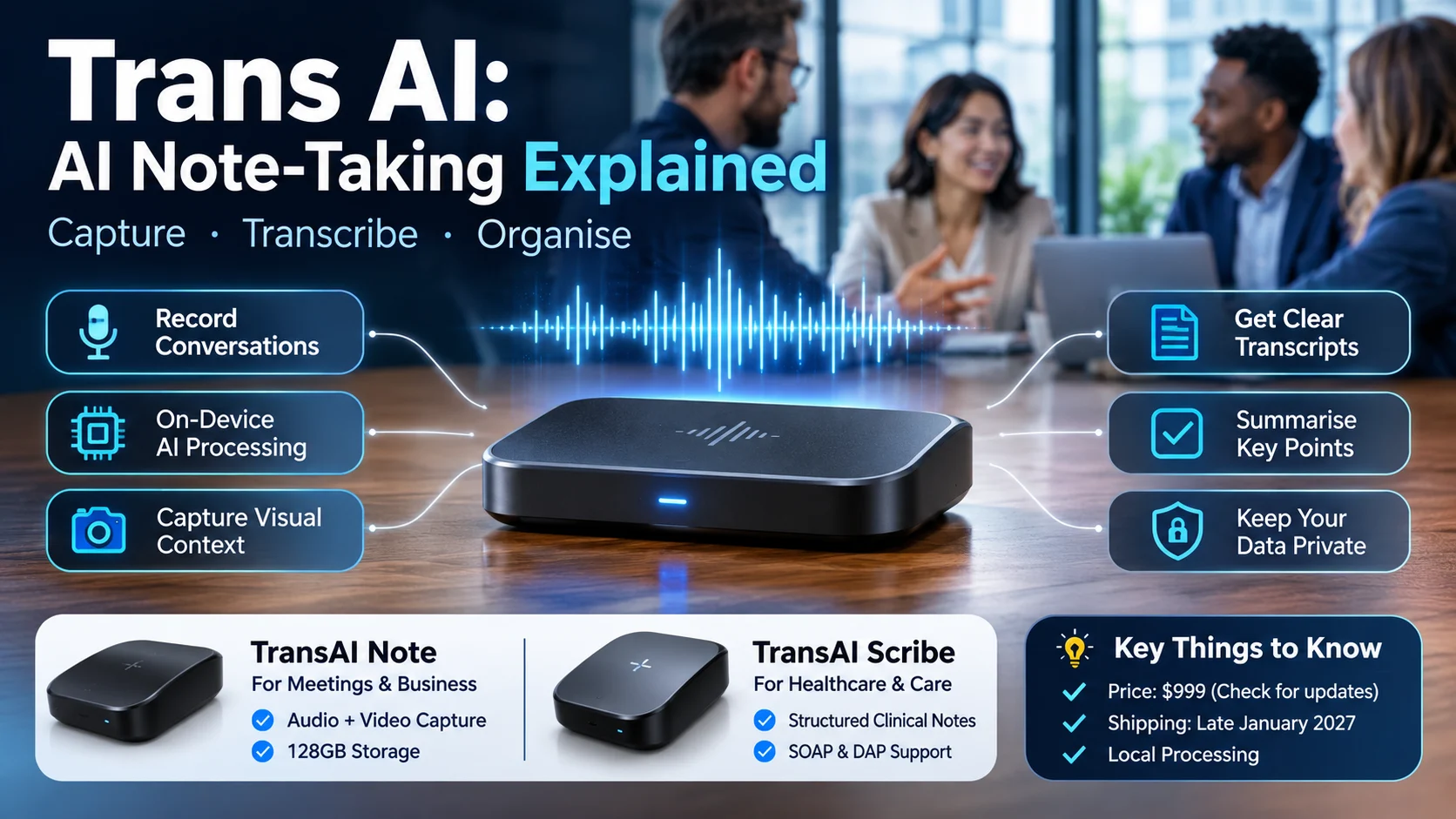
Quick Answer: Trans AI, branded as TransAI, is developing dedicated AI devices that turn in-person conversations into organised notes. Its main products are TransAI Note for meetings and TransAI Scribe for care conversations, with the company emphasising on-device AI processing.
What Is Trans AI?
TransAI is an AI technology company developing dedicated hardware for recording, transcribing, and organising conversations. Rather than offering only a browser-based transcription service, it is building physical devices intended to capture spoken information and turn it into useful written records.
The company currently presents two main products: TransAI Note and TransAI Scribe.
TransAI Note focuses on everyday professional conversations, such as business meetings, interviews, and discussions. TransAI Scribe is aimed at care environments where professionals need to document conversations and prepare structured notes.
The main difference between TransAI and many familiar AI note-taking services is its emphasis on local processing. TransAI says its devices can handle core AI tasks directly on the device. This may appeal to people and organisations that prefer not to send every recording to an external AI service.
However, local processing should not automatically be treated as proof of complete privacy or security. Those claims need to be assessed against the device’s actual data flows, software updates, storage, and export options.
How Does TransAI Work?
TransAI’s intended workflow is straightforward: capture a conversation, process the information, and turn it into a written record.
- Capture the conversation: The device records spoken information through its microphones.
- Process the recording: Its AI system analyses the captured audio. TransAI says core processing takes place locally on the device.
- Generate text: The system converts speech into a transcript and may identify different speakers.
- Organise the information: AI features can turn the conversation into summaries, key points, or action items.
- Review and use the result: Users can check the generated information and use it as a reference or working document.
The final result still needs human review. Speech recognition can misunderstand names, technical terms, accents, and unclear speech. AI-generated summaries can also leave out important details or misrepresent what someone said.
TransAI Note | AI Meeting Note-Taking Device
TransAI Note is designed for people who regularly attend in-person meetings and want more than a basic audio recording. The device is intended to capture spoken discussions alongside visual information, such as whiteboards and projected content.
According to its official product page, its advertised features include:
- Audio recording and transcription: Captures spoken discussions and converts them into text.
- Speaker identification: Helps distinguish between different speakers.
- Visual capture: Records whiteboard and projected information to preserve meeting context.
- AI summaries: Organises discussions into summaries, decisions, and action items.
- On-device processing: TransAI says the main recording and AI workflow runs directly on the device.
The product page also lists a 128GB storage capacity, an eight-microphone array, a 16MP camera, and a 48-TOPS AI chipset. These are manufacturer-published specifications, not independently verified performance results. The advertised 20-metre audio pickup distance should also be treated as a company claim rather than a guarantee for every room or recording condition. Private On-Device AI Meeting Notetaker
What makes TransAI Note different?
Many meeting assistants depend on a phone, computer, or cloud service to process recordings. TransAI’s approach is to combine recording hardware and local AI processing in one dedicated device.
That design may be useful for organisations that handle confidential discussions or work in places with unreliable internet access. It also means buyers should look closely at how the device handles software updates, file exports, backups, and data recovery.
The product page says there is no subscription fee for its on-device AI features. Buyers should still check the current terms and confirm whether any optional services or future features have separate costs. Private On-Device AI Meeting Notetaker
TransAI Scribe | AI Documentation for Care Conversation
TransAI Scribe is intended for healthcare and other care-related settings. Its purpose is to help professionals turn conversations into structured draft notes without having to write every detail while speaking with a patient or client.
The company describes support for SOAP, DAP, and custom note templates. These formats can help organise information into sections that professionals can review and edit.
For example, a SOAP note commonly separates information into:
- Subjective: What the patient reports.
- Objective: Relevant observations or measurements.
- Assessment: The professional’s assessment.
- Plan: The proposed next steps.
This structure can make documentation easier to review, but AI-generated notes should never be treated as automatically accurate or ready for a medical record without professional checking.
Is TransAI Scribe ready for clinical use?
This is an important question for healthcare buyers. TransAI’s current About page says Scribe is being evaluated across clinics, homes, care facilities, senior communities, and virtual visits. It also states that product capabilities, integrations, processing boundaries, and data-handling practices can vary by product, development stage, and approved workflow. TransAI
That means potential users should not assume every advertised clinical feature is already available in a fully deployed workflow. Before adopting it, a clinic should ask the company for evidence about transcription accuracy, supported languages, EHR integrations, security controls, regulatory requirements, and the status of any pilot programme.
TransAI Pricing and Availability
TransAI’s listed prices and shipping estimates can change. The following information reflects the official product pages checked on November 26, 2026.
| Product | Listed price | Availability information |
|---|---|---|
| TransAI Note | $999 sale price; $1,599 regular price | Estimated shipping: late January 2027 |
| TransAI Scribe | $999 displayed price | Product page also displays inconsistent promotional content; confirm directly |
The TransAI Note page says the product is not shipping immediately and gives an estimated shipping date of late January 2027. This is a forward-looking estimate, not confirmation that orders have shipped. Private On-Device AI Meeting Notetaker
The Scribe product page currently displays a $999 price, but it also contains unrelated promotional material and conflicting offer information. Treat that listing cautiously and confirm the actual price, availability, and product details with TransAI before placing an order. Private On-Device AI Clinical Documentation
Is TransAI worth the price?
That depends on what you need it to do. A dedicated device costing around $999 is a substantial purchase, especially for someone who only records occasional meetings.
Its value proposition is more relevant to professionals or teams that frequently document important in-person conversations and specifically want a dedicated device with local AI processing. Before buying, compare the total cost with software-based note-taking services, including any subscriptions, storage limits, and privacy requirements.
TransAI and Data Privacy | What Buyers Should Know
Privacy is one of TransAI’s main selling points. The company says its devices process conversations locally, without sending the core recording and AI workflow to external cloud servers. TransAI+1
This approach can reduce dependence on cloud processing, but it does not automatically prove that a product is completely secure. Buyers should understand exactly what happens to recordings, transcripts, exports, diagnostic information, and software updates.
Before purchasing, ask the company:
- Does any information leave the device during normal use?
- How are recordings and generated notes encrypted?
- Can administrators control access to stored information?
- How are software and AI model updates delivered?
- Can users permanently delete recordings and notes?
- Are there independent security assessments or recognised certifications?
Healthcare organisations need additional checks. The American Psychological Association recommends evaluating privacy compliance, technical security, data handling, consent procedures, and integration with existing clinical systems before adopting an AI scribe. It also stresses that professionals must review and correct AI-generated documentation before adding it to a clinical record. https://www.apa.org+1
Important: Do not assume that TransAI Scribe is HIPAA-compliant, GDPR-compliant, or approved for a particular clinical workflow simply because the company advertises on-device processing. Request the relevant documentation and legal agreements for your jurisdiction.
Benefits and Limitations of TransAI
TransAI has an interesting approach to AI note-taking, but buyers should consider both its potential advantages and the questions that remain unanswered.
Potential benefits
- Local AI processing: The company says core processing happens on the device, which may reduce reliance on external cloud services.
- Dedicated hardware: TransAI Note combines audio recording with visual meeting capture.
- Structured summaries: Its tools are designed to organise conversations into notes, decisions, and action items.
- Healthcare-focused product: TransAI Scribe is being developed for care conversations and structured documentation.
- No stated subscription for Note’s core features: The product page advertises on-device processing without a monthly AI subscription. Private On-Device AI Meeting Notetaker+1
Limitations to consider
- High upfront price: A listed price of $999 makes TransAI Note a significant investment.
- Shipping delay: The official Note page gives an estimated shipping date of late January 2027.
- Limited independent testing: Manufacturer specifications do not establish real-world transcription accuracy or performance.
- Clinical readiness needs verification: TransAI describes Scribe as being evaluated across care settings.
- Privacy claims need evidence: Local processing is useful, but buyers should still examine security documentation and data-handling practices.
- Language support needs confirmation: Users should check whether their required languages, accents, and terminology are supported reliably.
Who Should Consider TransAI?
TransAI may be worth evaluating for professionals and organisations that frequently handle important in-person conversations.
Business teams: TransAI Note may help teams preserve meeting discussions, decisions, and action items.
Researchers and interviewers: A dedicated recorder with transcription and summarisation could help organise interviews and research conversations.
Consultants and professionals: People who regularly document client discussions may find structured meeting notes useful.
Healthcare providers: TransAI Scribe may be relevant to clinicians exploring AI-assisted documentation. However, they should confirm its current evaluation status, clinical performance, integrations, and compliance requirements before using it with patient information.
TransAI may be less suitable for someone who only needs occasional voice recording or a low-cost transcription app. Its dedicated hardware and listed price make more sense when its specific features solve a regular documentation problem.
TransAI vs. Traditional AI Note-Taking Apps
The main distinction is the product approach.
Traditional AI note-taking apps generally operate through a phone, computer, or online service. TransAI is developing dedicated devices that it says can process core AI tasks locally.
| Comparison | TransAI approach | Traditional software approach |
|---|---|---|
| Product format | Dedicated AI hardware | Phone, desktop, or web application |
| Main use | Capturing and organising conversations | Recording, transcription, and meeting notes |
| Processing | Company says core tasks run on-device | Depends on the service |
| Internet | Core functions advertised as offline | Often relies on internet connectivity |
| Initial cost | Higher hardware purchase | May offer free or lower-cost entry plans |
| Best fit | Users wanting dedicated hardware and local processing | Users wanting flexible software-based tools |
Neither approach is automatically better. Software services can be easier to adopt and may offer broader integrations. Dedicated hardware may appeal to users who value offline operation and local processing.
The right choice depends on recording quality, workflow compatibility, privacy requirements, total cost, and the accuracy of the generated notes.
Frequently Asked Questions
1. What is Trans AI?
Trans AI, officially branded as TransAI, is a company developing AI-powered devices for meeting note-taking and care documentation.
2. What is TransAI Note used for?
TransAI Note is designed to record in-person meetings, transcribe speech, capture visual context, and generate summaries and action items.
3. What is TransAI Scribe?
TransAI Scribe is a product intended to turn care conversations into structured draft notes for professional review.
4. Does TransAI work without the internet?
TransAI says its devices are designed to process core AI functions locally without requiring an internet connection. Buyers should confirm the exact offline capabilities of the product they intend to purchase.
5. How much does TransAI Note cost?
The official product page lists TransAI Note at $999, with a regular price of $1,599. Its estimated shipping date is late January 2027. Prices and availability can change. Private On-Device AI Meeting Notetaker
Conclusion
TransAI is developing dedicated AI hardware for meeting notes and care documentation. Its focus on local processing, voice capture, and structured summaries makes it worth watching. However, its high price, shipping timeline, and limited independent performance evidence deserve careful consideration. Buyers should verify the product’s actual capabilities and privacy documentation before making a decision.