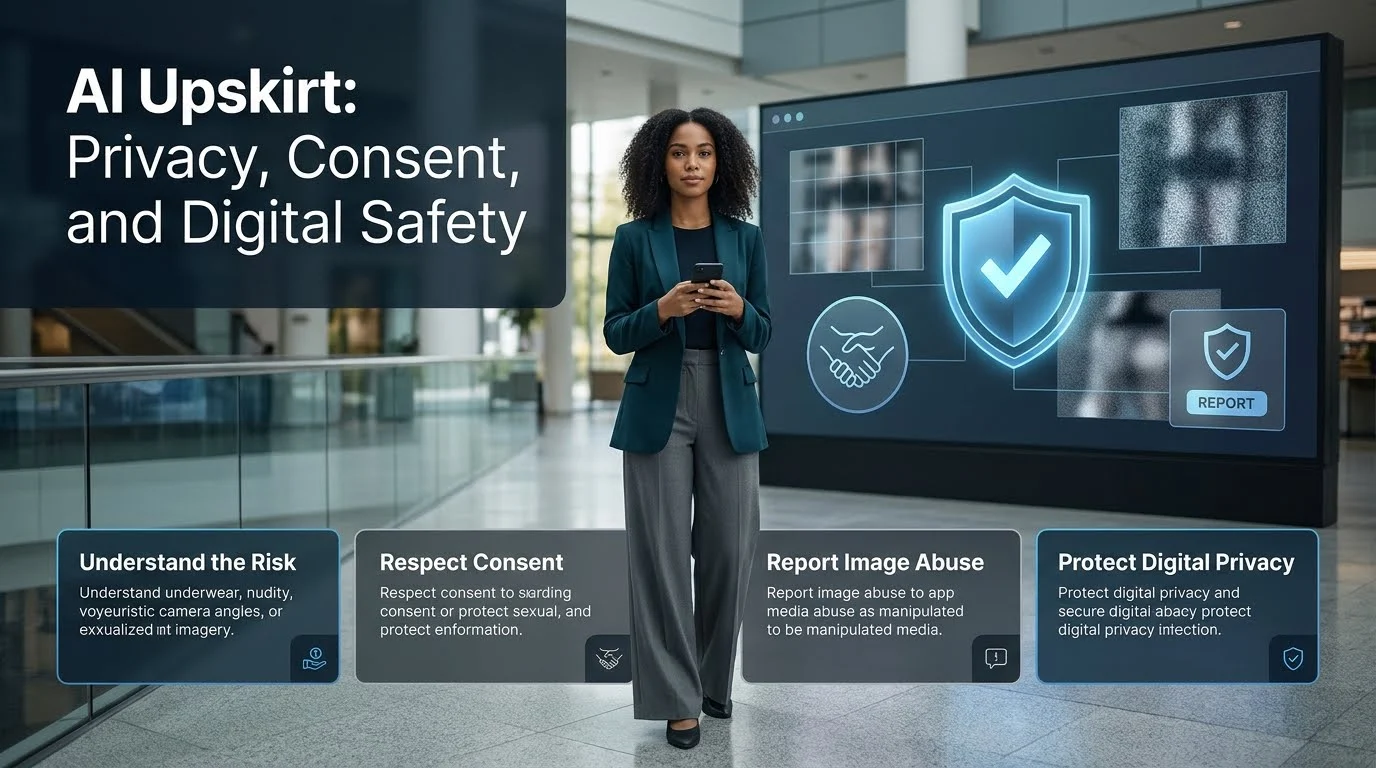
Quick Answer: AI upskirt refers to AI-generated or manipulated imagery that falsely depicts someone as being viewed under their clothing, often without consent. It is a form of image-based abuse that raises serious concerns about privacy, harassment, consent, and the misuse of generative AI.
The phrase AI upskirt describes imagery created or manipulated with artificial intelligence to make it appear that a person is being photographed beneath their clothing.
Traditional upskirt photography involves capturing an image beneath someone’s clothing without their knowledge or permission. AI changes the process by allowing someone to fabricate or alter an image instead of taking an actual photograph.
The result may look realistic, but it does not necessarily represent a real event. It can be an artificial depiction created from an ordinary photograph.
How does AI-generated intimate image abuse happen?
Generative AI systems can create or modify images based on text instructions and visual references. Some image-editing systems can also alter clothing, backgrounds, body appearance, or other visual details.
When people misuse these capabilities, they may create fabricated sexualized images of someone who never agreed to participate.
At a high level, the process can involve three broad stages:
1. An ordinary image becomes a target
A person may take a publicly available photograph from a social media account, website, or other online source.
The original photograph may show someone fully clothed. Its public availability does not grant permission to turn it into sexualized material.
2. AI manipulation changes the image
A generative or editing system may produce an altered depiction. The output can falsely suggest that a person was photographed in an intimate or compromising situation.
This is a form of synthetic media. The image may look convincing despite depicting an event that never happened.
3. The fabricated image is distributed
The resulting content may be shared through messaging apps, social media, websites, or private groups.
Distribution can increase the harm because copies may spread beyond the original audience. A victim may also face harassment, threats, humiliation, or blackmail.
Important distinction: The issue is not ordinary AI photo editing. It is the non-consensual sexualization or exploitation of another person.
AI upskirt images versus deepfakes
The terms AI upskirt and deepfake are related, but they are not identical.
A deepfake is synthetic or manipulated media that makes someone appear to say, do, or experience something that did not happen. It can involve faces, voices, videos, or other visual content.
AI-generated intimate imagery is a more specific category. It involves fabricated or altered sexualized depictions of a real person.
| Term | Meaning | Main concern |
|---|---|---|
| AI upskirt imagery | Fabricated imagery that simulates non-consensual under-clothing photography | Sexual privacy and dignity |
| Sexual deepfake | Synthetic intimate or explicit media depicting a real person | Non-consensual sexual representation |
| Face swap | Replacing one person’s face with another in an image or video | Identity misuse and deception |
| Ordinary AI photo editing | Non-sexual changes to an image | Depends on consent, context, and use |
Not every deepfake is sexual. Likewise, not every AI-edited photograph is abusive.
The important factors are the content, the person’s consent, the intended use, and the consequences of sharing it.
Why is AI upskirt imagery harmful?
The harm extends beyond whether an image is authentic. A fabricated image can still create real-world consequences.
Violation of privacy and consent
People have a right to control how their likeness is used. An ordinary photograph should not become material for unwanted sexualization.
Consent to take or publish a normal photograph is not consent to create intimate alterations.
Emotional and reputational damage
Victims may experience anxiety, embarrassment, distress, or fear of being recognized. They may also worry about their relationships, education, employment, or public reputation.
The impact can continue even after an image is removed. People may remain concerned about copies circulating elsewhere.
Harassment and blackmail
Abusers may use fabricated imagery to threaten someone, demand money, pressure them into contact, or damage their reputation.
This makes AI-generated intimate imagery more than an image-editing issue. It can become part of a wider pattern of harassment and coercion.
Harm to minors
Sexualized synthetic imagery involving children is particularly serious. Creating, possessing, or distributing such material may trigger child-protection and criminal laws, depending on the jurisdiction.
Do not download, forward, or repost suspected sexual imagery involving a minor. Report it through the appropriate platform and child-protection authorities.
Is AI upskirt imagery illegal?
There is no single worldwide law covering every form of AI-generated intimate imagery. Legal treatment depends on the country, the content, the person’s age, the creator’s intent, and whether the material was distributed or used for threats.
Some countries have introduced laws that specifically address non-consensual intimate imagery and synthetic sexual content. Other legal systems use existing laws covering harassment, privacy, sexual exploitation, blackmail, or image-based abuse.
Legal position in Pakistan
In Pakistan, the Prevention of Electronic Crimes Act (PECA), 2016 is relevant to certain forms of online sexual-image abuse.
Section 21 addresses offences against the modesty of a natural person and minor. Its provisions include intentionally and publicly displaying or transmitting information that superimposes a person’s face onto a sexually explicit image or video, or includes a person in sexually explicit conduct, with the specified harmful purposes.
The section provides penalties that can include imprisonment and fines. It also provides a mechanism for an aggrieved person, or a guardian acting for a minor, to apply for removal or blocking of relevant information.
Section 24 addresses cyberstalking. Its provisions include certain forms of watching or spying on a person and taking or distributing photographs or videos without consent in a manner that causes harm. Whether a particular AI-generated image falls within a specific offence depends on the facts and applicable legal interpretation.
Pakistan’s National Cyber Crime Investigation Agency (NCCIA) lists PECA and its 2025 amendment among the laws relevant to cybercrime. People affected by online abuse can consult the agency’s official resources for current reporting procedures.
This is general information, not legal advice. A lawyer or relevant authority can assess the specific circumstances of a case.
Laws differ internationally
The legal position is changing as governments respond to synthetic media.
For example, the United Kingdom’s Crime and Policing Act 2026 factsheet describes measures addressing the creation, supply, or offering of tools intended for non-consensual intimate-image generation. It also describes platform duties to remove reported non-consensual intimate imagery within a specified period. GOV.UK
In the United States, the Take It Down Act establishes requirements for covered platforms to provide reporting mechanisms and remove qualifying non-consensual intimate images, including certain digital forgeries. The Federal Trade Commission explains the reporting process and the 48-hour removal requirement. Consumer Advice
These examples should not be treated as universal rules. Always check the law that applies in your location.
What should you do if someone creates or shares an AI-generated image of you?
Discovering a fabricated intimate image can be distressing. You do not have to handle the situation alone.
The following steps can help protect your safety and preserve useful evidence.
1. Do not engage with threats
If someone is using an image to blackmail or intimidate you, avoid negotiating or sending money. Do not provide additional photographs or personal information.
If you face an immediate physical threat, contact local emergency services or someone you trust.
2. Preserve evidence safely
Record useful details such as:
- The account name or profile involved
- The website or platform where the content appeared
- The post URL, if available
- The date and time you discovered it
- Any threatening messages or demands
Keep evidence in a secure location. Do not redistribute intimate material to friends or public groups as a way of proving what happened.
If the material involves a minor, do not download or copy it for evidence. Follow the instructions of the relevant reporting authority.
3. Report the content to the platform
Use the platform’s reporting process for non-consensual intimate imagery, sexual exploitation, harassment, or impersonation.
Include the relevant post URL and explain that the image is fabricated or shared without consent. If the platform offers a specific synthetic-media reporting category, use it.
4. Request removal from search results
Google provides a process for requesting removal of non-consensual explicit imagery, including fake imagery that falsely depicts someone in a sexual situation.
Its updated reporting process allows users to report multiple images and track requests through its removal tools. blog.google+1
Removing an image from Google Search does not automatically delete it from the original website. Contact the hosting platform as well.
5. Consider specialist support
If the incident involves threats, blackmail, stalking, or repeated harassment, consider contacting a lawyer, victim-support organization, or cybercrime authority.
A trusted person can also help you document the incident and manage reports. You do not need to share the image itself with everyone who offers support.
Tools that can help prevent the spread of intimate images
Some services help victims reduce the circulation of intimate imagery. They do not guarantee complete removal from the internet, but they can provide useful support.
StopNCII.org
StopNCII.org is a free service for adults whose intimate images may be shared without consent.
It creates a digital fingerprint, known as a hash, on the user’s device. The image itself is not uploaded to StopNCII.org. The hash is shared with participating platforms, which can use it to identify matching content and apply their policies.
There are important limitations:
- It is designed for adults depicted in intimate images.
- It works with participating platforms, not every website.
- It does not guarantee that every copy will be found.
- Platforms still review matching content under their own policies.
Take It Down
Take It Down is a free service operated by the National Center for Missing & Exploited Children.
It is designed for people whose intimate images or videos were taken when they were under 18. It creates a hash on the user’s device without requiring the original image to be uploaded. Participating platforms can use that fingerprint to detect matching material. Take It Down+1
Do not create, download, or share an image to use this service. The tool is intended for content already on the person’s device.
Can AI-generated intimate images be detected?
Detecting manipulated images is difficult. Some images contain visible inconsistencies, but advanced editing can make those clues less obvious.
Digital forensic tools may examine image metadata, editing traces, compression patterns, and other technical signals. AI-generated content may also carry provenance information when the creation system supports it.
However, no single detection method can reliably identify every fabricated image.
Why visual inspection is not enough
People sometimes look for unusual hands, distorted details, inconsistent lighting, or unnatural textures. These clues can be useful, but they are not proof.
Real photographs can contain visual defects. AI-generated images can also look convincing. A person should not be accused of creating or distributing manipulated content based only on an informal visual assessment.
What is digital image provenance?
Digital provenance refers to information about an image’s origin and editing history.
Standards and systems such as Content Credentials can attach information about how digital content was created or modified. When available and preserved, this information may help establish context.
However, metadata can be missing or removed. The absence of provenance information does not prove that an image is genuine.
How can people protect their digital privacy?
No privacy measure can prevent every form of image misuse. Still, sensible digital habits can reduce exposure and make abuse easier to address.
- Review public profiles: Check which photographs and personal details are visible to strangers.
- Limit unnecessary sharing: Avoid sending sensitive images to untrusted accounts.
- Use account security: Enable multi-factor authentication and use strong, unique passwords.
- Check privacy settings: Review who can view, download, or share your content.
- Be cautious with unknown apps: Read privacy policies before uploading personal photographs.
- Report impersonation: Contact platforms when someone uses your identity or images deceptively.
- Discuss consent: Make it clear that editing or sharing someone’s likeness for sexual purposes without permission is unacceptable.
These steps are not a guarantee against abuse. Responsibility remains with people who create and distribute non-consensual imagery.
Ethical use of AI image editing
AI image editing has many legitimate applications. People use it to improve photographs, remove unwanted objects, create illustrations, design marketing materials, and produce creative visual effects.
The ethical boundary is crossed when someone uses these systems to sexualize, humiliate, deceive, or exploit another person without consent.
Responsible AI use involves more than following a platform’s technical rules. It requires respecting the people represented in images.
Before editing or publishing an image of another person, consider three questions:
- Consent: Has the person agreed to this specific use?
- Context: Could the edit misrepresent, sexualize, or embarrass them?
- Distribution: Would sharing the result violate their privacy or cause harm?
If the answer raises concerns, do not create or distribute the image.
Frequently asked questions about AI upskirt
1. What is an AI upskirt image?
An AI upskirt image is a fabricated or manipulated image that depicts someone as if photographed beneath their clothing. Creating or sharing such images without consent can constitute image-based abuse.
2. Are AI-generated intimate images considered real?
Although digitally fabricated, their consequences are real. They can violate privacy, cause emotional distress, damage reputations, and enable harassment or blackmail.
3. Can someone report an AI-generated intimate image?
Yes. Victims can report the content to the hosting platform and request removal. Services such as StopNCII.org and Take It Down may also help eligible individuals.
4. Is creating an AI upskirt image illegal?
Legality depends on the country and circumstances. Laws may address synthetic intimate imagery, privacy violations, harassment, and non-consensual distribution. Seek legal advice for specific cases.
5. Can AI-generated intimate images be removed from the internet?
Removal is sometimes possible through platforms and search services, but complete removal is not guaranteed. Copies may remain on other websites or private networks.
Conclusion
AI upskirt imagery represents a harmful misuse of image-generation technology. It can violate privacy, damage reputations, and expose victims to harassment or blackmail.
Consent remains essential, regardless of whether an image is captured by a camera or generated using AI. Affected individuals can report abusive content, request removal, preserve evidence, and seek legal or specialist support.
Although AI has legitimate creative applications, those uses should never compromise another person’s dignity, privacy, or control over their own likeness.